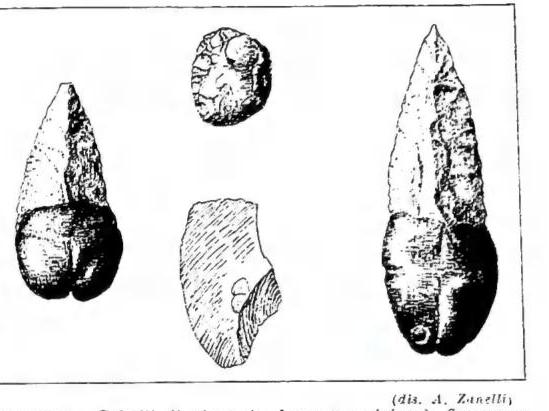
PRIMITIVES — Stone knives (on the right and on the left), finely chipped and with serrated edges, used for subincision, employed by the Boorungoo indigenous people of Kimberley, northwestern Australia; in the center: sharp lithic flakes used to circumcise young men, collected among the Peedong, Upper Murchinson, western Australia — Roma, Museo preistorico etnografico « L. Pigorini ».
De quibusdam praelatis Romanae Curiae, in Apollinaris, 8 (1935), pp. 64-67; A. van Hove, De rescriptis, Malines-Roma 1936, pp. 13-15, nn. 9-11; H. Leclercq, Primicier, in DACL, XIV, cols. 1179-81. Giuseppe Palazzini
PRIMITIVES. - Until around 1860, the question of “regression” or “degeneration” was still very much alive, that is, whether primitive peoples, who at that time were called “savages” and about whom abundant documentation was by then available, were to be regarded as remnants of peoples who had declined (the theory of degeneration), or as peoples whose cultural development had come to a standstill (the theory of stagnation).
SUMMARY:
I. Primitive cultures
II. The original culture
III. Primary cultures
IV. Secondary cultures
V. Tertiary cultures
VI. The diffusion of cultures in the various parts of the world.I. PRIMITIVE CULTURES
For several decades J. Boucher de Perthes had been conducting excavations in the Somme valley, where he had found remains of stone artifacts (knives, axes, and other tools) predating any written information about the inhabitants of those regions—remains that he considered to belong to a prehistoric man.Having found his attempts to convince the French geologists of the importance of his results fruitless, in the spring of 1859 he invited Sir Charles Lyell, who was then the greatest authority in geology, to visit his excavations. The latter recognized the importance of Boucher de Perthes’s results and sided with him. Such authoritative support secured the acceptance of Boucher de Perthes’s results in the scientific world and gave impetus to numerous excavations in all the countries of Europe, from which the existence of prehistoric man emerged ever more clearly confirmed. Thus the question of the p. was resolved. They were to be regarded as peoples whose development had come to a standstill. Further confirmation of this conclusion was provided by the fact that, with rare exceptions, no traces of more advanced cultures were found among the p. in the numerous excavations. Nor could the objection be admitted that these were civilizations that had regressed because of an unfavorable geographical environment, such as the lack of metals, plants suitable for making fabrics, or domestic animals, since the environment would often have been favorable to development.
PRIMITIVI - Form of dwelling among populations belonging to original cultures. The Vedda generally do not build huts but shelter beneath rocks—Island of Ceylon.
(from M. Gusinde, Die Yamana, Mödling presso Vienna 1937, fig. 13)
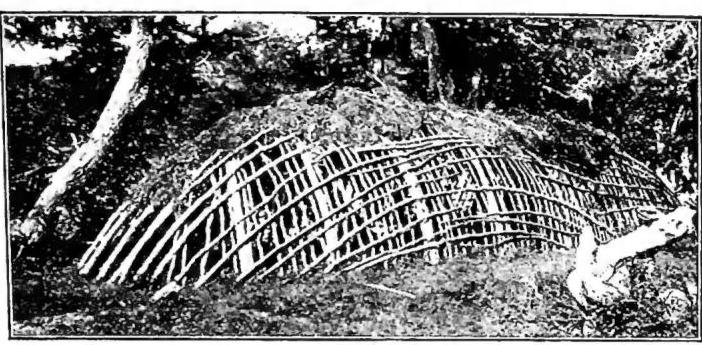
PRIMITIVI - Exterior of the hut where initiations take place - Yamana.
Under the most favorable conditions, the remains of ancient civilizations do not go back beyond the fifth millennium B.C., but almost always date from the third to the first millennium and even later. Beyond these chronological limits, excavations provide only prehistoric documentation.
The stages of development of the languages of peoples who have attained a high degree of civilization (Indo-Europeans, Semites, Hamites, Ural-Altaic peoples, and others) are now known at least from the earliest written documents onward; but no point in this development can be posited as the basis of the languages of primitive peoples. Even when a certain kinship can be established between the languages of primitive peoples and those of peoples with a great civilization—as with the Hamitic languages of northern and eastern Africa in relation to ancient Egyptian, or with the languages of the peoples of Tibet and Burma in relation to Chinese—the primitive languages always possess forms more archaic than the oldest forms of the languages of peoples with great civilizations; alternatively, the two forms are such that they can only be derived from a common form older than either. Thus it can be seen that even in these cases the point of diffusion of the related languages predates the formation of the great cultures. The hypothesis of degeneration becomes even more untenable when one considers the many languages of primitive peoples that have no remotest connection with the languages of peoples who have attained a great civilization.
Primitive peoples are therefore peoples who have experienced a halt in their development. But this does not mean that they have undergone no development and are entirely without history. They too possess cultural elements (tools, weapons, the use of fire, language, family, social, ethical, and religious institutions) that demonstrate intelligence, thought, development, and creative power—in other words, civilization: primitive peoples are peoples of limited civilization, poor in history, relatively primitive, but not without civilization, without history, or absolutely primitive. No people exists in a purely natural state; all have exercised creative power and formed a certain civilization, but at a given point they stopped developing (for the conditions that favored this arrest, V. ETNOLOGIA. For a more profound treatment of the progress and regression of primitive peoples, cf. W. Schmidt and W. Koppers, Völker und Kulturen, Ratisbona 1924, p. 41 ff.).
The concept of primitive peoples thus assumes a meaning very different from that commonly attributed to II. It is not easy—indeed, it is impossible—to formulate an absolute criterion on the basis of which a population or culture can be included within the concept of the “primitive.” Yet perhaps no invention has exerted so profound an influence on human thought and the development of civilization as writing (v.). This invention had a decisive influence on human history and brought cultures that were still poor to the level of great cultures. Writing is therefore the most comprehensive division that can be made of human civilization. To the first period belong peoples without writing, whom we shall call “primitive,” characterized by still-naive thought; to the second, peoples with writing, characterized by critical and reflective thought (v. ETNOLOGIA).
Before presenting the characteristics of the various cultures, it should be remembered that the basic concept of modern ethnology is the historical method. This method first seeks to gather the greatest possible amount of information about primitive peoples; it then groups populations with a common cultural foundation into cultural areas or cycles, which are called cultures; and finally it asks whether populations often separated by great distances but sharing a similar cultural foundation were once united. Similarities are no longer explained simply by accepting convergence, whereby identical objects or institutions would have arisen independently in different parts of the world; rather, an attempt is made to discover whether there were migrations of the different peoples, or at least of the cultural elements that display similarities. Indeed, the historical method has demonstrated that even in primitive societies many changes occurred as a result of immigration and not through intrinsic development. Contact between different tribes gave rise to different mixtures of cultures (v. ETNOLOGIA).
II. THE PRIMAL CULTURE
The designation “primal culture” is to be understood not in the absolute sense of primordial culture—a culture that is not directly accessible but only through induction—but in the sense of the most archaic culture ethnologically ascertainable. To this belong peoples who live mostly in regions that are difficult to access, such as the Pygmies who inhabit the margins of the forests of the Congo.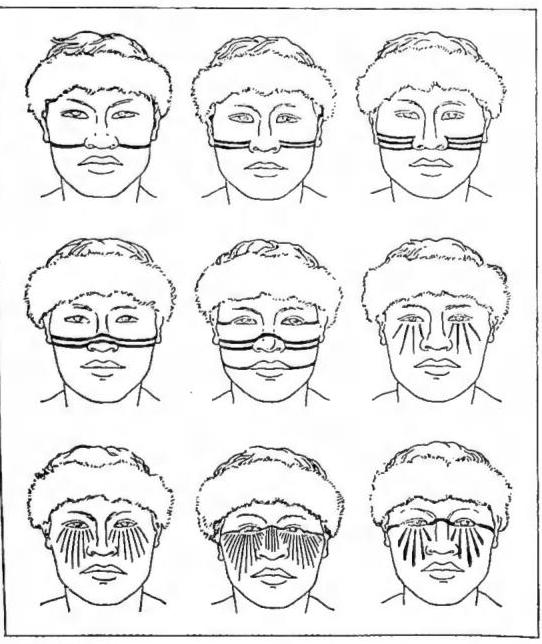
(from M. Gusinde, Die Yamana, Mödling near Vienna 1937, p. 161)
PRIMITIVES – Initiates with painted faces – Yamana.
a loincloth. The bow, with a round cross-section, is their weapon; living in the forest, they use wood to manufacture the utensils needed for their daily life; thus one may speak of a wooden age preceding the Stone Age. They acknowledge a Supreme Being, creator of the world, conceived as the father and protector of morality. This God generally dwells in heaven and receives sacrifices of first fruits. Magic, animism, and the cult of the dead are little developed. The family is founded on monogamy, with equal rights for man and woman. They recognize private ownership of utensils, weapons, ornaments, and tools—that is, of everything resulting from individual labor. The land on which they hunt, fish, and gather, on the other hand, belongs to the group. They have no tribal chiefs and no tyranny; the true authority is that of the head of the family. A form of State already exists, but it is still very weak, so much so that in the event of homicide, if the families do not reach an agreement, the blood feud falls to the relatives of the murdered person and not to the State.
According to the culture-historical school, the Negritos, the Bushmen, and the inhabitants of Tierra del Fuego may still be included in this culture, although they already have a more complex social organization, since young men and girls, before becoming part of society, must undergo an initiation of a pedagogical and moral nature, during which the initiates are taught the precepts they must observe (v. INIZIAZIONE DELLA GIOVENTU). The Tasmanians, now extinct, the Indians of central California, the most primitive peoples of Australia, and the Eskimos of the Arctic regions represent a further stage of development because, although living by gathering, hunting, and fishing, they begin also to use stone as a tool; indeed, the peoples of Australia and Tasmania work II. The beginnings of the spear also belong to this period; this weapon is at first very simple. In the more primitive cultures of Australia, the bâmerang, a throwing weapon, is used, as is the shield, of a very crude form, called a stick-shield because, rather than being a true shield, it is simply a stick used to ward off blows from the club. The first manifestations of tattooing by means of scars begin to appear; the huts have the form of a round beehive. Polygamy also begins.
III. PRIMARY CULTURES
From the original cultures, more complex cultures arise, known by the name of primary cultures. This development occurs in two very different forms, distinguished above all in sociological terms: if women occupy the more important position in society, matriarchy arises; if they take second place in relation to men, patriarchy emerges. The first form is characteristic of populations passing from the primitive state to agriculture; the second develops among peoples whose economy is based on hunting and livestock.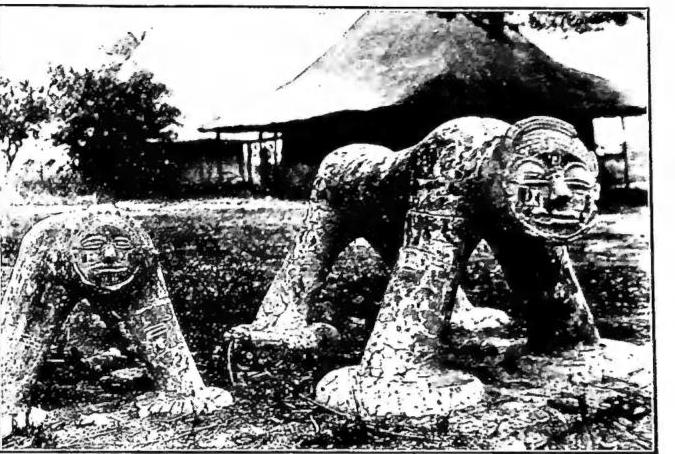
PRIMITIVI - Stone fetishes depicting the divinity of the hunt: Kaliwe the Little Hunter - Franciscan mission of Lulus-Katanga, Belgian Congo.
lunar mythology, the cult of skulls and the dead, dances during which masks are worn, and two-stage burial. Two other cultures also developed from the original cultures, in which patriarchy predominates.
In totemism, the essential sociological characteristic is that the tribe derives from an animal (this is the most common case) or from a plant, and sometimes even from a body (the moon, water), which consequently becomes tabu. In the totemist tribe, hunting is much more developed than in the original cultures; great hunts are organized in which the entire tribe participates, and weapons are much more advanced. They are chiefly pointed weapons (spears, swords, daggers). The spear is thrown with a frambola; the house is round, with a chimney-shaped roof. Clothing consists of a broad, stiff belt and a sheath around the penis. Totemists paint their entire bodies, or at least parts of them, red, and wear many ornaments, especially necklaces, earrings, and round disks. The axe is characterized by the fact that its blade is inserted directly into the thicker end of a branch. Totemists work wood extensively, making oval dishes and headrests on which they carve figures, especially of animals. Ornamentation is rectilinear and arranged in bands; the canoe is made by hollowing out a tree trunk, and the oars are lancet-shaped. Among musical instruments, the simple flute should be mentioned. The sociology of totemist peoples is characterized by the social bond with the totem and by initiation into the tribes, reserved only for young men and accompanied by painful practices. Descent is regulated exclusively along the patriarchal line; members of the same clan, who therefore have the same totem, may not marry one another. Religion consists chiefly of solar mythology with a strong development of magic. It seems that the dead are not buried but exposed to the sun; mummification perhaps begins with totemism.
In the culture of nomadic pastoralists, too, the house originally has a round shape. Stone is little used, and objects are made chiefly of wood and bone. The economy is based on livestock breeding; milk and blood constitute the essential nourishment of these peoples. Containers, and originally boats as well, are for the most part made of leather; the bow is reflexed and is also called, because of its provenance, the Asian bow; the spear, with a bone point and fitted with hooks, is also used. Large families are formed, in which the authority of the chief grows ever stronger. The monotheism of the original cultures remains relatively pure.
IV. SECONDARY CULTURES
The secondary cultures belong to a third group, resulting from the intermingling of primary cultures.The economy, sociology, and religion develop—
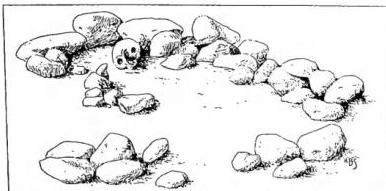
PRIMITIVI - Forms of burial and funeral rites. The corpse is laid in the ground, surrounded by a ring of stones and covered with a hide. Caribou Eskimos - Hudson Bay.
They develop and transform. In matriarchy, upon contact with other cultures, large families arise, but descent remains along the matrilineal line. The house is still rectangular but assumes larger dimensions in order to accommodate the entire lineage; it is often supported on posts (pile dwellings). The weapons of this culture are the bow with a flat cross-section and the shield, which is hung from the shoulder; small bows and small arrows are also used to draw blood from animals. The use of tobacco and betel begins. The canoe, still constructed from planks, is improved; oars resembling crutches are used; to pass from one pile dwelling to another, suspension bridges are built. Characteristic of this culture are small wooden drums shaped like an hourglass, and combs; coloured substances are used in tattooing. Regular gynecocracies are formed. At their first menstruation, girls are initiated by their mother. Magic and fetishism continue to develop; ancestors and spirits are represented in a crouching position.
Patriarchal cultures seem more inclined toward specialization and, at least in the manifestations of their material culture, are often different. Particular mention should be made of the Austronesian or Malayo-Polynesian and Sudanese cultural cycles. They have in common the formation of social classes, a tendency toward absolute monarchy, and polytheism. Their material culture, however, is very different, since the Malayo-Polynesians inhabit islands and are therefore navigators, whereas the Sudanese live in the interior of a continent.
Nomadic pastoralists tend to establish themselves over other peoples and dominate them.
V. LE CULTURE TERZIARIE
The basis of the great civilizations that developed in the various parts of the world, they are the result of mixtures of primary and secondary cultures and differ from these because they developed writing and literature. Three major cultural complexes may be distinguished: the Asian, the American, and the European. The first comprises the Chinese, Japanese, and Indian cultural cycles; the second, the cultures of Central America (Nahua and Maya) and South America (Cauca, Chibcha, Juha, Aymara). The third lies at the beginning of our civilization and also extends into historical times.VI. THE DIFFUSION OF CULTURES IN THE DIFFERENT PARTS OF THE WORLD
82. Arctic regions
The Arctic cultural cycle is widespread in America (Greenland) and northern Asia. It was originally an indigenous culture to which many foreign elements have become intermixed. The en-vironment requires extensive use of bones in the manufacture of weapons and utensils (v. ETNOLOGIA).
83. America
Only in California are there still indigenous cultures, whereas the whole of North America is the result of a mixture of matriarchy and totemism, which is particularly strong in the north-west. In the south, the influence of Mexican culture, which developed in Central America, begins to make itself felt, while in the neighbouring islands the later matriarchy has made itself strongly felt. In the southernmost part of South America are the inhabitants of Tierra del Fuego, who still belong to an indigenous culture. Proceeding northwards, one encounters cultures of earlier matriarchy and totemism, and, in the north-east, of later matriarchy. In the north and north-west extend the great cultures of Peru and Colombia.84. Melanesia
In Melanesia there is a great mixture of cultures. Most of northern Melanesia is occupied by populations with later matriarchy. In the south there are totemistic cultures among which earlier matriarchal cultures have driven a wedge.85. Polynesia, Micronesia, and Indonesia
These islands form, in a certain sense, a unified cultural complex, which is called Austronesian and is the result of the fusion of patriarchal and matriarchal cultures.86. Australia and Tasmania
In south-eastern Australia there are indigenous cultures, or at least cultures very close to them; in the eastern part, a culture of earlier matriarchy, and in the north, totemism. The Tasmanians disappeared several decades ago; it seems that their culture was very close to the indigenous cultures.87. Africa
In Africa there are various groups of populations that have preserved many archaic elements: the Pygmies on the margins of the forests of central Africa, who are the most genuine representatives of indigenous culture; in the south (the Kalahari region), the Bushmen, who already represent a more advanced stage. The populations situated along the Nile (Nilotes), and others besides, have preserved archaic cultural elements. Matriarchy plays a predominant role in the Congo and in West Africa. In the north-east there are nomadic pastoralists (Somalis, Galla, and other tribes), while in the north there are features of matriarchy. Great cultures developed in the Sudan and Abyssinia.88. Asia
As in all other parts of the world, in the south there are indigenous cultures (the Semang of Malacca and the inhabitants of the Andaman Islands). In Further and Peninsular India and in southern China there are matriarchal populations; in the centre and to the west, pastoral cultures. The rest of the great continent, apart from the Arctic populations already mentioned, is occupied by peoples who have developed great cultures (India, China, Japan).