
PERU. -
I. GEOGRAPHY
It is the largest (1,250,000 sq. km.), but not the most populous (8.2 million inhabitants; 7 per sq. km.) of the Andean States.The territory comprises a coastal region about 2,000 km. long, with a dry climate and, in the south, an almost desert aspect; the Sierra, which is the most important part of the country, consisting of alignments of high mountain ranges (6,765 m. in the Nevado de Huascarán), separated by high plateaus and deep valleys, and the Montaña, descending to the Amazonian lowlands, covered by impenetrable equatorial forest. 70% of the population lives in the Sierra, where the main centers are found at altitudes ranging from 2,300 to 3,360 m. (Cerro de Pasco, at 4,300 m., is one of the highest in the world); 25% on the coast, enlivened by the growing development of irrigation; the rest in the Montaña. Of this population, about half are Amerindians, the rest mestizos, Creoles, Negroes, and mulattoes. Asians are relatively numerous (23,000 Japanese and 7,000 Chinese); Italians number about 15,000.
Peru is a country with broad agricultural and mining possibilities, but it has long suffered from a lack of capital, labor, and political stability, although it has recently begun a certain economic recovery, to which Italians have contributed and continue to contribute significantly. Agriculture yields a variety of products (cotton, sugarcane, rice, coffee, citrus fruits, vines, fruit, etc.), but cereals are insufficient for domestic consumption. Rubber is in decline; coca cultivation is notable (from which cocaine is extracted). Little is still obtained from the forest (communication difficulties); livestock raising is moderate (especially sheep, llamas, and alpacas); fishing along the coasts, rich in plankton and therefore in fish, is continuously developing (recent establishment of canneries). From the subsoil are extracted petroleum (2 million tons in 1949), copper, silver, lead, iron, coal, vanadium, bismuth, etc.; along the coast are the famous guano deposits. Industry is still on a scale entirely inadequate to the country's potential; so too is commerce.
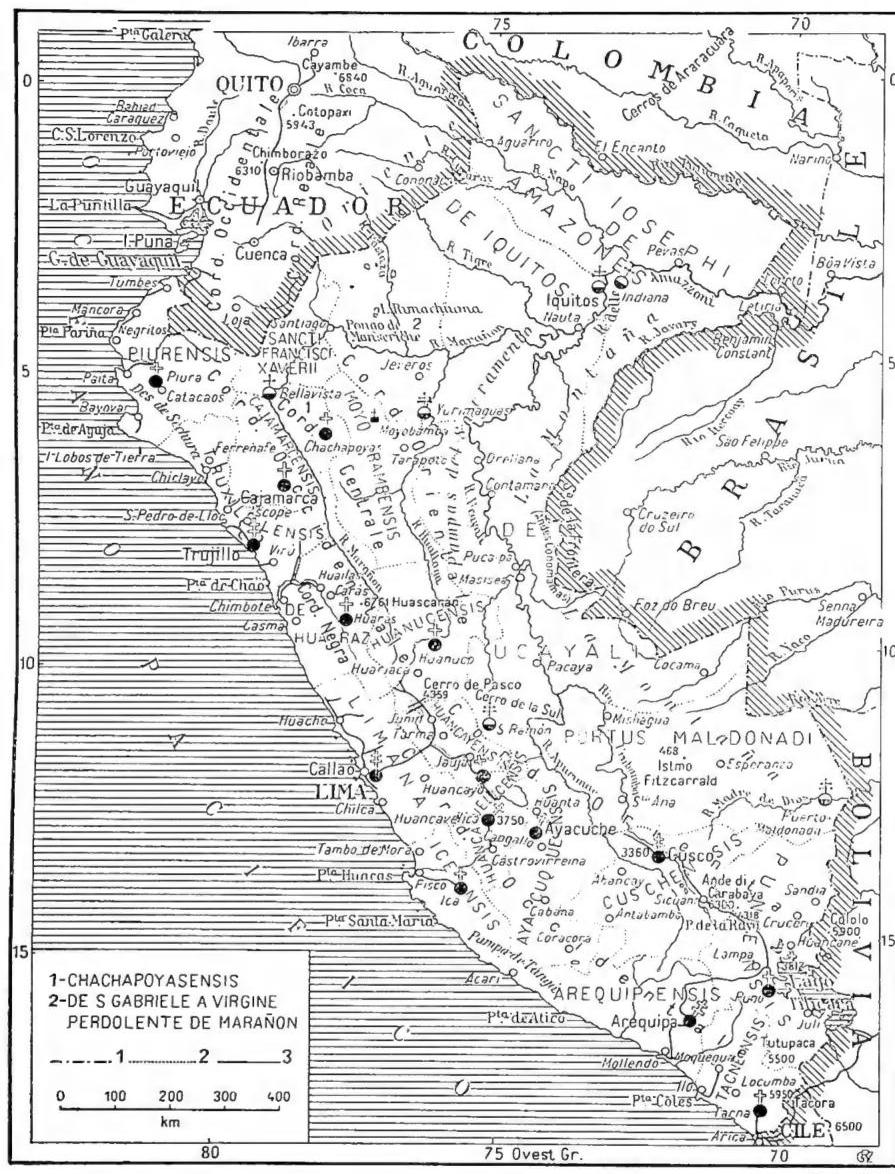
PERU – 1) State boundary; 2) ecclesiastical circumscription boundary; 3) railway.
The main ports are Talara (15,000 inhabitants) and Mollendo (14,000). Peru is a unitary republic with a representative government and a bicameral legislature; the president is elected every six years. The country is divided into 24 departments. The Catholic religion is the state religion; pagans are still numerous in the interior.
II. RELIGIONE
The Inca conquerors underwent in their religion the influence of the countries they conquered and assimilated a large part of their culture. It was therefore a natural consequence of the fusion with the various pre-Inca civilizations that a kind of religious syncretism arose.The official religion of the Peruvian Empire consisted mainly in a solar cult. The Sun, the deity of the Inca clan, was represented on earth by the Emperor. The Sun was accorded the highest honours through solemn ceremonial which took place especially at the solstices and equinoxes.
The solar cult included several deities personifying celestial bodies. The most important were the Moon, wife and sister of the Sun; Pitua, the Sun’s eldest son, who represented the planet Jupiter, considered the abode of the blessed; Chasca, corresponding to the planet Venus, depicted as a youth with long curly hair, acting as a page to the Sun, now preceding, now following it in the sky. The Pleiades, regarded as regulators of moisture, were especially venerated in December: prayers were addressed to them to send rain upon the sown fields. The god of lightning, Catequil, who was worshipped in his three aspects of flash, thunder and lightning, was represented as a serpent, with or without feathers, and was one of the ministers of the Sun. This deity belonged to a very ancient stratum of Peruvian religion; his cult had probably required human sacrifices in the most remote times.
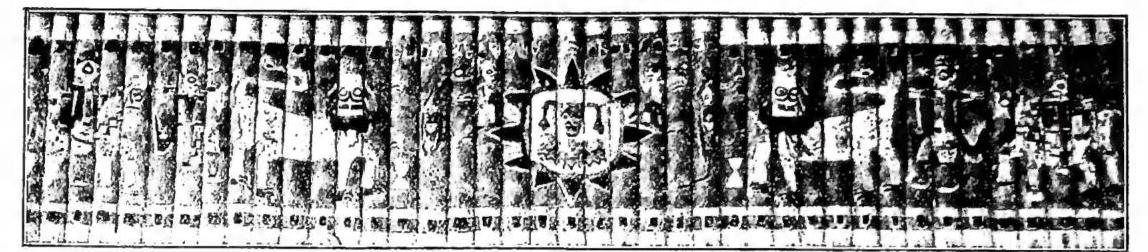
PERÙ - Cintura peruviana in piume donata al S. Padre.
(per cortesia di mons. A. P. Frutasi)
The Peruvians had as their supreme being a deity whom the ancient chroniclers called Pachacámac, the creator of the world and of man. He was the greatest god of the Chimu people, who settled in Peru at a very remote period. No cult was paid to him: he was the indefinable or, simply, “He who is.” His name could be pronounced only in a low voice, with the head bowed and accompanied by special gestures. Human affairs were governed by him through eternal laws, from which no one could escape. In ancient times he had destroyed humanity and then created a better one. Other deities of very remote origin were: Mamapacha, the earth mother; Waku, the water; Nina, the fire; Uayra, the wind. Great mountains, great rivers, and various plants and animals were also venerated.
Besides the higher deities, the Incas worshipped certain things, objects, and places, generically called huacas (or also huilicas). There were immobile and mobile huacas. The former included temples, tombs of ancestors, places connected with memories of mythical personages or deceased Inca emperors, battlefields, hills, caves, palaces, prisons, houses, meeting places, bridges, quarries; the most common huacas were springs and rocks. A special type of huaca was the Apacita, a heap of stones marking some critical point along roads (e.g., mountain passes) before which travellers would pause to make offerings and pray. Among the mobile huacas were images and amulets serving different purposes: some represented human beings, others animals. Corpses and unusual or exceptional things were also huacas, such as special maize ears, stones of unusual shape or colour, crystals, etc.; twins, persons with six fingers, and those born feet first. Every Inca emperor had a personal guardian whom he called brother; this guardian was generally considered a mobile huaca. Perhaps other men too could have personal guardians. It is not entirely clear whether the Indians believed in the existence of supernatural beings distinct from the objects in which they resided or whether they regarded the object itself as a supernatural being. The latter hypothesis, however, is the more probable.
The highest religious authority was the sovereign (called Inca), a living god and head of the priests. In his religious functions he was assisted by the silac Humu, chosen from among his closest relatives (usually brothers or uncles). The other priests were divided, according to their duties, into sacrificers, soothsayers, hermits, mediums, etc. They were not organized into colleges. Only certain women, the husta or virgins of the sun, were gathered into a special institution. They were chosen from noble maidens and from among the common people for their beauty. At the age of eight they were shut up in convents where they remained for life. A solemn vow bound them to chastity and to seeing no men except the sons of the sun; if a vow was broken—which almost never happened—the culprit was liable to the death penalty, which could be extended to her lover and relatives. The husta attended to the service of the temple of Cuzco and, in particular, kept the sacred fire burning perpetually; they wove the fabrics for the Emperor, kneaded the sacred bread, and prepared the sora for the cult ceremonies. Among the husta the Emperor could choose some concubines. Religious practices, besides the prescribed rituals, consisted of prayers, individual or collective, fasts and pilgrimages, and the confession of sins. Belief in a life after death was deeply felt. In keeping with this belief, objects—often of value—were placed in the tomb beside the deceased to serve him in the future life. In the realm of the dead, nobles and commoners had separate dwellings. Many temples, including the famous one at Cuzco, stood throughout the empire.
III. HISTORY
In 1529 Charles V granted F. Pizarro (q.v.) permission to explore, occupy and settle new lands south of Panama, beyond the river Birù (or Pirù), a little south of the bay of S. Miguel (7° 34′ N.), leaving the conqueror the widest freedom of movement in those unexplored regions.The history of Peru before the arrival of Pizarro and his companions eludes all inquiry because of the lack of sources, the destruction wrought by the conquerors and the partiality of the first Spanish chroniclers who accompanied Pizarro or immediately succeeded him. Among these, the only exception—though not entirely above rigorous criticism—is the chronicle of Girolamo Benzoni, a Milanese, who reached those lands around 1541. The Spaniards thus came into contact with the Empire of the Incas, whose name in the local language was Tahuantinsuyu, meaning the “Four Regions”: the western (Cuntisuyu), the northern (Chinchaysuyu), the southern (Collasuyu) and the eastern (Antisuyu), embracing an area much larger than present-day Peru.
From Cuzco, through various vicissitudes, the empire extended to the Pacific and then, gradually, as far as present-day Pasto (in Colombia) to the north and to the south into Argentina at the time of the Inca Huayna Capac. This is the tradition, but modern scholarship holds that the foundation of Cuzco and the preeminence attained by the Inca Empire should be attributed to the cohesion of certain members of the privileged caste from which the expansionist movement of the entire nation developed. The reasons for the decline of the Inca Empire, aside from the military activity of the conquerors, are to be found in the succession war between the last two Incas, Huáscar and Atahualpa, sons of Huayna Capac, a conflict that greatly facilitated the task of the arriving Spaniards. From Cuzco the Sapa Incas extended their dominion over the surrounding tribes, defeating them and transferring the subjected populations to different locations from their original ones, thereby bringing together tribes from various regions. In this way the Incas (that is, the ayllu which supplied the civil and military leaders of the empire) were able both to enlarge the territory under their control and to strengthen the imperial stock, from which power later passed to the line of Haman-Coczo as a result of a palace revolution. It may be considered that the Inca Empire lasted about two and a half centuries, ending with Pizarro’s execution of Atahualpa in 1533.
The most important archaeological discoveries in Peru range from the area between the 4th and 17th parallels south, from the basin of the Marañón (north) to the course of the Desaguadero river.
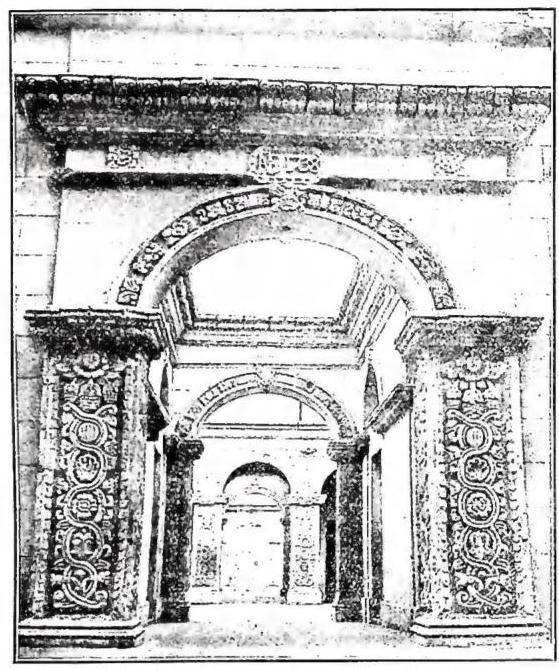
PERÙ - Cloisters of the Jesuit fathers' college. Hispano-Indigenous art (1738) - Lima.
The territory of Peru, though the largest (1,250,000 sq. km), was not the most densely populated of the South American states. The major archaeological discoveries in Peru extend from the area between the 4th and 17th southern parallels, from the basin of the Marañón (north) to the course of the Desaguadero river (south), from which it can be concluded that territorial expansion had occurred in all directions. Although it cannot be established how the cultural and social level of the entire Inca imperial complex was achieved, it is certain that the civilization found in the central zone was far superior to that of the surrounding populations: proof of this is found in the system of roads radiating from Cuzco in various directions; in the succession of staging posts; in the organization of messengers; in the rope bridges over which it was possible to cross terrifying chasms and rapid watercourses; in the constructions of dry-stone or mortar-built walls; in the organization of the army; in the cult of the dead; in the veneration of the Sun, to which temples of incomparable richness and splendour had been erected; in the agricultural customs of the Sapa Inca; in the obligation for all to work the fields and in the distribution of the harvests; in pottery and weaving. There were, however, true grey areas of considerable importance: the lack of beasts of burden stronger than the llama; the non-use of carts and wheels; the absence of iron and, what is more important, of writing, not replaced by the quipu, a mnemonic system of recording by knots on prepared cords.
The population was organized in a kind of agricultural collectivism whereby, from the members of the dominant caste down to the humblest subject, all worked the land, the primary source of national wealth, and then devoted themselves to the arts, crafts, or military service. The great merit of Inca agricultural organization lay in having devised and constructed systems of terraced fields, to make the most of every plot of land. Private and political life in the vast Inca organization was based on the ayllu, a complex of leading families placed under the same command and sharing a common totem and a specific area of land to cultivate. The union of various ayllus, due to the expansion of cultivable land and the development of agricultural work, led to the tribe, which, united with others, gave rise to the district, governed by a chief; the subjection of these latter to the Inca necessarily led to the confederation of the four regions, each ruled by a royal lieutenant of the Inca and directly dependent on the Sapa Inca. Each year the distribution of land to the ayllus was regulated, and at harvest time the produce was divided among the families after the portions due to the Sun temples, the Inca, and the State had been set aside; while meadows and woods belonged to the ayllus, herds and mines were the property of the Inca; public works were carried out jointly by all the ayllus of the region.
On 24 September 1532 the Inca era ended and the history of Peru in the proper sense began, through the agency of Pizarro (cf. PIZARRO). A first period, characterized by adventurous conquistadors, was followed by that of Hispanic-colonial organization. This recognized as tiny towns the seats of military detachments, divided the territory into repartimientos and, after confirmation to the heirs of the first Spanish possessor, into encomiendas. For these, recourse was constantly made to masses of indigenous people for agricultural and public works, to their great detriment. Charles V, also through the intervention of the Church, issued in 1542 the Nuevas Leyes, which, applied arbitrarily, had considerable impact after the discovery of important deposits of gold, silver, and mercury (1544-54).
The rapid development of industries, besides giving rise to new cities such as Potosí and Huancavelica, increased the demand for indigenous labour, which, despite the remonstrances of some viceroys and many authoritative local figures, was exploited in a barbarous manner until 1742, when the corregidores (a kind of administrative officials) were suppressed and Peru was divided into eight intendancies, each headed by Spanish officials directly dependent on the viceroy. Trade was monopolistically exercised by the Universidad de mercadores of Lima, while in Spain only Castilians and, from 1775, all Spaniards were authorized to trade with Peru: only in 1808 would full freedom of trade between the mother country and Peru be established.
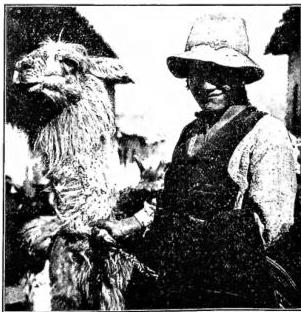
PERÙ - Peasant with a lama.
The ideological movement arising from the emergence of the United States and the French Revolution influenced the liberal and educated classes of Latin America, thereby provoking that series of uprisings which would lead to the separation of the various Hispanic colonies. However, within the closed and almost inaccessible Peru these new ideologies took root only after a column of Argentines and Chileans, under the command of the Libertador General San Martín, landed on the coasts of the region and seized Lima (1822), giving rise to the proclamation of independence (28 July).
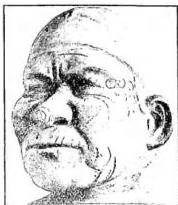
The prosperity and progress of Peru were partly interrupted by a war against Spain, in which Chile also participated (1866), and then by the more serious “War of the Pacific,” fought by Peru together with Bolivia against Chile from 1879 to 1884 and concluded only on 30 April 1885. After these events, national life resumed its uninterrupted rhythm, which has continued to the present day.
IV. EVANGELIZATION
At the first military reconnaissance of Peru in 1524, the secular priest Fernando de Luque took part together with Pizarro and Almagro; in 1527 Pizarro explored the country together with the Franciscan Marco da Nizza and the cleric Alfonso di Molina. During his campaign of 1523 for the conquest of the territory, he had brought with him from Spain, under the leadership of Reginaldo di Pedrazza (v. PANAMA), 6 Dominicans, among whom was Fr. Vincenzo Vaveride, who, appointed bishop of Cuzco (1536), was consecrated in Spain and on his return brought with him other Dominicans. Charles V appointed him “protector of the Indians.” In 1541 he was massacred by the Indians on the island of Puna (Ecuador). In 1534 the Dominicans founded their first convent in Cuzco in the Temple of the Sun, which had been given to them by Pizarro after the conquest of the city. In 1553 the Dominican province of Lima was erected, with 18 convents; by 1565 there were more than 100 Dominicans in Peru.Equally active were the 12 Franciscans who, with their superior Marco da Nizza, Pizarro’s companion in 1557, went to that land. Among the Franciscan missionaries, the lay brother Mateo di Xumilla and St. Francis Solano distinguished themselves. In 1555 the Franciscan custody of Peru was erected, which by 1550 had 15 houses. In 1553 it was transformed into a province, with 18 houses. Their work took place among colonists and Indians. The Mercedarians claim that their brethren, around 1534, in the number of 24, were the first to evangelize Peru. After having given the Church of Peru some good bishops, their activity ceased in the country. The Augustinians also preached the Gospel to the Peruvians from 1550 onwards. Among them, the Fathers Garcia and Ortiz distinguished themselves; they obtained from the last Inca prince permission to preach, to erect chapels, to open schools, and finally had the joy of baptizing him with the name Philip.
In 1551 the University of Lima was founded, the first on the American continent. Peru, with St. Rose of Lima, gave the Church its first American saint. The Jesuits joined the other missionaries in 1568, immediately founding churches and schools in almost all the cities, and in 1577 a seminary for missions at Juli, on the shores of Lake Titicaca. By 1582 the Jesuit province of Peru already numbered 1,533 members. In 1572 the Jesuits took on the mission among the Indians. Fathers Samaniego and Martínez established the famous mission of Santa Cruz de la Sierra, where in a short time more than 10,000 were baptized. In 1580, only three years after the beginning of the missions, 50 Jesuits were preaching in Indian languages, whereas ordinarily in other missions of the time preaching was often done through interpreters. The Jesuits, often at the risk of their lives, sought to draw the Indians from the forests into Christian centers. In 1690 and 1710 they succeeded in obtaining from the viceroys the prohibition of the Indian slave trade. With the mission among the Moxos, whom they gathered into 6 reductions, they brought Christianity to the borders of the country. Towards the end of the 18th century, the Jesuits Arlet and Borin were in Peru, evangelizing the Canichanas. After the expulsion of the Jesuits (1767), their missions passed to the secular clergy, but they steadily declined. The struggle for independence against Spain first, then the civil wars and the dominance of Freemasonry in the 19th century were disastrous for the Church and the missions. In 1849 the Franciscans were able to revive their mission at Ocopa. But only in 1900, following Leo XIII’s invitation in 1895, at the request of the regional bishops and in full agreement with the government, Propaganda Fide created 3 new apostolic prefectures for the Indians of the mountainous regions of the interior: namely, that of Ucayali, entrusted to the Franciscans, that of Urubamba, given to the Dominicans, and that of San León de los Amazones, to the Augustinians.
(from Pél Keizmen, Medieval American Art, New York 1916, inv. 59)
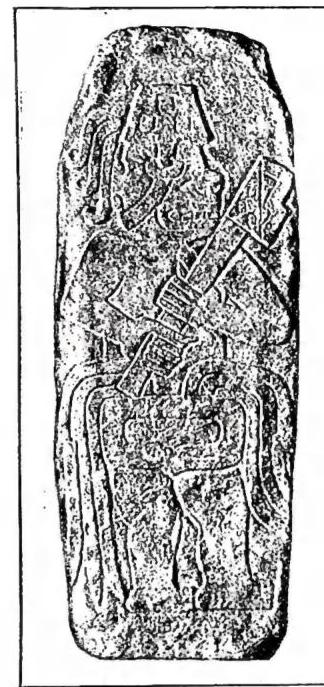
PERÙ - Stele figurata - Casma.
Costa Nord.
1943), with the suffragan dioceses: CAJAMARCA (5 Apr. 1908); CHACHAPOYAS (formerly MAYNAS 1805; present name 4 July 1943); PIURA (20 Feb. 1940) and the prelature nullius: MOYOBAMBA (7 Mar. 1948).
2. Apostolic vicariates: IQUITOS (1 Aug. 1945); PORTO MALDONADO (10 Mar. 1949); S. GABRIELE DELL'ADDOLORATA DI MARAÑON (3 June 1936); UCAYALI (14 July 1925).
3. Apostolic prefectures: S. FRANCESCO SAVERIO (11 Jan. 1946); S. GIUSEPPE DELLE AMAZZONI (13 July 1945).
VI. LEGAL STATUS OF THE CHURCH
Article 232 of the Constitution of 9 April 1933 declares that “while respecting the sentiments of the majority of the people, the State protects the Catholic, Apostolic, and Roman religion,” while other religions enjoy freedom to exercise their respective cults. Article 233 recalls the exercise of the right of patronage. This right, which many countries born of the dismemberment of the Spanish Empire invoke from the Holy See by appealing—not altogether justly—to that granted to the Spanish Kings by Pope Julius II in the bull of 8 December 1498 and in the Universalis Ecclesia of 28 July 1508, Peru derives instead from the Apostolic Letters of 3 March 1874. With these letters, Pius IX in fact granted to the President of the Republic and his successors the enjoyment of the right of patronage, on condition that ecclesiastical goods be left to the clergy and administered with diligence and fidelity, and that the Peruvian government favor and protect the Catholic religion. Hence, the designation of archbishops and bishops now takes place as follows: from a double list of three priests to be promoted (three from the diocese or archdiocese to be filled and three from another diocese: law of 1874), whichV. ECCLESIASTICAL ORGANIZATION
According to the Pontifical Yearbook, 1952 (p. 1217), it is composed of 4 metropolitan sees, 11 suffragan dioceses, 4 apostolic vicariates, 2 apostolic prefectures, 1 prelature nullius.1. Metropolitan sees: 1) AREQUIPA (15 Apr. 1577; metropolitan 23 May 1943), with the suffragan sees: PUNO (7 Oct. 1861); TACNA (18 Dec. 1944); 2) CUZCO (5 Sept. 1536; metropolitan 23 May 1943), with the suffragan see: AVACUCHO or HUAMANGA (20 July 1609); 3) LIMA (14 May 1541; metropolitan 12 Feb. 1546), with the suffragan sees: HUANUCO (17 Mar. 1865); HUARAZ (8 May 1899); HUANCAVELICA (18 Dec. 1884); HUANCAYO (18 Dec. 1884); ICA (18 Aug. 1946); 4) TRUJILLO (15 June 1577; metropolitan 23 May
The art. 234 provides for the stipulation of a concordat with the Holy See: a concordat which is probably delayed by two facts: the impossibility of maintaining the right of patronage, at least in its present form, since it is now a principle enshrined in concordatory law that the Church freely choose its shepherds; and the existence of divorce, introduced in Peru in 1931.
Diplomatic relations are maintained through the Apostolic Nuncio in Lima and the ambassador accredited to the Holy See. Giulio Dante
VII. LITERATURE: V. HISPANO-AMERICAN LITERATURE.
VIII. ART
The territory of Peru possesses the most important archaeological evidence of the cultures of the Andean region, both from the prehistoric American era and from the protohistoric period. In quality, if sculpture is excepted, they are not inferior to those of the Mexican and Maya cultures (q.v.), with which they are ideally connected, although contacts were few and rare, and it is more fitting to speak of analogies and similarities due to identity and contemporaneity of development.The area of Andean cultures encompasses the vast territory over which the Incas extended their dominion, extending beyond the present borders of Peru into the Bolivian zone around Lake Titicaca. Indeed, the remains of the sites of Tiahuanaco, Pirapi, and Sallustani cannot be separated from those of the Peruvian region of the same lake and the valley of the Hurubamba River, since they belong to the same system and display the same tectonic and decorative themes. For the sake of exposition, without entering into the lively controversies that have divided scholars seeking to establish the priority of coastal cultures over those of the Sierra and the Montaña, or vice versa, the traditional distinction will be accepted, analyzing the monuments of the so-called Chimu civilization, which developed in the northern part of the coastal region. According to Spanish chroniclers, the Kingdom of Gran-Chimu came to an end with the Inca invasion about a century before the conquest. Of it remain the imposing ruins of the city of Chan-Chan, built in the fertile plain between the Chicama and Moche rivers, near the present-day city of Trujillo, during the period from 800 to 1000 A.D.
The vast extent of the ruins, which cover more than 15 sq. km., suggests that it was the capital of the kingdom. It is divided with perfect topographical distribution into four walled quarters, enclosed by sturdy walls with low rectangular houses, alternating with vast earthen platforms on whose terraces are situated temples and dwellings of dignitaries and priests, with façades spanning many tens of meters and rising to heights of up to five meters.
The building material used is sun-dried clay, which in the arid climate achieves a stonelike hardness. The devastations wrought by time and by treasure hunters, who have literally crumbled many structures, make it impossible to form an adequate idea of the whole. The constructive genius of these peoples is revealed, not only in the geometric perfection with which walls, entrances, and pediments are squared and leveled, but also in the complex and advanced irrigation systems that supplied gardens and orchards around the city. Of the original ornamentation, few traces remain. Stuccoes and frescoes once adorned exteriors and interiors. The prevailing taste was for minute figurations, with geometric patterns similar to those of pottery and textiles, or with stylized fish and birds. The monotony of repetition is avoided by a highly skillful asymmetrical alternation.
At the southern extremity of the Chimu kingdom, in a locality today called “La Fortaleza,” on the summit of a hill terraced according to the contour lines and each surrounded by a high wall of sun-dried clay, stands the fortress of Paramonga. Four projecting bastions guard the corners. The defensive technique revealed in the complex of constructions (the stronghold is surrounded by small dwellings connected by narrow passageways) is extraordinarily advanced compared to that of all other primitive peoples; the fortress resisted the onslaught of the Incas, and only the great Pachacutec was able to overcome it at the beginning of the 15th century. South of the Chimu kingdom, along the Peruvian coast, other cultures developed from very ancient times until their encounter with Inca civilization. Interesting finds were made in the valleys of Ancon, Chancay, and Rimac: here the major ruins of Pachacamac have walls that once bore splendid polychrome frescoes, of which only insignificant traces remain. Further south, in the territory of the ancient Chincha confederation, lies the seat of the culture known as Ica or Nasca, which flourished between 900 and 1400. It was the first to be encountered by the Inca conquerors. The ruins of La Centinela, the most important in the area, clearly attest to the succession of pre-Inca and Inca cultures and the frequent exchanges between the coast and the highlands. The presence of niches on the exterior and interior of the masonry structures brings these constructions close to those of the Urubamba valley.
It is unnecessary to proceed further south, for although there are reports of very ancient cultures that flourished along the entire coast up to the Chilean border, archaeological recoveries have thus far revealed nothing of artistic interest beyond ceramic or textile artifacts, particularly from the Paracas peninsula.
The Peruvian highlands possess, around Lake Titicaca and in the upper valley of its outlet, the Urubamba, at exceptional altitudes nearing 4,000 meters, one of the most interesting and evocative archaeological zones in the world.
In Bolivian territory, Tiahuanaco has the admirable “Gate of the Sun,” designed and cut with an exceptional sense of proportion, whose decoration constitutes the masterpiece of Inca sculpture. Viracocha, the creator god, is represented hieratically surrounded by stylized symbols of his earthly manifestations. Also in Bolivian territory, at Pirapi and Sallustani, are the finest examples of the characteristic chulpas, the circular funerary towers of the Incas built of perfectly squared basalt blocks and crowned by a projecting cornice of slabs; they open onto an inner chamber through doors without lintels or jambs and devoid of any decoration.
The capital of Inca civilization was the city of Cuzco. Here the ancient constructions served as foundations for the buildings erected by the Spanish conquerors; the city’s streets today present a picturesque aspect, due to the contrast between the ancient ashlar blocks laid without mortar and the white plaster of the upper structures.
The ancient city had a regular plan, with narrow paved streets. On the religious constructions of which traces remain, the Spanish chroniclers tell fabulous tales. The Temple of the Sun, the largest in the city, had a sumptuous decoration in which gold was lavishly used. Other temples were dedicated to the moon, the stars, thunder, lightning, and the rainbow. Near Cuzco rise the ruins of Tampumachay. At Kenko, semicircular ruins of an amphitheater have been found. The center is marked by a large carved stone with the figure of a puma. North of Cuzco, ruins of a fortress with angular spurs in descending terraces exist at Sacsahuaman; the summit of the hill is occupied by the celebrated and mysterious staircase hewn from the living rock, known by the improper designation of “Throne of the Incas.” The excellence of the structures and the acute-angled bastions, arranged with masterly military intuition, made it one of the strongholds during the civil war among the conquerors. Another fortress, protecting the sacred valley of the Urubamba, stands at Ollantaytambo, notable for its niches, similar to those of La Centinela.
At Pisac, 80 km northeast of Cuzco, the complex of semicircular fortifications and temples attests to the degree of perfection achieved by Inca architects in the most splendid period of their civilization, between the 14th century and the beginning of the 15th. The great blocks are fitted together with meticulous precision: although the copper clamps that once held them together have been removed, the walls remain perfectly plumb. Although the Incas lacked knowledge of iron and possessed no pulleys
and the other great blocks are fitted together with meticulous precision: despite the removal of the copper clamps that once held them in place, the walls remain perfectly plumb. Although the Incas lacked knowledge of iron and possessed no pulleys or other tools common to European craftsmen, the windows and the beveled corner stones are of the most exact alignment. One of the most singular structures in this complex is the Intihuatana, an elliptical edifice presumed to have served as an astronomical observatory.
The ruined city of Machu Picchu, 80 km northwest of Cuzco, situated more than 3,000 m above sea level on one of the many mountains carved into elbows by the Urubamba, inaccessible in earlier times and discovered only in 1911 by Hiram Bingham, offers, through the perfect preservation of its monuments—untouched by treasure seekers—the highest example of Inca art and urban planning. The city is built in conformity with the irregularities of the terrain and divided into compartments, seemingly according to a precise hierarchy that scholars have sought to determine. In the northwest direction, the religious center occupied the most elevated part. Private dwellings are arranged on the periphery; and in all directions, by means of terraces, walls, and enclosures, space was gained from the mountain’s precipices to erect houses, gardens, and orchards. No primitive culture displays, as does that of the Incas, such wisdom in adapting to the terrain and such high capacity for exploitation and organization. Yet unlike the artists of Aztec and Maya civilizations, the Inca builders did not elaborate fanciful decorations; they appear concerned solely with practical solutions and structural integrity. Bound to the earth, as one scholar remarks, they did not trouble to convey their own sentiments: the soul of the Incas, like their art, remains hermetic, despite countless attempts to penetrate and comprehend II.
Andean sculpture is meager. The most important finds are the monolith of Cerro Sechín (upper P.) and the Raimondi stela of Chavín de Huántar (central P.), which present examples of highly refined and delicate carved decoration on anthropomorphic themes. The stylization reduces figurative elements to a flat surface, employing a technique akin to that of vase ornamentation.
Andean ceramics, by contrast, has no rival on the American continent for originality of form and refinement of design and execution; it may perhaps stand comparison with the finest Greek and Italic production. It is impossible here to distinguish the countless varieties of styles from Mochica to Chimú, Nasca, Tiahuanaco, and those of the southern coast and the highlands. One can only provide a few examples among the most singular of Mochica style (from 500 to 800 A.D.), characterized by original and realistic portraits, and of classic Inca style (14th–15th centuries), of which an aryballos with typical vertical bands is published. Weavers and goldsmiths produced artifacts of excellent quality, mainly in the central coastal zone, and widely disseminated throughout the empire.
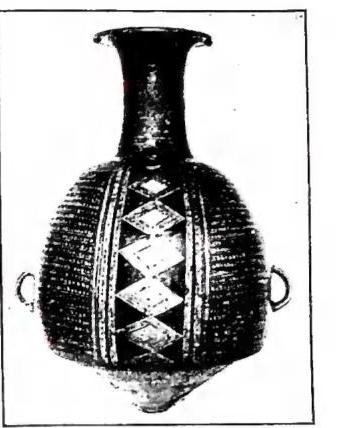
(from Pál Kelemen, Medieval American Art, II, New York 1916, pl. 159)
PERÙ - An Inca vase (aryballos) from the 14th–15th century.
With loans and exchanges among all the nations of South America, but here it produced no monument of exceptional importance.
IX. SCHOOL SYSTEM
Article 25, Title III of the Peruvian Constitution stipulates that all those who provide the guarantees of capacity and morality prescribed by law may direct or teach in establishments of every grade. It is the right of the State to supervise all educational activity through the National Council of Education, reorganized in 1907 and dependent on the Central Office of Education. It is the duty of the State, pursuant to the reform of José Pardo (1905), to provide free of charge all elementary school pupils with books, notebooks, and pencils. Every pupil must be guided toward the pursuit of beauty, truth, goodness, and justice.The entire school system, based on psychotechnics and school medicine, comprises elementary, secondary, and higher schools. The latter include: the Universidad nacional del Gran Padre S. Agustín in Arequipa, founded in 1821; the Universidad de S. Marcos in Lima, founded in 1571; the Universidad de S. Antonio Abad in Cuzco, founded in 1598; the Universidad de S. Tomás y Santa Rosa in Trujillo, founded in 1835; and the Catholic University of Lima, founded in 1917 and canonically erected in 1942.
Schools dependent on Catholic missions are as follows: 9 catechism and prayer schools, 103 elementary schools, 3 lower secondary schools, 9 vocational schools, and 1 normal school. The education of the Catholic clergy takes place in 1 preparatory school, 2 minor seminaries, and 8 major seminaries. — See pl. LXXX.