
MERCEDARI. — A religious order founded by St. Pietro Nolasco in 1218 with the aim of ransoming Christians enslaved by the Muslims. St. Pietro Nolasco, under the protection of King James I and on the advice of St. Raimondo di Peñafort, received in the cathedral of Barcelona, together with his first companions, on 10 August, from the hands of Bishop Beranguer de Palau, the white habit in honor of the Virgin.
The King granted his royal arms, which, together with the Cross, formed the Order’s coat of arms. Nolasco established that not only all the possessions and activities of the Institute should be devoted to the liberation of slaves, but also that, as the first Constitutions express it, “all the religious, as sons of true obedience, should gladly be ready at all times to give, if necessary, their own lives, as Christ gave his for us,” and that each religious should undertake the obligation of remaining himself a slave in order to free those who might be in danger of losing the faith (the fourth vow). The Order was approved in 1235 by Gregory IX, who assigned it the rule known as that of St. Augustine.
At first it had a predominantly military character and, during its first century, was governed by lay grand masters; but from 1317 onward, as the occasions for redemption diminished, by priest generals. Families and isolated individuals soon joined the Order as confraternities, helping it through donations, collecting alms, and caring for and assisting those who had been freed, the sick, and pilgrims in the infirmaries of the convents. For this purpose, the second female Order also arose in 1265 through the initiative of St. Maria di Cervellon. The Order developed in Spain, France, Portugal, and Italy, especially in the coastal cities, and carried out its work of redemption first in Spain
and then in North Africa, where the Moors took the slaves. With the discovery of America, it contributed greatly to its evangelization, through fra' Giovanni de Solórzano, who accompanied Columbus on his second voyage to Santo Domingo, fra' Bartolomeo de Olmedo in Mexico, p. Bovadilla in Panama, p. Marco Perez Danton in Guatemala, p. Giovanni de Salazar in Argentina, p. Antonio de Almansa and Antonio de Solís in Chile, and others in Peru and Ecuador.
At the beginning of the seventeenth century, the Discalced M. arose, still dependent upon the General of the Calced, as well as the cloistered Mercedarian nuns with b. Marianna di Gesù.
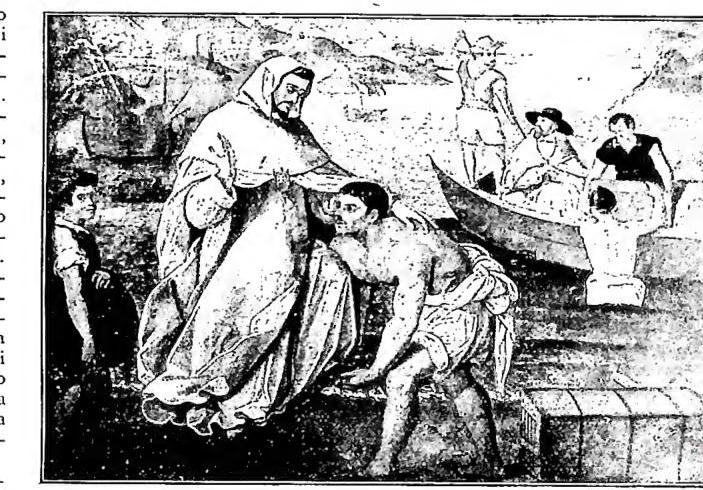
(fot. V. Vrancel)
MERCEDARI – The “Redeemers.” In the foreground, s. Pietro Nolasco; in the boat, Cardinal s. Raimondo Nonnato; the oarsman is said to be Cervantes. Painting by F. Pacheco (late sixteenth–early seventeenth century) – Seville, Provincial Museum.
tion of youth, charitable works, and social assistance (prisons, reformatories, re-education homes, etc.). Among its saints, the Order numbers, besides s. Pietro Nolasco, s. Pietro Pascasio, bishop and martyr, s. Serapio the martyr, s. Pietro Armengol, s. Raimondo Nonnato, cardinal, s. Maria di Cervellon or del Soccorso, and the blessed Marianna di Gesù. Among its theologians and writers: s. Pietro Pascasio (d. 1300), Fr. Natale Gaver (d. 1474), Fr. Domenico di s. Giovanni (d. 1540), Fr. Girolamo Perez (d. 1549), Fr. Gaspare de Torres (d. 1583), Fr. Francesco Zumel (d. 1670), Silvestro Saavedra (d. 1624), Fr. Pietro de Ona, bishop of Gaeta (d. 1626), Fr. Giovanni Falconi (d. 1638), Fr. Ambrosio Machio, archbishop of Cagliari (d. 1640), Fr. Alfonso Remon, Fr. Gabriele Tellez (Tirso de Molina, d. 1648), Fr. Pietro Armengaudo Valenzuela, bishop of Ancud (d. 1922), and Fr. Manuel Sancho (d. 1936).
The Order currently has 9 provinces and 3 vice-provinces; it has missions in Brazil, Ecuador, and Puerto Rico, and 4 houses in the United States for the assistance of Italian emigrants.
FEMALE BRANCHES OF THE ORDER. – In addition to the two ancient ones already mentioned, there are: the Mercedarians of Berriz (v.) of Spain; the Mercedarians of Charity (Spain), with 109 institutions comprising sanatoria, hospitals, hospices, leprosariums, prisons, and schools; the Mercedarian Missionaries, with houses and schools in Spain, Ecuador, and Peru; the Mercedarians of the Child Jesus, with various schools in Argentina; the Sisters of Our Lady of Mercy, with numerous institutions for assistance and education and hospitals in France, Belgium, Switzerland, Chile, and especially Italy; the Mercedarians of the Most Blessed Sacrament, who devote themselves to Eucharistic worship, with houses in Mexico, Havana, Spain, and Italy; and the Mercedarian Missionaries of Brazil, who cooperate in the missions of Piani.
Ordinis B.M.V. de Mercede, Palermo 1622; I. Linás, Bullarium Coelestis ac Regalis Ord. B.V.M. de Mercede, Barcellona 1696; U. Ribera, Centuria Primera del Real e Militar Istituto de N. S. de la Merced, there 1726; J.A. Gari y Siumell, Biblioteca Mercedaria, there 1875; G. Vasquez-Nuñez, Manual de Vitoria de la Orden, Toledo 1931; Buletin de la Orden de la Merced, General Curia, Rome. Vincenzo Ignelzi