
LEBBRA and LEBBROSARI. — Leprosy properly so called (lepra tuberculare) is an infectious, transmissible disease with a chronic course, characterized by the formation of tubercles or growths in the skin, mucous membranes, peripheral nerves, bones, and internal organs, producing deformities and mutilations, and generally resulting in death. It is caused by a particular bacillus (bacillus leprae) discovered in 1868 by A. Hansen.
I. LEPROSY IN HOLY SCRIPTURE
In the Bible no illness is mentioned so frequently and with such horror as leprosy, both in the Old and in the New Testament. Certainly, not all the cases examined or recalled refer to true leprosy, or elephantiasis of the Greeks; this also seems to be indicated by the multiplicity of the Hebrew terms (gārāb, neghabh, netheq, sārā'ath, sēbīn). At times it may perhaps concern simple psoriasis vulgaris.In Lev. 13:1–14:37 there is almost a brief treatise on this terrible disease. It falls to the priest, for whom the various signs are described in detail according to the semiotics of that time (ibid. 13:1–44), to judge whether it is true leprosy or a sore or pustule. As long as any uncertainty remains, the sick person is isolated. Once the period of observation has ended, if the examination confirms the suspicion, the unfortunate man is declared unclean and expelled from the camp in order to prevent contagion. He shall wear torn garments and leave his head uncovered, cover his face up to his moustache, and go about crying: “Unclean! unclean!” The segregation was not strictly individual, since lepers were permitted to live together outside the camp or settlement (cf. II Reg. 7:3; Lc. 17:12).
If a sick person recovered, he was subjected to meticulous observation, and then the priest, who had declared him healthy, readmitted him to the community with a complicated ceremony (Lev. 14:1–32). The offering for this purification, reduced in cases of poverty, consisted of the sacrifice of two male lambs and one female lamb,
as well as a certain quantity of flour and oil. The expiatory sacrifice implies the concept of leprosy regarded as a punishment from God. In the Old Testament (cf. Ex. 4:6; Num. 5:2; 12:10; II Reg. 5:1; 7:3; II Par. 26:20 ff.) and in the New (cf. Mt. 8:2; 10:5; 11:5; 26:6), lepers are often mentioned, and the miraculous healing of some of them is recounted. By analogy, based on external signs, the Bible also speaks of leprosy of garments (Lev. 13:47–59) and of houses or walls (ibid. 14:33–57). In the first case, these are evidently moulds or other germs that corrode woollen and linen fabrics; in the second, one thinks above all of incrustations of saltpetre or similar stains often found on walls. From the regulations established to determine the character of the various phenomena, from the destruction of the objects and houses, and from the rite prescribed when it becomes evident that the danger has been averted, it may be inferred that for the Hebrews such stains were regarded as infections capable of spreading the disease.
II. THE HEALING OF LEPERS IN ICONOGRAPHY
In ancient Christian art, G. Wilpert identified two examples of this miracle, according to the account of the three Synoptic Gospels, in Roman cemetery frescoes, one at ad duas lauros and the other at the Nunziatella (Pitture, pp. 205–206, pls. 68, 3 and 74, 2). In sculpture, the same author recognized it in a polychrome slab in the Museo nazionale delle Terme. The scene is also found in an ivory diptych from Palermo (Venturi, I, p. 417, fig. 382). In later cycles, for example, in the mosaic cycle of Monreale and in the frescoes of S. Angelo in Formis, it appears accompanied by the distich: «Hunc maculis mundat, mundum qui crimine mundat». Enrico JosiIII. SPREAD AND TREATMENT OF L
The disease, very ancient and first described by Rufus of Ephesus, initially spread rapidly with the fall of the Roman Empire, and later through the invasions of the Saracens and the Crusades. In Italy, as early as the 5th century A.D., it was raging in Lombardy; in 643 the Lombard king Rothari issued extremely severe laws on the matter, prescribing the isolation of lepers and the deprivation of their civil rights. In the 16th century leprosy began to decline in intensity, giving way to syphilis.Both in antiquity and in the Middle Ages, there were two forms of defense against L.: prophylactic measures intended to circumscribe and limit the disease, and medicinal treatments aimed at curing the leper. While the former, however cruel from a human standpoint, helped to limit the disease, the latter amounted only to superstitious and often magical practices, without any practical result. The prophylactic measures intended to isolate the leper from the community, separating him—even from his spouse and offspring—amounting to a true civil death, belong to the anti-leprosy legislation. Isolation had appeared to be the best prophylaxis since biblical times; in the Middle Ages, authority over the leper was entrusted to the ecclesiastical authorities, since he was regarded as a «poor little one of God» and, in this divine trial, if victorious, as a candidate for paradise.
The councils of the Catholic Church also addressed the matter; thus Pope Siricius is seen, at the end of the 4th century, authorizing the separation of spouses in order to prevent contaminated offspring; the Third Lateran Council also sanctioned the indissolubility of the marriage bond for lepers; according to the Councils of Orléans (549), Tours (561), and Lyon (583), the issuing of isolation decrees belonged to the ecclesiastical authority. Later, this was replaced by the civil authorities, resulting in royal and municipal laws and decrees; and the bishop’s tribunal was succeeded by a tribunal consisting of seven lepers, a physician, and a surgeon.
(from M. Neveu-Lemaire, Principes d'hygiène et de médecine minantes, Paris 1925, fig. 32)
LEBBRA E LEBBROSARI - Geographical distribution of leprosy.
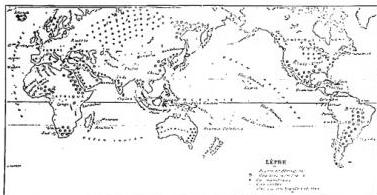
While in ancient times lepers, cut off from human society, wandered through the countryside, they soon felt the need to gather in communities, living in clusters of huts. Thus genuine leprosaria arose, the first recorded being that built by a certain Zodeco or Zotico, a Roman nobleman who had followed Constantine to Byzantium. Although the primitive groups of huts remained, especially near springs of sulphurous mineral waters, if any of them acquired particular importance, it was provided with an enclosure, a chapel, a cemetery, and masonry buildings.
Subsequently, the type of leprosarium consisting of a single building was reached, such as S. Lazzaro at the foot of Monte Mario in Rome. S. Lazzaro, the man resurrected by Christ, was chosen as the patron of such patients; thus the Order of S. Lazzaro was established, founded by Pope Damasus II (1047–48), under the Rule of s. Augustine. Its members, dressed in black and marked with a green cross, aimed to establish leprosaria and, insofar as possible, to maintain them, supplemented by offerings.
As the disease declined in the 16th century, the spread of leprosaria became increasingly limited, surviving in increasingly well-organized form as genuine hospital cities wherever leprosy still persisted in endemic foci.
Although now far less widespread than it was in the Middle Ages, leprosy still cannot be said to have been completely eradicated and, in addition to isolated cases, numerous endemic foci are found in almost every part of the world, involving a total of more than 3 million people afflicted by the terrible disease.
Its geographical distribution in Europe includes certain countries bordering the Mediterranean, certain regions of France and Italy (Sardinia, Sicily, Puglie), some areas south of the course of the Danube, Sweden, Norway, and Ireland. Eastern Siberia is extensively affected; so too is Asia, between the equator and the 40th parallel north, particularly British India, French Indochina, Japan, and the Indo-Malayan Archipelago. Leprosy is also widely endemic in Australia and in the islands and archipelagos of the Pacific; in North America, along the Pacific coasts, California, and Mexico; in Central and South America, the Antilles, the tropical zone, Brazil, and Argentina; and especially in southern Africa, the southwestern coast (from Senegal to Cameroon), the Union of South Africa, and, to a lesser extent, Algeria, Morocco, Tunisia, Egypt, and the eastern coast (Mozambique, Zanzibar, Madagascar).
The modern leprosaria are now distributed throughout this vast territory, for the most part genuine hospital towns, where scientific treatment is intertwined with the loving care of charity, provided in particular by religious men and women of various congregations.
In such institutions the leper can lead a life very similar to that of any other healthy individual, even maintaining family ties and contracting new marriages, provided that newborn children are removed from their parents, since it has been demonstrated that leprosy is not transmitted through germinal contagion or during gestation, but only, after birth, through repeated external contact. Apart from this, new medical treatments deprive leprosy of much of its formerly terrifying character of incurable chronicity.
Gustavo M. Apolloni-Giuseppe de Ninno
IV. L. IN THE MISSIONS. — Even in the missions of recent times the Church has not forgotten lepers. As early as the sixteenth century, leprosariums distinct from other hospitals are found, such as S. Lazzaro in Manila (the Philippines), founded in 1570 by the Franciscan Juand Clemente. In the S. Giuseppe and S. Anna hospitals in Miyako (Japan), directed by the Franciscans from 1594 to 1597, between 100 and 130 lepers were encountered. In China there still exist leprosariums established in the seventeenth century by Jesuit missionaries, and Macao has had its asylum for more than 200 years, moved in 1874 to a nearby island.
The care of lepers was developed in a special way by the Catholic mission of the nineteenth century, beginning with the leprosarium of Acarouany in French Guinea, personally established by B. Anna Maria Javouhey in 1832. Wherever missionaries encountered lepers, they took special care of them with Christian charity, establishing leprosariums or at least special sections in hospitals, where priests, brothers, and sisters devoted themselves to their care, even to the sacrifice of their own lives. The most celebrated of the apostles of lepers is Fr. Damiano Deveuster SS. CC. (1840–89), who from 1873 cared for the lepers interned on the Island of Molokai (Oceania), and himself died of leprosy. Like him, Fr. Giovanni Beyzym of the Society of Jesus (1850–1912), who from 1898 devoted himself to caring for the lepers of Madagascar, fell victim to the terrible disease. Likewise, the Capuchin Daniele da Samarate (1876–1924) died of leprosy in the Tocundula leprosarium in Brazil. Alongside these heroic apostles of the lepers there is a large number of priests, brothers, and sisters devoted to the service of these patients, both in mission asylums and in government institutions, despite the danger of contagion.
According to the latest statistics, from 1949 there are in the Catholic missions, under the S. Congr. of Propaganda Fide, 174 leprosariums with 31,452 lepers: in Africa, 130 with 21,820 patients; in America, 7 with 928; in Asia, 21 with 4,229; and in Oceania, 16 with 4,475 inmates. — Vedi tav. LXIV.