
ANTILLE. -
This name denotes the long island complex which, extending between the two Americas from Florida to Venezuela, closes the American Mediterranean and separates within it the Gulf of Mexico (N. of the peninsula of Yucatan and of Cuba, which continues it) from the Caribbean Sea. Tradition distinguishes the Greater from the Lesser A. The former—Cuba (v.), Giamaica (v.), Haiti (v.) or Hispaniola, PUERTO RICO (v.), together with their dependencies—constitute the western and central part of the great archipelago; the latter, much more numerous but all fairly small or very small, are arranged between Puertorico and the Venezuelan coast in two series, one internal and distinctly volcanic, the other external, calcareous, and discontinuous. The Bahama Islands are also connected with the latter; being external to the Greater A., the northernmost of all, and possessing partly distinctive characteristics, they may be considered separately.
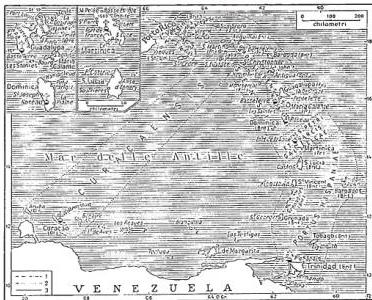
The Lesser A. comprise the group of the Virgin Islands immediately E. of Puertorico, the Windward Islands from Anguilla to Grenada, and the Leeward Islands, the others, from Trinidad to Oruba. It should nevertheless be remembered that the English give the sector from Anguilla to Dominica the name Leeward Islands (also Northern Caribbean Islands), and the name Windward Islands (also Southern Caribbean Islands) to the remainder as far as and including Grenada.
(Enc. Catt. reproduction)
ANTILLE – The Lesser A. 1. State or colonial boundaries; 2. Ecclesiastical jurisdictional boundaries; 3. Railways.
…ic. The population, relatively dense and at times extremely dense, consists chiefly of Creoles and blacks, the former descended from the old European colonists, the latter from the slaves imported from Africa for plantation labor.
Of the A., only Cuba and Haiti constitute independent states (the latter divided between the Republic of Haiti and the Dominican Republic; V. DOMINICANA); the others are divided into several dependent colonies: those of Great Britain—which possesses most of them: BAHIA (v.), Leeward Islands, or Leeward, Windward Islands, or Windward, Barbados (v.); TOBIA (v.)—; those of France: Guadeloupe and dependencies (v.), Martinique (v.); those of the United States—to which part of the Virgin Islands belongs (v.)—; and those of the Netherlands—Curaçao (v.), Aruba, Bonaire, St. Martin and St. Eustatius—while some of those nearest the coast of South America (Margarita, Coche, Los Roques Archipelago, Crasqui, Los Testigos, La Tortuga, Blanquilla, Orchilla, and other uninhabited islands) belong to Venezuela. For the ecclesiastical aspect, vedi the individual entries.