
ANGOLA. –
1. GEOGRAPHY
It is the largest (including Cabinda and Landana N. of the mouth of the Congo, 1.2 million sq. km.), though not the most populous (3.7 million inhabitants, fewer than 3 per sq. km.), of the Portuguese colonies. Behind the narrow coastal strip along the Atlantic, for the most part low-lying and inhospitable and surmounted by a mountainous rim, it expands into a vast plateau, which is better suited to the settlement of European colonists and consequently to agricultural practices and livestock raising. The altitude (averaging about a thousand metres) tempers the excesses of the tropical climate and, above all, its aridity, which increases towards the S. The population includes, alongside the Bantu who constitute its bulk, approximately 45,000 whites and 30,000 people of mixed race. Catholics number more than 500,000; the rest are pagans.Agricultural production is varied; its principal exports are coffee, maize, sugar, cotton and tobacco. Livestock raising is directed chiefly towards cattle. Diamonds attain even higher values in the exports; their collection centre is Malange, in the Cuanza basin.
Communications have also received an impetus because A. constitutes the outlet for Katanga, which is reached from Lobito by a railway (1,344 km.) crossing the entire colony from W. to E.
The most important centres are Loanda (61,000 inhabitants), seat of the Government (a high commissioner assisted by an advisory council), and Lobito (14,000 inhabitants), on the coast.
Giuseppe Caraci
2. HISTORY OF CHRISTIANITY
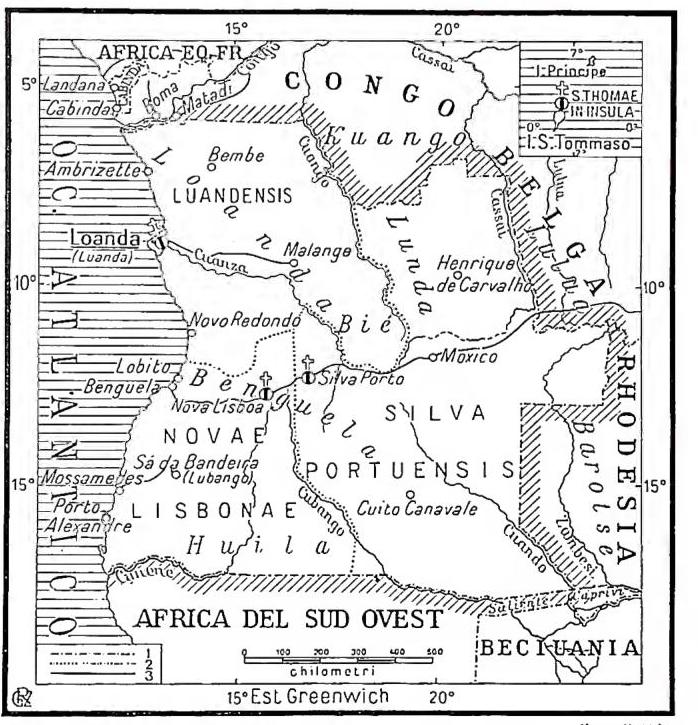
Under the name of «A. and Congo» de-ANGOLA - 1. State or colonial boundaries; 2. Boundaries of ecclesiastical jurisdictions; 3. Railways.
until 7 May 1940 designated the diocese that comprised part of the present Portuguese colony of A., with its residence in S. Paolo di Loanda, whose erection dates back to 1596. Within the territory of the colony there also existed: the apostolic prefecture of Cubango in A. (from 1921), formerly Cimbebasia (from 1879), and the missions «sui iuris» of Cunene (from 1881), Basso Congo (1888), and Lunda (from 1901). Until about the beginning of the 15th century A. formed part of the indigenous kingdom of Congo, from which it later became independent; its capital was Dongo. Evangelization began immediately in that century, toward the end of which there were 20,000 Christians, and continued there, though sporadically and intermittently, during the following 16th century, also suffering the repercussions of the not infrequent rebellions against Portugal. In the 17th century A. formed a single mission with that of Congo, directed by the Italian Capuchins. At the end of that century, besides the Capuchins, the Jesuits were working in A., directing a seminary at Loanda; the Carmelites, under the authority of the bishop (whose see was at Loanda) and of the parish priests, within a radius of five miles; and outside it, by virtue of the faculties granted by Propaganda Fide. A century later the missions declined because of the suppression of religious Orders in Portugal, and subsequently because of the French Revolution, so that, by the middle of the 19th century, the bishop of Loanda had only five priests at his disposal, while the interior was entirely abandoned: the Italian Capuchins had withdrawn between 1830 and 1840. Since the colony, being Portuguese, was subject to the patronage of that nation, the arrangements for sending missionaries of the Holy Spirit (French), who, assisted by Propaganda, aspired to take over those missions, proved difficult; consequently, in 1873, they decided to establish themselves at Landana, outside Portuguese dominion. Subsequently, the difficulties in this regard were smoothed out, since the Congregation of the Holy Spirit had opened a house in Santarem (1867) for the recruitment of Portuguese vocations; other difficulties arose, however, owing to the competition of the Protestants who flocked there after Stanley’s journey (1878). As the apostolate expanded, the four missions of Cunene, Basso Congo, Cubango in A., and Lunda developed; autonomous, certainly, but included—with the exception of a few small areas—within the radius of the diocese of A., by which the apostolic prefects of the individual missions were recognized as vicars general for their respective territories. During the period 1910–24 they suffered the repercussions of the religious struggle following the establishment of the republic in Portugal. Most recently the missions were flourishing. Throughout the colony, in 1940, there were 167 priests (32 Portuguese secular priests, 124 of the Congregation of the Holy Spirit, and 11 Portuguese Benedictines), 125 brothers, and 150 sisters (61 of the Congregation of S. Giuseppe di Cluny, 8 Franciscan Missionaries of Mary, 20 Dorotheans, 17 of the Most Holy Savior, and 3 Benedictines of Tutzing, all Europeans, together with 41 indigenous women). The total Catholic population, of European and indigenous origin, was 530,000 souls.
With the Missionary Agreement of 7 May 1940 between the Holy See and Portugal, the entire ecclesiastical organization was altered: the former missionary jurisdictions having been abolished, the colony of A. was divided into three dioceses—Loanda, Nuova Lisbona, and Silva Porto—all erected on 4 September of the same year as the Agreement (1940); a fourth, S. Tommaso, was erected later. The Agreement also provided for a reorganization of the mission in the colony, with the creation of new missionary jurisdictions; owing to present circumstances, this has not yet taken place.