
ALTO ADIGE. —
1. GEOGRAPHY
Name given (by E. Tolomei in 1906) to the basin of the river upstream from the Salorno narrows, which, in its present administrative meaning, also includes a small portion of the Drava basin (S. Candido and Sesto), that is, essentially, the region called by the Germans Deutsch-Südtirol.The territory, whose northern boundary coincides with the Italian-Austrian frontier, is also clearly defined to the south by high mountain barriers (Ortler-Cevedale, Sella, Sasso Lungo, Catinaccio, Lateran, etc.) that isolate it from the neighboring Trentino region, with which, however, communications remain easy. It is a mountain region, more than four-fifths of it lying above 1000 m. (and two-fifths above 2000), in which, however, the rugged landscape of the elevated mountain margins alternates with the more open landscape of the broad valley floors shaped by the Quaternary ice; areas often well sheltered from the N. (Merano) and with not excessively abundant rainfall. As throughout the Alpine arc, in the A. A. the major valleys constitute distinct and clearly defined units, usually with proper names (Val Venosta, Pusteria, Val Gardena, Val Badia, etc.).
The lower parts of the territory are cultivated (cereals, especially rye, and potatoes; in the more sunlit basins vineyards and orchards flourish; overall, barely 6% of the total area); the remainder is sparsely populated, but rich in pastures (37.5% of the total) and with extensive woodland areas (39%). Industry has recently experienced considerable growth, especially owing to the development of hydroelectric plants (the most powerful power station in Italy is on the Isarco); tourism is also significant, leading to some of the most frequented holiday and sporting resorts in our country and benefiting from excellent hotel facilities. The A. A. is commercially important because of its lines of communication, which, following the three major valleys (the upper Adige valley, or Venosta; the Isarco Valley; the Rienza Valley, or Pusteria), lead, through the three great Alpine passes corresponding to them (Resia, Brennero, and Dobbiaco), to the transalpine countries. Along these routes are the principal urban agglomerations: Bolzano (75,000 inhabitants), at the confluence of the Adige and the Isarco, which is tending to become an important industrial center; Merano (26,000 inhabitants), an international climatic resort; and Bressanone (7,000 inhabitants), the center of the eponymous bishopric.
The A. A., now included in the region called Trentino-A. A., corresponds to the province of Bolzano, established in 1927. The German element predominates over the Italian, whose percentage has nevertheless increased since the separation from Austria (8.7% in 1869; 11% in 1921; probably about 20% today). During the recent war, the transfer (Rückwanderung) to Germany of those who had opted for German citizenship had been planned; but on 1 December 1942, when the exodus should have ended, only 72,749 had left the country. On 29 January 1948, the Constituent Assembly of the Republic approved the special Statute for Venezia Tridentina, which protects the German element (a minority in the region as a whole) by recognizing a particular provincial autonomy within the region.
The province covers 7085 sq. km.; its population rose from 239,940 inhabitants in 1910 to 277,720 in 1936 (289,000 as of 31 December 1947; density 41 per sq. km.).
The territory of the A. A. falls under the ecclesiastical administration of three dioceses: Trento, which includes the greater part of it; Bressanone (the eastern section and Ampezzano); and Coira (Val Monasterio).
2. ART
Since the Middle Ages, the art of Alto Adige has developed as an integral part of German art, naturally undergoing intense influence from Italian art. The region’s importance in the history of art rests on the continuity of the use of fresco, especially during the Romanesque and Gothic periods; it is further documented by the typical carved altarpieces, composed of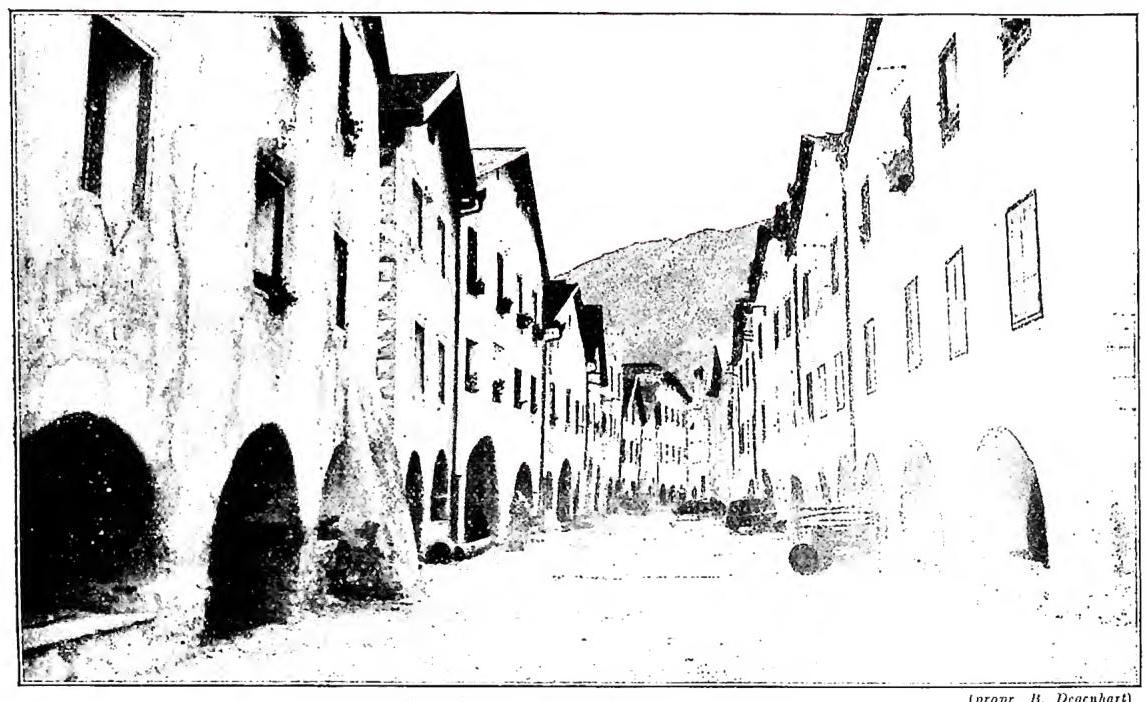
(propr. B. Digenhart)
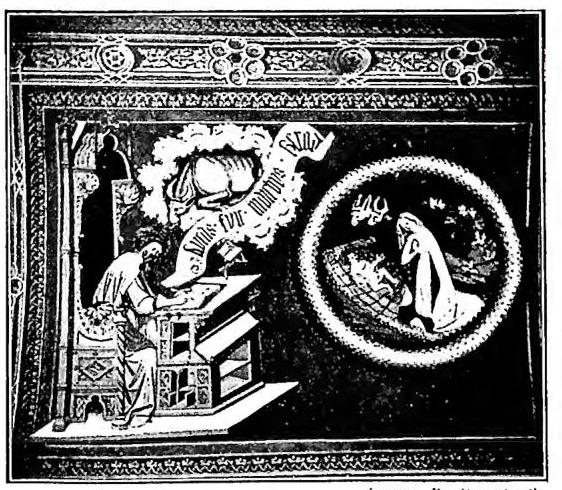
Still extremely simple architecturally, but important for their frescoes, are the two pre-Romanesque churches of Val Venosta: S. Procolo at Naturno, with ninth-century frescoes, and S. Benedetto at Malles. Romanesque monuments are very numerous; typical examples are the abbey of Montemaria near Burgusio in Val Venosta, with twelfth-century frescoes, and the chapel of Castel d’Appiano in the Adige Valley, with sacred paintings (twelfth century) inside and a Demonic Hunt of Theodoric on the exterior. Slightly later are the Byzantine-influenced frescoes of Grissiano near Malles and of Lana, belonging to the same artistic current as those of Val di Non (Romeno, Sanzeno); interesting are the representations of monsters—northern transformations of ancient motifs—beneath the Christ with the Apostles in S. Jacopo at Termeno (mid-thirteenth century). At Bressanone there once existed a whole complex of Romanesque architecture: part of it has been transformed (the Cathedral), while another part still preserves its original frescoes—for example, those of the baptistery, the cloister, and the church of Nostra Signora, linked to Salzburg painting (Nonnberg). The remains of Romanesque sculpture are scarcer. Stone works are rare (the portal of the abbey of S. Candido, thirteenth century); wooden works are more frequent, since this material was henceforth preferred (crucifixes and sacred images of S. Candido and Castel Tiralli). Illumination also flourished: from the ninth century dates the Evangelary of S. Candido (University Library of Innsbruck); numerous codices from the twelfth, thirteenth, and subsequent centuries are found especially in the convents of Bressanone and Bolzano.
The first castles also date from the twelfth and thirteenth centuries, though most have now been transformed or lie in ruins: Greifenstein, Stein am Ritten, the Romanesque chapels of the castles of Tiralli, Appiano Alto, Roncolo, and Montechiaro, of Romanesque origin with Lombard elements; in addition, the churches of Tubre (Val Monasterio), S. Pietro near Merano, and the cloister of Novacella; noteworthy is S. Giorgio at Scena, with a central-plan layout.
Romanesque art began to yield to Gothic art only in the first half of the fourteenth century. In painting, western and northern elements consequently predominated, from which direct Italian influences became clearly distinct in the second half of the century. Examples of the first current are part of the frescoes in S. Giovanni and in the cloister at Bressanone, at Novacella, and in the chapel of Castel Tiralli; sculptures in the parish church of Bolzano; and goldsmiths’ work in the treasury of Bressanone Cathedral. The principal monument of the second current (Italian-Giottesque) is the painting in the Dominican church of Bolzano (executed by Italians), and, under its influence, that in the churches of S. Vigilio and S. Giovanni in Villa at Bolzano, of S. Cipriano at Sarentino, at Campiglio, at Terlano, and at Nova Ponente. Numerous Gothic churches arose at that time, beginning with the most important, the parish church of Bolzano (completed in the sixteenth century): the Franciscan and Dominican churches at Bolzano, and the parish churches of Merano, Terlano, Termeno,
S. Sigismondo, Falzès, S. Valentino, S. Lorenzo, Ora, Lana, Silandro, Glorenza, Chiusa, Vipiteno, Brunico, Tubre, etc. Gothic forms continued to be used until the sixteenth century. At the end of the sixteenth century and in the seventeenth century, Renaissance forms, followed by Baroque forms, began to appear.
Exceptional are the monuments of chivalric painting at Montechiaro (now in the Innsbruck Museum) and Castel Roncolo, as well as the frescoes from the end of the fourteenth and beginning of the fifteenth centuries in the churches of Presule, Riffiano, Termeno, Terlano (Hans Stockinger, 1407), Nova Ponente, Scena, Novacella (Joh. V. Bruneck), and Bressanone (cloister).
Among the sculptures, those in the churches of S. Sigismondo in Pusteria (altar of approximately 1430), Merano, and Terlano should be mentioned. Relations with Trentino, Verona, and other places where this style flourished were also numerous at that time (Stefano da Verona painted in Val di Non; the master of the paintings in the Torre Aquila of Trento worked in Merano Cathedral in 1414). Panel painting, hitherto of secondary importance, now began to develop vigorously, receiving, through German painting, the reflections of the new Flemish realism. The influence of Multscher’s activity at Vipiteno in 1456–58 was extensive. As indigenous masters who prepared the milieu on which Michael Pacher would build, and who participated in the development described above, there appear: the «Master of Villa Ottone or of Utta» (Uttenheimer Meister, Novacella), Jakob Sunter (Bressanone, 1472, etc.), and Friedrich Pacher. Some of these predecessors of M. Pacher already anticipate, alongside the German-Flemish component of their style, the Italian-Renaissance component, which later became decisive for the full development of the genius of M. Pacher, who exercised an immense influence on all the art of A. A., ultimately determining the most widespread type of altar.
After the appearance of Pacher, Alto Adige art never again attained a similar height. Italian influences (especially Venetian ones) on local artists such as Helfenrieder, Th. Polack, Kessler, and M. Stölzl in the late sixteenth and seventeenth centuries resulted in provincial forms; the works of M. Günther (Vipiteno, Colle Isarco) and Troger (Bressanone, also active in Vienna) belong to the eighteenth century and became exemplary: while Hauzinger, M. Knoller, and the Unterberger brothers established an artistic bond between Austria
Tuttavia per la varietà degli altari, delle oreficerie, dei numerosi piccoli castelli, e insomma per la dignità con la quale le antiche case dei contadini si uniscono col paesaggio, è evidente una continuità fra lo stile romanico e l'arte del sec. XVIII; ciò che forma una cultura veramente notevole anche se non sempre assurse a importanza europea. - Vedi Tav. LXXII.