
INNSBRUCK. – Apostolic administration, established on 11 December 1921 for the territories of the diocese of Bressanone that remained in Austria after 1918. According to the Austrian Concordat of 1934, it should have been transformed into a diocese, but political difficulties have not yet permitted its implementation. It has annexed the “general vicariate of Feldkirch,” which comprises the “Land” of Vorarlberg. This originated from the fact that Vorarlberg depended upon three different dioceses (Augusta, Coira, Costanza), so that Francesco I obtained from Rome in 1818 the ecclesiastical unification of Vorarlberg as a separate diocese; but in 1819, instead of a diocese, a “general vicariate” was established, headed by a titular bishop and dependent upon Bressanone. In 1921 it was joined to the new apostolic administration of I.
The apostolic administration of I. comprises North and East Tyrol (9,662 sq km) and Vorarlberg (2,602 sq km), with a total of 520,000 inhabitants, of whom 481,146 are Catholics. It has 394 parishes, 605 diocesan priests and 395 religious priests, a minor and major seminary, and 38 male and 30 female religious communities (Annuario pontificio, 1951, p. 641).
The following are noteworthy: in I. itself, the “Hofkirche,” built in 1553–63 in the Gothic-Renaissance style, with the magnificent cenotaph of Massimiliano I, a work of art “sui generis,” with 24 alabaster reliefs depicting events from the life of Massimiliano, and 28 enormous bronze statues of his legendary and actual ancestors, designed and cast by the finest artists of the period; the Jesuit church (1627–40), a typical example of the “Jesuitenstil,” with a dome; the present episcopal church, the “Stadtpfarrkirche,” a magnificent late-Baroque construction; at Hall, the enormous Gothic parish church, dating from various periods; and that of Schwaz, Gothic and with four naves, two of which were originally intended for the townspeople and two for the miners, with two separate choirs.
Among the sanctuaries, the following should be noted: Absam, near Hall, the principal Marian center of Tyrol; Eben, a Gothic building with a Baroque marble altar (1740) dedicated to s. Notburga, a popular saint; Judenstein, near Rinn, where s. Andrea of Rinn, a three-year-old child murdered by the Jews on 12 July 1462, is greatly venerated; his cult was recognized by Benedetto XIV (25 December 1752). In East Tyrol, near Lienz, are the ruins of Aguntum, an ancient episcopal see until the sixth century, and the excavations on the Kirchbichl near Lavant, where seven churches have been discovered, one above another or adjacent, dating from as early as the fifth century up to the present Gothic church, which perpetuates a primitive Celtic sanctuary. The best-known sanctuary in Vorarlberg is Rankweil, already frequented in 1550.
THE UNIVERSITY. – S. Pietro Canisio obtained from Ferdinand I the establishment of a Jesuit institution (1562), the
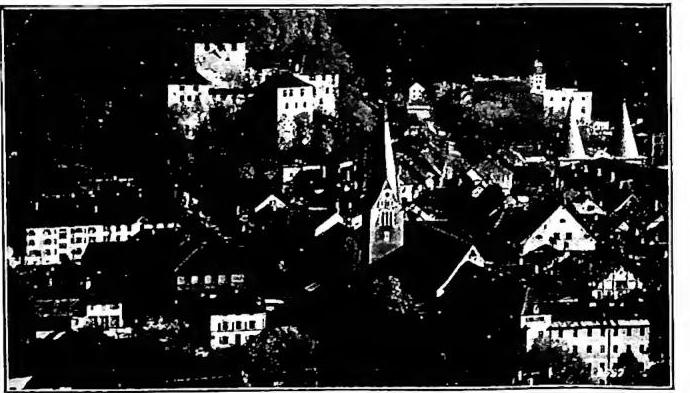
INNSBRUCK - Panorama of Feldkirch (Vorarlberg): Church of S. Nicola (1478).
At the far right, the “Stella matutina” Institute of the Jesuit Fathers. In the background, the
“Schattenburg” castle (13th century, partly 16th century).
which, having developed rapidly, was raised in 1677, by pontifical and imperial diplomas, to the status of a University, at least eight chairs of which were permanently entrusted to the Society of Jesus. After the suppression of 1773, the University also declined and was, indeed, reduced to a secondary school. In 1826 Francesco I restored it, but without the Faculty of Theology. In 1832 the Jesuits returned to I., and in 1856 the Faculty of Theology was re-established, entrusted entirely to the Society of Jesus. The Faculty, which soon attained international renown, was suppressed during the Nazi period. Among its principal professors, the Jesuits H. Hurter, H. Grisar, N. Nilles, E. Michael, L. Fonck, and H. Noldin should be remembered; among the laymen, Baron L. von Pastor. Since 1877 the Jesuits have published the Zeitschrift f. kath. Theologie.
ISTITUTO «CANISIANUM». - The theological College of I., as a continuation of the old Nikolaihaus student residence, founded in 1569 and closed in 1783, was reopened for theology students in the academic year 1858 in the Sillgasse, and soon achieved considerable prosperity. The resulting lack of space led to the construction of a new building, the Canisianum on the Tschurtschenthalerstrasse, which was occupied on 1 October 1911 by 276 students. Following the closure of the College as a result of the laws of November 1938, it moved with a smaller number of students to Sion (Valais, Switzerland), where it remained until September 1945; after its return, it began to develop again in the same localities in which it had previously flourished.
The Canisianum can accommodate theology students from all the dioceses of the world, provided that they observe the conditions laid down in the statutes and that space permits. At the residence, the students receive a solid religious education of a universal character. Upon leaving the College, they attend philosophy and theology lectures at the Faculty of Theology of the University of I., which, like the College itself, is directed by the Fathers and professors of the Society of Jesus. The extensive Libraries of the University and of the College of the Society of Jesus are available to scholars. Physical health is also carefully attended to through games, sports, mountain excursions, and recreation. Many thousands of priests, several cardinals (among them Cardinal Count Preysing of Berlin, Cardinal Frings of Cologne, Cardinal Count Galen of Münster, and others), seventy bishops, many general abbots of Orders, and canons scattered throughout the world received all or part of their formation here. - Vedi tav. VII.