
«IN PARTIBUS INFIDELIUM». — Until 1882, those bishops who had been duly appointed and consecrated, but to whom the pope did not entrust the governance of a defined group of the faithful living in a particular territory (diocese), were called «episcopi i. p. i.» or simply «in partibus». Instead, he assigned them as their episcopal title one of those ancient episcopal sees of the Near East, destroyed by the Ottoman invasion, in which they could not reside. They were therefore bishops possessing the power of order, but not that of jurisdiction.
The origin of such a designation dates back to the end of the 13th century or the beginning of the 14th and may be considered to have been definitively accepted in the following century. It was, in fact, following the Crusades and the establishment of a Latin empire at Constantinople (A.D. 1204), that, alongside Churches of the Eastern rite, many epis-
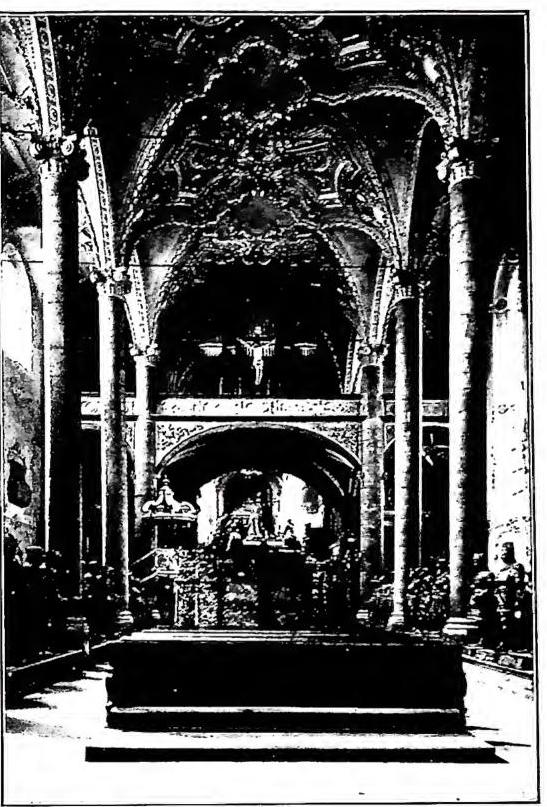
INNSBRUCK — Interior of the Hofkirche (1553–63). At the center, the grandiose cenotaph of Massimiliano I, and on either side the statues of his legendary and actual ancestors.
Latin episcopal sees were established for the spiritual care of Latin Catholics in the lands of the East occupied by Western princes or subject to their influence: Asia Minor, Egypt, Palestine, the Aegean Islands, and the Balkan Peninsula. Some centuries later, the Muslims, having succeeded in reconquering the lost territories, abolished and destroyed the civil and ecclesiastical organization established by the Crusaders, and the bishoprics in fact ceased to exist. The refugee Latin bishops adapted themselves to serving and assisting their confrères from regions free of Turkish rule, who had given them shelter. It must nevertheless be noted that the forced suppression of many Latin dioceses in the Levant did not interrupt the continuity of the hierarchical succession (not all were overwhelmed simultaneously: those in the Venetian dominions lasted longer). When the pastors who had governed them disappeared, others were appointed, though not always in the regular forms; inheriting merely their title, they received the fullness of the priesthood. The Holy See soon intervened, reserving to itself the provision of these nominal sees, whose generic designation for several centuries was «i. p. i.».
Later, owing to the decline of the Turkish Empire, the territory of many of these sees again came to be inhabited mainly by populations of Eastern rite, separated from the Catholic Church but not infidel in the sense given to the word. The designation of sees «i. p. i.» was therefore in many cases no longer appropriate.
For this reason Leo XIII, by means of a decree of the Sacred Congregation of Propaganda Fide dated 3 March 1882 (Collectanea Sacrae Congregationis de Propaganda Fide, II, Rome 1907, no. 1565, p. 157), abolished the formula «episcopi i. p. i.» and established that it be replaced by «titular bishops», in order
to distinguish them from residential bishops. Titular bishops enjoy, with few exceptions, the privileges and honors of residential bishops (can. 439 § 1).