
LEONE XIII, POPE. – Vincenzo Gioacchino Pecci, born at Carpineto (Frosinone) on 2 March 1810, died at Rome on 20 July 1903. The sixth of the seven children of Ludovico Pecci, colonel of the baronial militia of his region, and Anna Prosperi Buzi, of Cori. Of Anagnine nobility. At the age of eight he was entrusted, together with his elder brother Giuseppe, to the Jesuit College at Viterbo. Having moved to Rome, to the Collegio Romano, he had Perrone as his teacher. Deeply devout, temperate and simple in his conduct, frail in health, of a meditative and thoughtful temperament and a shrewd intellect, he excelled in his studies, especially theology and literature, and in Latin didactic and satirical poetry. He had a profound sense of the dignity of his family and an even more profound regard for the honor of the Church. At the Academy of Noble Ecclesiastics (1832), and subsequently a prelate, he celebrated his first Mass at S. Andrea al Quirinale (1838), with his brother Giuseppe, who had become a Jesuit, serving as assistant priest.
After a month he was sent to Benevento as papal delegate and in 1841 to Perugia, with the same office. Consecrated archbishop of Damietta, he was sent as nuncio to Brussels (1843). His nunciature was extremely demanding, especially because of a disagreement with the government over the question of education, which also prompted the intervention of the Austrian minister in Brussels. Recalled to Rome, Pecci was appointed bishop of Perugia, where he took possession of his see ten days after the election of Pius IX. Here he would remain for thirty-two years (in 1853 he was made a cardinal), while the Italian national movement advanced: in 1859 an insurrection plotted at Perugia by a group of conspirators was suppressed by a battalion of papal troops coming from Rome (liberal polemic spoke of the “massacres of Perugia”); in 1860 Perugia was annexed to the Kingdom of Italy, and Pecci, amid these difficult circumstances, displayed moderation in his conduct, but without compromises or weakness, indeed in certain cases with great courage. It suffices to recall the tragic episode of the pious priest Santi. The royal troops had scarcely entered the city when someone attempted to take revenge on the aforesaid priest by reporting to General De Sonnaz that he had seen him firing from a window at the Piedmontese. The general, in a summary judgment, condemned Santi to be shot. The archbishop intervened with such magnanimous words and such apostolic firmness as to move the entire citizenry; but all was in vain, whereas only a few days after the execution the innocence of the victim was proved by the archbishop himself.
Although he remained a convinced supporter of the necessity of the civil government of the Holy See, he notoriously did not share the methods and political assessments of Cardinal Antonelli, who for twenty-seven years had been Pius IX’s secretary of state. This difference of judgment (which can also be noted in the Perugian pastoral letters of 1876–77–78) is perhaps connected with his stay in Belgium, which brought Pecci into contact with a new world: a Catholic nation under a liberal, non-concordat regime,
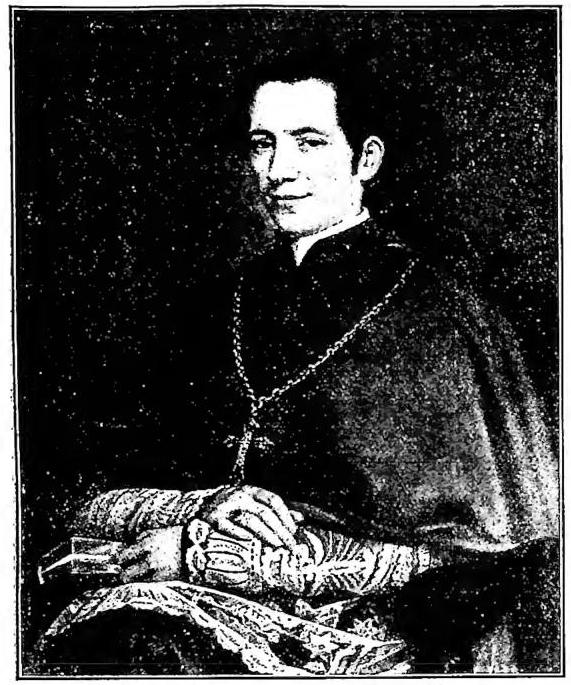
His pontificate was immediately expected to be one of transition, partly because of his age and his middle-of-the-road tendencies. Leaving aside the predictions concerning his age, disproved by twenty-five years of government—the longest after s. Peter and Pius IX—he gave from his earliest acts the impression that he wished to assert the Church’s view in the face of the problems of the age, not so much to point out conflicts and pronounce condemnations, a task fulfilled by his predecessor, as to outline possibilities for convergence. Typical was R. Bonghi’s prediction, which hailed in L. the doctor of broad doctrinal visions (the Lumen de coelo of the pseudo-prophecy) who would give the pontificate “his own stamp.”
The first encyclical, Inscrutabili (21 April 1878), describes the evils of society, to which the Church offers remedies on the spiritual and civil planes. The appeal to the piety of the faithful was made with particular insistence on devotion to the Rosary (encyclical Supremi Apostolatus, 1 September 1883, and many other documents), linked with devotion to s. Joseph (encyclical Quamquam plurius, 15 August 1889) and to the Holy Family (letter Novum argumentum, 20 November 1890). The growth of devotion to the Sacred Heart was solemnly expressed at the beginning of the century through the consecration of the human race (encyclical Annum Sacrum, 25 May 1899). The religious apostolate of the faithful was entrusted above all to the Third Order of s. Francis (encyclical Auspicato concessum, 17 September 1882), and this also brought about a broad movement of Franciscan scholarship. He restored celebrations in the Vatican Basilica, which had been suspended after 1870, including beatifications and canoniza-
tions, which resumed at S. Peter’s in 1897. Among the saints and blesseds of his pontificate (approximately fifty in all) were the Seven Founders, La Salle, Zaccaria, Labre, and Rita da Cascia.
Notable was the initiation of the causes for the beatification of Thomas More and Joan of Arc. The celebration of the Holy Year 1900, which he insisted upon despite many difficulties, was an event of great importance: it successfully resumed the series of Jubilees, interrupted in 1825, and crowned the many Italian and foreign pilgrimages that had flowed into Rome for his personal Jubilees, especially for his episcopal Jubilee (1888), with the magnificent Vatican Exhibition, which brought together substantial tributes from throughout the world.
He considered the education of the clergy chiefly from the intellectual point of view, adopting the teaching of Thomism in clerical schools. This was a constant initiative (encyclicals Aeterni Patris, 4 August 1879; Cognita nobis, 15 February 1882; Fin dal principio, 8 December 1902), which rescued Catholic culture from the caprices of excessive eclecticism and gave rise to successful attempts at renewal (for example, the Neo-Thomist school of Louvain, with Mercier). He wished Thomist culture to be accompanied by a broad literary and social education, with the foundation of the Leonine Seminary in Rome (the Dante chair being entrusted to Mons. Poletto). He called the regular clergy back to unified discipline through the Leonine Union of the Franciscan foundations attached to the Friars Minor and the federative organization of the Benedictines (1893), with the abbey of S. Anselmo in Rome (1900). There were not many approvals of new foundations, but notable among them were those of the White Fathers (Lavigerie), the Canons of the Immaculate (Grea), the Priests of the Sacred Heart (Dehon), the Divine Word, and the Pallottines. He fostered the development of the Salesians and the sanctuary and Works of the Rosary at Pompeii (Bartolo Longo).
He energetically pursued the reconstitution of the hierarchy in separated countries, the strengthening of the Eastern Church, and the Church’s active presence in relation to schismatics, seeking to place the Holy See in good relations with the civil governments of the respective countries. Among his first significant acts were the letter concerning the restoration of the hierarchy in Scotland (4 March 1878), the allocution on the Eastern Churches (28 February 1879), the encyclical on ss. Cyril and Methodius (30 September 1880), and the address to the Slav pilgrims (5 July 1881).
The most interesting pro-Catholic movement occurs in England, following the Oxford Movement (among the first cardinals created by L. was Newman), and resumes (1889) with the meeting of Lord Halifax and the Lazarist Portal, and with the proposal to recognize Anglican Orders. A Roman commission rejects the proposal (1896), but nevertheless the fervor of the studies and discussions greatly benefits the cause of Catholicism.
In the Near East, improved diplomatic relations with Russia benefit not only the Catholics of Poland but also help to arouse among the Orthodox currents of sympathy for Catholicism (the work of W. Soloview is typical). In Egypt, Greece, Turkey, and Chaldea, L.’s action produces good results; not so in Bulgaria (with the apostasy of King Ferdinand, 1895) and in Armenia, where the repeated massacres of Christians (1895–96) go unpunished by the Sultan. The solemn Eucharistic Congress of Jerusalem (1893) contributes to the growth of the Eastern Churches. Special relations are maintained with the Maronites and the Copts.
L.’s missionary activity is exceedingly arduous: in India it is invigorated by the end of the Goa schism (1886) and the establishment of the hierarchy; in Indochina, a severe persecution (1885) promises a renewal; in China, xenophobic opposition to the missions, with the persecution of 1900, which L. seeks to confront by establishing a nunciature in Beijing, though this is obstructed by France; in Japan, the hierarchy is established (1891); in Korea, religious freedom is proclaimed. In Africa, Lavigerie develops new methods of evangelization among the Arabs (Sudan, Sahara, and North Africa, with the restoration of the archbishopric of Carthage, 1884). In the Congo, L. obtains guarantees for the missions (Berlin Conference, 1885). In Uganda, the violent persecution (1887) preludes major conquests; in Abyssinia, the flourishing apostolate of Msgr. Massaia (created a cardinal), led by the French and Italian Capuchins.
L. attaches great importance to action against slavery (encycl. In plurimis, 5 May 1888; Catholicae Ecclesiae, 20 Nov. 1890), in cooperation with civil governments, by encouraging the national associations promoted by Lavigerie (in Italy, with Filippo Tolli, 1888).
In relations with Christian nations and their respective governments, L.’s attitude is always that of creating positive relations with the Church, regarded as a promoter of civilization, in harmony with the aspirations of peoples and of the times. His action, incessant and vigorous, through diplomacy, the episcopate, and organized Catholics, is closely connected with his teaching, systematic and coherent in the fields of religious culture and political and social doctrine. From his writings and speeches it is possible to derive an encyclopedia of contemporary Catholic thought (the Church, the State, Catholics and political parties, the family, public liberties, the social question, democracy...). He gives innovative impulses to religious culture (letter on historical studies, 18 Aug. 1883; encycl. Providentissimus, on biblical studies, 18 Nov. 1893), provoking numerous initiatives (among them, the Biblical School of Jerusalem, the University of Fribourg, the Biblical Commission, and the work of Ludovico Pastor). It is noteworthy that L., even when (as in the encycl. Immortale Dei, 1 Nov. 1885, on the constitution of States; encycl. Libertas, against liberalism, 20 June 1888) he enunciates the sharpest contrasts between Catholic doctrine and certain modern doctrines, always leaves open the possibility of loyal practical agreements, by virtue of the distinction, extensively developed by modern canonists, between thesis and hypothesis. The affirmation that the Church has no preferences for particular political regimes is joined to the declaration of social doctrine, in the encycl. Rerum novorum (15 May 1891), the most characteristic Leonine document, whose directives, fruitful in countless developments in all countries, are taken up by his successors.
Among the countries in which L.’s action was felt most intensely, though under differing circumstances, the United States, Germany, France, and Italy must be mentioned.
The astonishing growth of American Catholicism, supported neither by a national tradition nor by concordat legislation, is followed with the greatest interest by L. (letter Loughqua, 1 Jan. 1895), who makes its most distinguished representative, Msgr. Gibbons, a cardinal. Certain attitudes of Catholics—those most influenced by the modernity of customs—give rise to lively controversies (the question of the Knights of Labor is resolved; not so that of Catholic participation in the Parliament of Religions, disapproved in a letter to the apostolic delegate, 8 Sept. 1895): the letter to Gibbons on Americanism (22 Jan. 1899) gives these controversies a moderate solution. The apostle of the Italian emigrants, St. Francesca S. Cabrini, receives from L. the mandate to devote her labors to the United States.
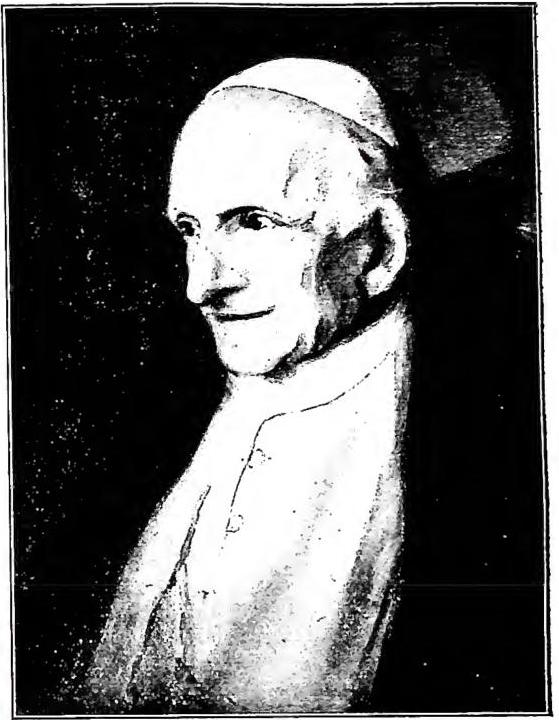
(phot. Giordani)
LEONE XIII, pope — Portrait. Study from life by F. A. László (1900) — Rome, property of Countess Pecci-Blunt.
In France, the political situation, with the failure of the monarchist restoration (1873 and 1877), leads to a republic, at first moderate, then induced, under Gambetta’s patronage (1878), into the most vehement anticlericalism. The new nuncio, Msgr. Czacki (1879–82), seeks to lessen the conflicts and, through a slow process of sounding out opinion, to set in motion the solution that appears decisive: the resolution of the monarchist opposition, which has with it the majority of the clergy and of militant Catholics. L. reaffirms (encycl. Sapientiae Christianae, 10 Jan. 1890) the Church’s indifference toward political regimes and authorizes Cardinal Lavigerie, through the sensational toast of Algiers (12 Nov. 1890), to proclaim the ralliement of French Catholics to the Republic. The Masonic faction does not accept the ralliement and instead intensifies the religious conflicts (the struggle against the Congregations, the Dreyfus affair, etc.), ultimately leading, under the Combes ministry (1902), to the abolition of the Concordat (1905).
In Italy, the “Roman question” produces situations opposite to those of other countries: for “most grave reasons,” Catholics are forbidden to participate in public life (non expedit), which places them outside and against the regime that emerged from the Risorgimento. L. softens the harshness of the opposition between 1870 and 1878, and allows, especially until 1887, the conciliatory Catholics to express hopes for pacification; but he sees its possibility only with the historical and juridical guarantee of a civil sovereignty. At times he allows initiatives aimed at resolving what he calls the disastrous dissension to manifest themselves (as in 1887 with the famous pamphlet by Fr. Tosti, prompted by Crispi), but then, above all because of the implacable hostility of Freemasonry, he returns to his former positions. On the occasion of the disgraceful attack on the remains of Pio IX (1881), and then of the sectarian uproar over the monument to G. Bruno (1889), there is talk of the possibility of the Pope’s departure from Rome, because he considers the subjection of the Holy See to a government that claims to have resolved the Roman question through the Law of Guarantees and through those laws directed against religious Orders, Catholic schools, charitable institutions, and (1898) Catholic associations themselves to be intolerable. This conflict, transferred to the international arena (and made more acute by the clash between the Italian minister, Crispi, and Cardinal Rampolla, Secretary of State (1887-1903)), places papal diplomacy in opposition to the Triple Alliance (to which, however, Bismarck remains faithful) and in favor of the Franco-Russian Dual Alliance. The issue of the Roman question, which predominates in Leonine policy, does not diminish the values that it realizes in every country through the participation of Catholics in the most vigorous national activity and through the affirmations of the social program, entitled Christian democracy.
Biographies: T. Serclas, Le pape Léon XIII, 3 vols., Paris 1894-1906; A. J. Boyer d'Agen, La jeunesse de Léon XIII, there 1896; id., La préfecture de Léon XIII, there 1900; H. des Houx, Joachim Pecci, there 1900; J.-A. Guillermin, Vie et pontificat de Léon XIII, 2 vols., there 1902; N. Schneider, Leo XIII, sein Leben u. Wirken, Kempten 1903; M. Spahn, Leo XIII, Mainz 1912; G. Fraikin, L'infanzia e la giovinezza di L. XIII, Grottaferrata 1914; G. Goyau, Léon XIII, in DThC, IX (1926), cols. 334-49, to be corrected on the basis of J. Schmidlin, Papstgesch. der neuesten Zeit, II, Munich 1934, pp. 331-389, and E. Soderini, L. XIII, 3 vols., Milan 1932-1934. In addition: E. Vercesi, Tre papi, L. XIII, Pio X, Benedetto XV, Milan 1929; G. Semeria, I miei quattro Papi, I, there 1930; F. Hayward, Léon XIII, Paris 1937; F. Crispolti, Pio IX, L. XIII, ecc., Milan 1939.
Studies: R. Bonghi, L. XIII e l'Italia, Milan 1878; id., L. XIII e il governo italiano, there 1882; R. de Cesare, Il Conclave di L. XIII, Città di Castello 1888; Grégoire (G. Goyau), Le Pape, les catholiques et la question sociale, Paris 1893; P. De Meester, L. XIII e la Chiesa greca, Rome 1905; E. Lecanuet, L'Eglise de France et la Troisième République, II, Paris 1907; C. Crispolti-G. Aureli, La politica di L. XIII da Galimberti a Mariano Rampolla, Rome 1912; G. Goyau, Bismarck et l'Eglise, Paris 1913; E.-M. Janvier, Action intellectuelle et politique de Léon XIII en France, there 1914; L. Thillet, Les doctrines politiques de Léon XIII, there 1920; D. Ferrata, Mémoires, 3 vols., Rome 1920; C. Manfroun, Salle soglie del Vaticano, 2 vols., Bologna 1920; O. Schilling, Staats u. Sociallehre des Papstes Leo XIII, Freiburg im Br. 1925; P. Tischleder, Die Staatslehre Leo's XIII, München-Gladbach 1925; id., Leo XIII, in Staats Lexikon, III (1929), cols. 926-60; F. Salata, Per la storia diplomatica della questione romana, I, Milan 1929 (with regard to the departure of L. XIII from Rome); E. Hocedes, Hist. de la théol. au XIXe siècle, III. Le règne de Léon XIII, Paris 1947; A. C. Jemolo, Chiesa e Stato in Italia negli ultimi cento anni, Turin 1948, pp. 372-482; F. Chabod, Kulturkampf e Triplice Alleanza in discussione fra il Vaticano e il governo austro-ungarico nel 1883, in Riv. st. ital., 62 (1950), p. 257 ff.