
OXFORD, UNIVERSITY of. — In England. It comprises approximately 7,000 students, of whom 1,500 are women; Catholic students now number approximately 400 among graduates and undergraduates (including approximately 50 women), whereas in 1911 they did not exceed one hundred.
The University appears in the second half of the twelfth century and grew as a result of the exodus from the University of Paris in 1167, when King Henry II recalled his subjects from that seat. The chancellor is mentioned for the first time in 1214, but until 1368 there was also, as papal legate, an official of the episcopal Curia of Lincoln, in whose territory O. was situated (today O. belongs to the Archdiocese of Birmingham). In 1395 Boniface IX exempted the University from every episcopal visitation; this privilege, removed by John XXIII, was restored by Sixtus IV in 1479.
Houses of study in O. were opened in 1221 by the Dominicans, in 1224 by the Franciscans, followed later, before 1300, by the Carmelites, Benedictines and Cistercians. The other students were dispersed in various lodgings, causing a lack of discipline and moral disorder. To remedy this, colleges for lay students were established, on the model of the religious ones. Thus arose the « University College » in 1249, the « Balliol » around 1262; the « Merton » in 1264, transferred from Surrey to O. in 1274; this was the first true college and served as a model for the others that followed, namely the « Exeter » in 1314, the « Oriel » in 1326,
the « Queen's » in 1340, the « New College » in 1379, the « Lincoln » in 1427 to combat the heresy of Wycliffe; the « All Souls » in 1437; the « Magdalen » in 1458; the « Brasenose » in 1509; the « Corpus Christi » in 1516; the « Christ Church » in 1525; there were also many « public halls », of which only that of « St. Edmund's » remains (1269). Under the devout Queen Mary, the Cistercian College of St. Bernard was refounded under the name of « St. John's College » (1555), and the Benedictine « Durham College » under the name of « Trinity College » (1554). After the apostasy of Queen Elizabeth, the « Jesus College » was founded in 1571, principally for the Welsh; the « Wadham » in 1613; the « Keble » in 1870, always exclusively Anglican. The old « Broadgate Hall » became « Pembroke College » (1624); the Benedictine « Gloucester College » became « Worcester College » (1714); and « Hart Hall » (1284), called « Hertford » in 1740, was suppressed in 1818 and reopened in 1840. Women were admitted to degrees in 1920.
The University was incorporated in 1571 (by Act of Parliament) and remained exclusively Anglican until 1870, when the religious examination was abolished. Catholics thus returned in 1896, with the approval of the English bishops, but « Campion Hall » was then founded; it was followed in 1897 by « St. Benets' Hall » for Benedictine students.
In the thirteenth and fourteenth centuries O. achieved its splendour through professors and students such as Roberto Grossatesta, Adam Maesh, Alexandro di Hales, Ruggero Bacone, John Pekcham (Archbishop of Canterbury), Dune Scoto, William of Wykeham and, in the fifteenth and sixteenth centuries, William Waynffete, Wolsey, Lily Liniaere, Groeyn, Colet, Norton, Warham, s. Tommaso Moro, Cardinal Reginaldo Polo and many others. The period 1220–70 is regarded by many as O.’s golden age, and the period 1485–1525 was likewise illustrious. O.’s apostasy under Henry VIII was disastrous: he prohibited the study of canon law, and under Edward V (1547–53) certain pretentious advocates of the « New Learning » plundered the libraries. Queen Mary (1553–58) did everything possible to restore matters; but the Elizabethan persecution expelled the best students, as even some Protestants, both earlier ones such as Pietro Martire (Vermigli), Jewel and Pilkington, and modern ones such as Brodrick (1886), Gladstone (1892), etc., acknowledge. Among the exiles for the faith were William Allen (later cardinal), Robert Parsons, Gregory Martin, Richard Bristow, Thomas Harding, Thomas Stapleton and many others who took refuge in Louvain, Douai and Reims, refuting Anglican polemical writers. During the Anglican persecution (1534–1681), the University gave the Church 63 martyrs, among them s. Tommaso Moro, the bb. Edmondo Campion, John Storey, Cuthbert Mayne, Ralph Sherwin and John Roberts.
The University Library, established in the thirteenth century, was refounded by the great book collector Thomas Bodley in 1603 and is therefore known everywhere as « The Bodleian ».
The University remained loyal under King Charles I, but suffered greatly during the civil wars (1641–49) and under the Commonwealth (1649–60). Under the Catholic King Gia-
como II (1685–88), Holy Mass was celebrated freely in « University College », but when the King wished to introduce a Catholic president into « Magdalene College », the Anglican usurpers cried out against tyranny. After the Revolution of 1688, the University went into decline; Christian indifference then prevailed, although it was somewhat interrupted in the eighteenth century by the Methodism of John Wesley. In 1833 the O. Movement began, followed by many conversions to the Catholic Church. Lay students now have their own chapel (oratory), with a resident chaplain (the present one is Msgr.
(fol. British Council)
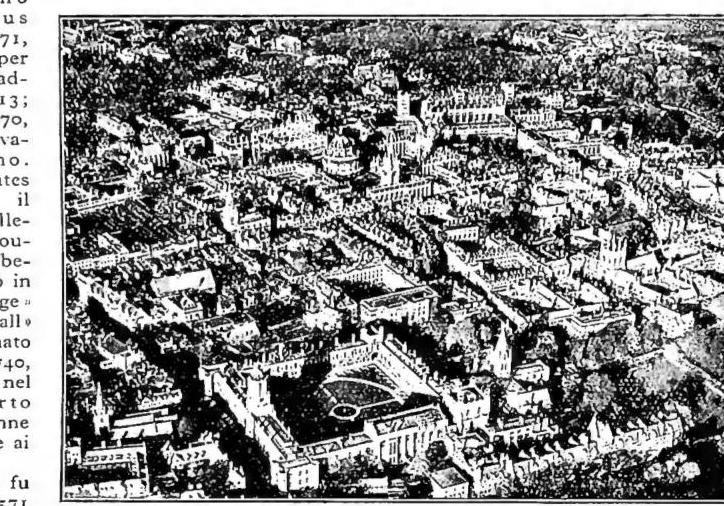
OXFORD, UNIVERSITY of — Aerial view of O. and the various Colleges of the University.
OXFORD MOVEMENT - This is the name given to the attempt made in the 19th century to bring about a Catholic revival within Anglicanism. Toward the end of the 18th century, the social and intellectual aristocracy of England, with very few exceptions, felt nothing but contempt for the Catholic religion. In this milieu, the Roman Church on the other side of the Channel was called “the little Italian mission” or “the little Irish mission.” The cry “no popery” (no Pope) was common among the English of that time; as late as 1770, armed bands, fanatical over that cry, had sacked and burned Catholic chapels. Only a few villages in Sussex and along the coast, and some castles, still preserved intact the faith of the period preceding the so-called Reformation.
In 1792, several bishops, 800 French priests, and 600 nuns abandoned their homeland, where the Revolution had broken out, and sought hospitality in England. The welcome was unexpected: Anglican pastors and the people gave the refugees proofs of exquisite charity and even had Catholic breviaries and Bibles printed for their use. The French priests spread throughout the Island and took up the most varied occupations: they became tutors, opened schools, and founded missions. The English and Irish Catholic priests seized the opportunity to broaden the scope of their apostolic activity. The example of the immigrant French clergy helped to bring down many prejudices. After the Concordat, most of them returned to their homeland, but some remained in England. In 1811, when J. H. Newman, a London boy of barely 10 years, arrived at the school of Ealing, there was still a French priest among the teachers. The influence of the immigrant clergy, the return of the intellectual part of the English clergy to the study of the Fathers of the Church as well as to scientific exegesis, and, moreover, the disgust which the Anglican clergy itself began to feel toward the government’s interference in spiritual matters, the incipient German criticism, and the progressive weakening of religious life, all contributed to preparing the Oxford Movement, the Catholic revival within Anglicanism.
July 14 is, in Newman’s own judgment, the day of birth of this movement. It is the day on which John Keble, the most eminent of the fellows of Oriel College, delivered in St. Mary’s at Oxford, the Anglican church of the University, his sermon on national apostasy. It was a true alarm cry that penetrated deeply into souls and aroused an echo in the better part of the University of Oxford. On September 9, an anonymous three-page writing was circulated among the public; it began as follows: “To my brethren in the sacred ministry, priests and deacons of the Church of Christ in England.” The writing was by Newman: “I must speak to you because times are troubled and no one raises his voice against them.” This call to arms was the first of the Tracts for the Times, which then appeared uninterruptedly for twelve years: from them came the name “Tractarian,” initially given to the Oxford Movement. The purpose of these anonymous writings was to restore to honor the Catholic dogmas and morality betrayed by Anglicanism. Their effect was prodigious. In 1835 Pusey devoted himself to them with great commitment: the Tracts became longer and richer in scholarship. Tract 90, the last, was published on February 27, 1841. In it Newman demonstrated that the Thirty-Nine Articles of Elizabeth, the Creed of the Anglican Church, although “the product of an anti-Catholic age, were, in God’s providential plan, not entirely anti-Catholic; indeed, they did not contradict the Council of Trent” and “could therefore be subscribed by those who aspired to Catholicism.” On October 9, 1845, Newman, in the solitude of Littlemore, returned to the true Church through the hands of Fr. Domenico della Madre di Dio, a Passionist. Disraeli later said of this conversion: “It gave England such a shock that the whole country still trembles from it.”
On September 29, 1850, Pius IX re-established the Wiseman (v.) cardinal archbishop of Westminster. Upon his arrival in London, a tumult was staged. But Wiseman’s personal qualities succeeded in transforming hostile opinion in his favor. In March 1815, Manning (v.), an Anglican pastor, a graduate of Oxford, and a longtime friend of Newman, converted. Upon Wiseman’s death, he succeeded him as archbishop of Westminster.
Pusey, whose learning was extraordinary, increasingly became the center of the Oxford Movement: he opposed individual conversions, carried out in such a piecemeal fashion, but favored corporate union with Rome, which was the movement’s ultimate goal. Tractarianism was becoming Puseyism. In 1856, Dr. Lee, an Anglican clergyman and Oxford graduate, shaken by Pusey’s ideas, launched a newspaper entitled The Union. Its aim was to promote union with the Holy See. The following year, Lee founded the Association for the promotion of the union of Christendom. Some Catholics joined this prayer crusade. Lockhart and, above all, Ambrogio Philipps distinguished themselves in II. Despite the sympathy shown by Cardinal Wiseman, on September 16, 1864, following certain incidents, the Holy Office condemned the A.P.U.C.; on November 8, 1865, in response to the letter sent by 198 Anglican unionists, a second rescript of the Holy Office ratified the condemnation. The Association then remained composed solely of Anglicans. From it emerged, in 1877, the Order of corporate reunion, founded by Dr. F. G. Lee. He requested episcopal consecration from Old Catholic bishops who unquestionably possessed apostolic succession. Two members of the O. C. R., the Rev. Moseman and Dr. Seccombe (some also add the name of G. Leycester Lyne), joined Lee and likewise received episcopal consecration from the same bishops. Lee and Moseman entered the Catholic Church shortly before their deaths. In September 1865 Pusey had published a work entitled Eirenicon, the Church of England, part of the one, holy, Catholic Church of Christ, and a means of restoring visible unity; in 1869 he published a second Eirenicon and a third in 1870. Unfortunately, the definitions of the First Vatican Council are presented to Anglicans in an exaggerated and inaccurate manner. Pusey too had to abandon any hope of union. He later wrote: “The majority of the Council broke me; since then I have not touched another book of Roman controversy.” He also wrote: “The Vatican Council was the greatest sorrow of my life.”
From 1870 to 1894, the Catholic revival continued across the Channel; but it was only in 1894 that a new concrete orientation toward union between Rome and Canterbury took shape, the supreme aim of the Oxford Movement, which from day to day came to be called the Anglo-Catholic movement. This concrete orientation, born of the meeting that took place in 1890 between a French Lazarist priest, M. Portal, and Lord Halifax, president of the English Church Union, after arousing great hopes, despite the tenacious opposition of Cardinal Vaughan, had to suffer a setback in 1896. On September 13 of that same year, Leo XIII issued the bull Apostolicae curae on the invalidity of Anglican ordinations. The Oxford Movement did not, however, come to an end. In particular, the revival of monastic life and the development of scientific exegesis attained great expansion within Anglicanism during the first half of the 20th century.
On 8 August 1920, the English press published the Lambeth Appeal, signed by all the Anglican bishops, for the union of the Churches. Lord Halifax saw his dearest hopes revived: with the help of the tireless M. Portal and under the direction of Cardinal Mercier, he organized the Malines Conversations (v.) which took place from 9 December 1921 to 12 October 1926: a new attempt at rapprochement between Rome and Canterbury. On 1 October 1933, in preparation for the centenary of the O. movement, 51 of the leaders of the contemporary Anglo-Catholic movement signed a Manifeste. From February 1933, more than 359 new adhesions by Anglican clergymen were added to the previous ones. The purpose of the Manifeste was to draw attention to the deviation of Anglo-Catholicism and to reaffirm the true path traced by Keble and Pusey, so as to bring back to it those who had strayed from II.
Giacomo de Bivort de la Saudée