Machine translation of the 1948–1954 Italian original. The original text is authoritative.
CANTERBURY. — The episcopal see of C. (Kent—England), founded in 597 by St. Agostino, apostle of England, sent there by St. Gregorio Magno, was the primatial see of that kingdom until the fifteenth century; after the schism occurred, it became the primatial see of the Anglican hierarchy, and it retains this primacy to the present day. Among the most notable Catholic archbishops were St. Lanfranco (1070–1089) and St. Anselmo (1093–1109), both Italians,
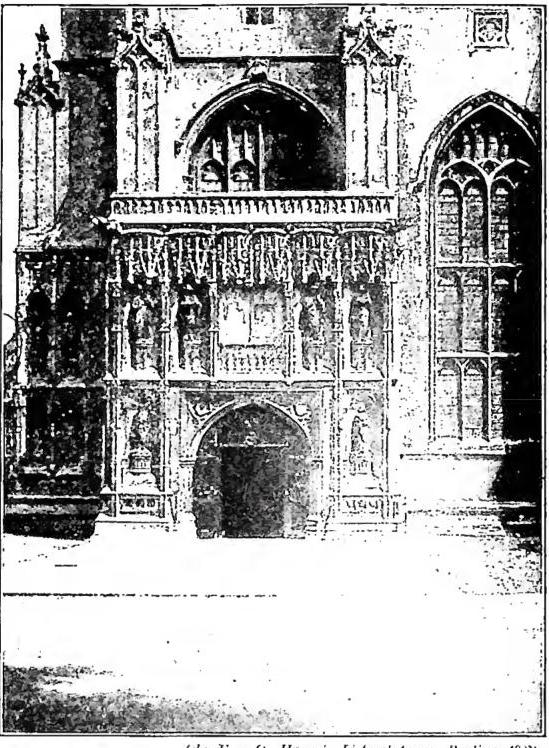
(from E. O. Happel, L'Angleterre, Berlin 1907) CANTERBURY — Side portal of the Cathedral (fifteenth century).the holy martyr Tommaso Becket (1162–70), and Stefano Langton (1207–28). The first Protestant archbishop was Tommaso Cranmer, elected in 1533, who in 1556, under the Catholic queen Maria Tudor, was succeeded by the last Catholic archbishop, Reginaldo Pole (1553–58). After Pole, all the archbishops have been Protestant. It should be noted that the Anglicans, in their lists of the archbishops of Canterbury, place them all consecutively, without any distinction, as though the Protestant ones were the legitimate successors of the Catholics. Among the Anglican archbishops, mention should be made of Matteo Parker (1559–75), famous for the question of the episcopal ordinations carried out by him using the Edwardine formula; Giovanni Whitgift (1583–1604), who attempted to introduce Calvinist doctrine into the Church of England through the “Lambeth Articles”; Guglielmo Laud (1633–45), beheaded by his enemies; Guglielmo Sancroft (1678–90), deposed for refusing to swear allegiance to the new king after the expulsion of the Stuarts; and, among the more recent, E. W. Benson (1883–96), Randall T. Davidson (1903–28), and C. Gordon Lang (1928–42), famous for the pan-Protestant congresses and for their efforts toward union with the Eastern schismatics.
The Anglican archbishop of C. has various functions, depending on whether he is regarded as a dignitary within the Anglican-Episcopal communion, spread throughout the world, or as head of the Church of England, or as metropolitan of the ecclesiastical province of C., or as the simple bishop of his diocese. Within the Anglican-Episcopal communion he is regarded as the «primus inter pares» among all the other bishops; he therefore has absolutely no jurisdiction beyond that which belongs to him within his province and his diocese; temporarily or occasionally he has jurisdiction over certain isolated dioceses that do not yet belong to any ecclesiastical province, such as those of Gibraltar, Jerusalem, etc. He presides over the Lambeth Conferences, to which all the Anglican and Episcopal bishops of the world are invited every ten years; these conferences, however, can formulate no canon or adopt any disciplinary or doctrinal decision that is binding. In the Church of England, that is, in the church formed by the two ecclesiastical provinces of C. and York, the supreme head is the King or Queen of England, according to the 37th Article of Religion, that is, in practice, the English Parliament, to whose will both the archbishop of C. and the other bishops of the Church of England are subject in the most serious cases, while in less important cases they are subject to the will of special delegations of Parliament (Privy Council, Court of Arches). The archbishop of C. bears the title “Primate of All England”; that of York is only “Primate of England.” It is his right to crown the King; he is regarded as the first Lord of the Realm and is preceded only by members of the royal family; he is also the legal chairman of the “National Assembly of the Church of England,” that is, of the Assembly consisting of the union of the two provincial assemblies of C. and York.
BIBL.: S. L. Ollard-G. Crosse, A Dictionary of English Church History, London 1912; E. A. McKilliam, A Chronicle of the Archbishops of C., ibid. 1913; A. W. Rowden, The Primates of the four Georges, ibid. 1916; H. Lowser Clarke, Constitutional Government, ibid. 1924; The Official Yearbook of the Church of England, 1928, ibid. 1948. Camillo Crivelli
ARTE. - The remains of the ancient abbey where St. Agostino and his successors were buried have been identified at C.; the church of S. Martino is also considered to predate the saint’s arrival in England. Nevertheless, the city’s most important monument is the ancient cathedral, which dominates the urban centre with its imposing bulk. Founded in 1070 by Bishop Lanfranco immediately after his appointment to the see of C., it soon underwent transformations and additions at the hands of Bishop Anselmo, toward the end of the 11th century. The beautiful crypt, with its interesting cubic capitals, together with part of the transept and the choir, nevertheless constitute all that remains in the cathedral of the original Romanesque church. This, in fact, through a series of works begun in 1175 under the direction of the French architect Guglielmo di Sens, was completely transformed toward the end of the 12th century, taking on the characteristics proper to French Gothic buildings. After 1192, the work of the French architect was continued by an English colleague, also named Guglielmo, who, although introducing some modifications to the original design, did not substantially alter its spirit.
The works nevertheless continued during the 14th century and the early years of the 15th, when the construction of the western transept and the great nave was completed, in the style by then of late English Gothic, which also stamped its character on the great central tower erected in 1495.
The north-west tower of the façade, on the other hand, dates from the first half of the 19th century.
Among the most important works of art still preserved in the cathedral, particular mention should be made of the tombs of Enrico IV and of Archbishop Warham, likewise in the English Gothic style.
In addition to some remains of ancient Franciscan and Dominican convents, C. preserves notable remains of the city’s ancient walls and fine medieval and Renaissance civic architecture.
BIBL.: C. Enlart, in A. Michel, Histoire de l'art, I, II, Paris 1905, p. 511 ff.; H. I, ibid. 1906, p. 70 ff.; W. Armstrong, L'arte nelle isole britanniche, Bergamo 1910, pp. 28 ff.; A. W. Clapham, English Romanesque Architecture before the Conquest, Oxford 1930; I. N. Summerson, s. V. in Enc. Ital., VIII, (1930), p. 778 (with preceding bibliography). Emilio Lavagnino
Cite this article
“CANTERBURY.” Enciclopedia Cattolica, vol. III (1949), p. 382. Azione Romana digital edition, https://azioneromana.com/article/canterbury.