Machine translation of the 1948–1954 Italian original. The original text is authoritative.
LANFRANCO di PAVIA. — Benedictine theologian and archbishop of Canterbury, born in Pavia at the beginning of the 11th century, died at Canterbury on 28 May 1089. Of noble family, he received an excellent education in the schools of law that were then flourishing in Pavia. Discouraged by his failure to find teaching work at Avranches and Rouen, where he had gone, he sought peace in the abbey of Bec (Normandy). Embittered by internal difficulties, he decided to withdraw to the eremitical life, but the abbot Erluin appointed him prior and head of the monastic school.
The beginnings of his teaching career were difficult, but one circumstance changed the situation: when Berengario di Tours began, at that time (1047), to spread his Eucharistic errors, L. went to Italy with Leone IX (1049), attended the Councils of Rome and Vercelli, where he engaged in a determined struggle against the heretic, at times harshly, and continued it in France. His attitude pleased the bishops and the duke, who by then regarded him as the standard-bearer of orthodoxy: thus L. became famous and the school of Bec acquired great renown. s. Anselmo di Aosta, Ivo di Chartres, and Anselmo di Lucca (the future Alessandro II) came there; from Rome, Nicola II sent the papal chaplains there to perfect their knowledge of dialectic and rhetoric.
Having become a friend and adviser of Guglielmo il Conquistatore, duke of Normandy, he was made abbot of S. Stefano di Caen and, after the conquest of England (1066), archbishop of Canterbury (1070), where he engaged in many struggles to defend the primatial rights contested by York and, above all, to reform the Church. In this he followed the directives of Gregorio VII, though moderating his intransigence on the two principal issues of celibacy and lay investiture. This displeased the Pope, with whom L. maintained rather cool relations. When Enrico IV opposed Guiberto (Clemente III), the antipope, to Gregorio, L., together with the English episcopate, took refuge in a comfortable and ambiguous neutrality.
A man of action endowed with political genius, L. was not a professional scholar; nevertheless, he knew how to address those subjects that circumstances imposed upon public attention. Some works, such as the Commentarius in Psalmos, have been lost; there remain instead: Commentarius in epist. s. Pauli (PL. 150, 101–406), whose authenticity has been debated; Decreta pro Ordine s. Benedicti (ibid., 443–516), a detailed exegesis of the Rule of s. Benedetto; Liber de celandia confessione (ibid., 624–32), important for the history of the sacramental seal and for medieval conceptions concerning the necessity of Confession; Epistolarum liber (ibid., 505–624), some sixty letters of value for the history of canon law and theology (Ep. 33 on the Communion of children and the necessity of the Eucharist); Libellus de Sacramento corporis et sanguinis Christi contra Berengarium (ibid., 407–42), L.’s best-known work. In the first part he refutes Berengario, whom he reproaches for oscillating between a simple explanation (that of Umberto di Selva Candida, expressed in the oath imposed upon him by Nicola II in 1159) and a subtle one (that of Scoto Eriugena, to whom the Eucharistic treatise of Ratrammo (v.) was then attributed), whereas the issue was whether or not to accept the doctrine of the Church, which rejects pure symbolism devoid of any foundation in the texts of s. Ambrogio and s. Agostino, so readily cited. In the second part he develops Catholic thought in positive form, expressing, in highly felicitous terms, the three truths of the mysterious presence of Christ’s body and blood, Transubstantiation, and the objective reality of the external species. He then justifies his position by invoking the authority of Scripture and the Fathers. He adduces texts, providing an exegesis that is at times exact (e.g., with regard to s. Ambro-
(phot. Esc. Cutt.)
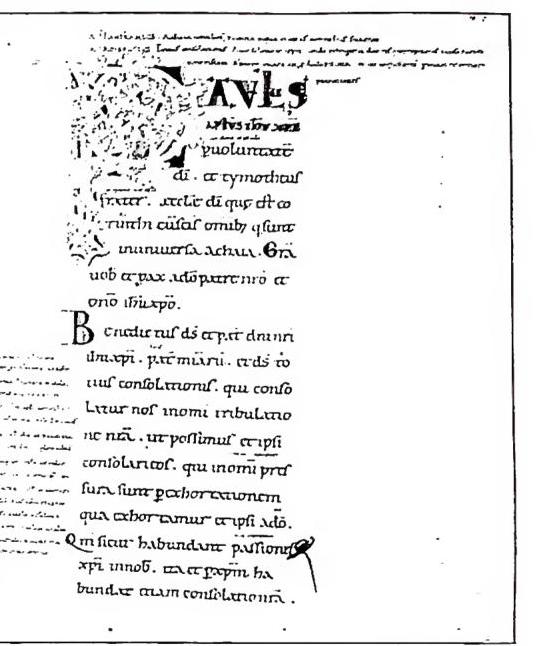
LANFRANCO DI PAVIA — Commentary on the First Letter to the Corinthians with annotations by L. — Vatican Library, cod. Vat. lat. 143, fol. 67 (12th century).
(gio), sometimes forced (e.g., concerning s. Agostino); in any case, he defends, with theological precision, the co-possibility within the same mystery of the Sacramentum and the res. As for the manner of Transubstantiation, he limits himself to observing: «Mysterium fidei credi salubriter potest, vestigari utiliter non potest» (PL. 150, 421-27).
It is L.’s merit to have unmasked the rationalistic tendency underlying Berengario’s theological method, and to have firmly defended the primacy of authority in theology. Accordingly, L.’s Eucharistic work is a vigorous testimony to the traditional faith, rather than an attempt to penetrate the dogma.
BIBL.: Milo Crispinus, Vita Lanfranci: PL. 150, 29-58; Guglielmus Malmesburgensis, Grata pontificum Anglorum: PL. 180, 1458-79; I. de Crosal, Lanfranc et Guillaume le Conquérant, in Revue des questions historiques, 30 (1881), pp. 329-82; H. Böhm, Die Fälschungen Erzbischof Lanfranck von Canterbury, Leipzig 1902; E. Amann-A. Gaudel, s. V. in DThC, VIII, II, cols. 2558-2570; R. Heurtevent, Durand de Troarn et les origines de l'hérésie bérégarienne, Paris 1912, passim; S. Mac Donald, Lanfranc. A study of his life, work and writing, Oxford 1926; I. Geiselmann, Die Eucharistielehre der Vorscholastik, Paderborn 1926, pp. 365-75; G. Paré-A. Brunet-P. Tremblay, La Renaissance du XIIe siècle. Les écoles et l'enseignement, Paris-Ottawa 1933, passim; L. Ramirez, La controversa eucaristica del siglo XI. Berengario di Tours a la luz de sus contemporanios, Bogotá 1940, pp. 39-42; I. De Ghellinck, Le mouvement théologique au XIIe siècle, 2nd ed., Bruges-Paris 1948, passim; R. Southern, Lanfranc of Bec and Berengar of Tours, in Studies in mediaeval history presented to F. Ponsche, Oxford 1948, pp. 27-48; P. Anciaux, La théologie du Sacrement de la Pénitence au XIIe siècle, Louvain-Gembloux 1949, pp. 16, 31, 32, 34, 35, 37, 45, 164, 608. Antonio Piolanti
Cite this article
“LANFRANCO DI PAVIA.” Enciclopedia Cattolica, vol. VII (1951), p. 545. Azione Romana digital edition, https://azioneromana.com/article/lanfranco-di-pavia.