
BENEDETTO, saint, founder of the Benedictines.
SUMMARY:
I. Life and mission
II. Iconography
III. Medal
IV. The Rule.I. THE LIFE AND MISSION
Around 480, s. B. was born into a noble family « ex provincia Nursiae ». His earliest formation was influenced by the famous examples of the venerated ascetics of the region and by that within his own household, his sister Scolastica, who had consecrated herself to God in the very years of childhood and was thereafter to remain so closely united with B.He was sent to Rome to complete his studies there, entrusted to the vigilant care of his nurse. But he soon withdrew from them and, accompanied once again by his nurse, took refuge at Enfide, present-day Affile, among the Monti Simbruini; there, near the church of S. Pietro, he perhaps continued his studies, alternating them with the fervent practice of asceticism (c. 500). He did not remain there long, for, faced with the danger of an unwanted popularity, he made his way to the nearby and deserted locality of Subiaco, close to the ancient Neronian villa. A monk, Romano, clothed him in the monastic habit and assisted him in the first steps of his new life. Above all, he faithfully kept his dwelling-place hidden, so that for three years, solitary in his cave, « in Superni Spectatoris oculis habitavit secum ». But he could not remain concealed for long. As his renown grew with time, he was invited to take charge of a nearby monastery, Vicovaro, where the abbot had died and the community was in decline.
His attempt to recall it to a new and more fervent life was shattered against the obstinate will of the monks, who even tried to poison him, and he returned « ad locum dilectae solitudinis ».
Before long, the need to become the master of the disciples who flocked to him in ever greater numbers, and to adapt himself to their requirements, compelled him once more—this time forever—to renounce the eremitical life which had formed his original, ardent ideal. He would always retain such high esteem and profound love for it that even in the Rule, written for cenobites, he would indicate it as the supreme summit of monastic asceticism. Yet in his new system he did not depart from imitation of the great Egyptian examples and, after the manner of s. Pacomio, he distributed his disciples into groups: there were twelve, each with its own abbot, in as many houses, while he reserved to himself the formation of certain chosen recruits. Among these were Mauro and Placido, the best known of his monks, whom their parents, like many others of the Roman nobility, had wished to entrust to him. But through contact with daily experience the legislator’s ideal was gradually modified, tending toward forms ever more completely cenobitic and closer to the Basilian model.
The persecution aroused against him by the jealousy of a priest in the vicinity seemed definitively to impel him to carry out the new plan; and in the vigor of his full maturity, he left Subiaco and made his way toward the ancient city of Cassino. This was not a resolution taken suddenly. B., in fact, built his new house—the definitive expression of an ideal matured through long years of experiment—upon a mountain that had once been a military acropolis and whose various temples were still at that time frequented by worshippers of idols. He took possession of it as master and without delay destroyed its altars and cut down its sacred groves, while by assiduous preaching (according to some authors, he had been raised to the priesthood) he devoted himself to converting that part of the population still pagan. All this, given the well-established requirements of civil and canonical laws, certainly could not have taken place without a specific mission or, at least, permission from the competent authorities. And what the Gregorian source does not state on this point, as on so many others, tradition allows us to glimpse in the various ways in which it recounts it: from the divine mission recalled by the earliest authors, to the donation of Tertullo, patrician, which, even amid legendary alterations, presents a substratum of truth; from relations with the Roman milieu to the approval and encouragement of the Apostolic See. Thus there arose upon the summit of the mountain the new monastery, complete in itself, a typical model of the most perfect cenobitic life, to be practiced under the immediate and continuous direction of a single father. As if to signify this new orientation, the two oratories built upon the citadel were dedicated in honor of s. Giovanni Battista, father of the monks of the New Testament and precursor of the Gospel, and of s. Martino di Tours, the monk-apostle of Gaul. The construction of the buildings, for which B. proved a wise architect, and the organization of the new life undoubtedly required time. The date 529, traditional for more than seven centuries, should probably be understood as a terminus « ad quem ». From that time onward, that new “company of monks, who read, cultivated the soil, and practiced the arts in the midst of the great society disintegrating through barbarism, prepared the seed of the future civilization and restoration of the peoples” (L. Tosti).
Upon the mountain there was a continual coming and going of people: from the humble, who went there to invoke the protection and assistance of father B., to ecclesiastical dignitaries, such as Bishop Sabino from distant Canosa, and powerful secular figures such as the king of the Goths, Totila, who sought from the Saint words of life and consolation. Once a year, it was the old man himself who left the monastery to meet his sister Scolastica and spend time with her in sweet spiritual conversations. At the place where, according to tradition, the meeting occurred, recent excavations (1939), although not brought to completion, have nevertheless brought to light the remains of a small single-apsed church, dating, at least in part, from remote antiquity.
The last visit, according to the Gregorian source, had to be prolonged throughout the night, against B.’s will: the violent storm, obtained through his sister’s prayers and love, compelled him to remain. Three days later, from his tower, he saw her soul fly to heaven in the form of a white dove, and he had her body carried to the tomb which, on the summit of the mountain, in the shrine of S. Giovanni Battista, he had prepared for them both.
Not much time passed before B. joined her in eternity. Six days before his death he had the tomb opened; then, feeling that his hour had come, he wished to be led into the oratory, where, fortified with the body and blood of the Lord, supported in the arms of his disciples, he surrendered his spirit to God in prayer. It was 21 March: the year, above all from the manner in which B. and s. Sabino spoke with one another of the ruin threatening Rome at the hands of Totila, would seem not to have been earlier than 547. This date, therefore, like almost the whole chronology of the life of s. B., remains only approximate.
The biography as Pope Gregorio has outlined it for us cannot meet all our requirements; not because of any culpable defect, but because of the exclusively edifying purpose that the writer proposed to himself and because of the character of hagiography in those times. Nor do we find in it secure elements for reconstructing the Saint’s physical appearance.
Yet we possess a very clear image of his spiritual character, as it emerges from the pure Gregorian narrative and from the immortal pages of the Rule. He is a man of firm and resolute character. In the profound sincerity of his being, concerned only to please God, he turns to seek Him and consecrates himself to His service. This single purpose gives unity to his whole life, which is spent in the presence of God, in justice and truth. The natural gifts of his disposition—reflective, serious, loving order and peace, endowed with an exquisite sense of balance and discernment—are thus fused and ennobled in the practice of the love of God, before whom he sets nothing, and of neighbor, upon whom, in his pious and paternal teaching, he lavishes his treasures of intelligence and experi-
for bringing him ever closer to God. Thus natural qualities cooperate with grace in making him fit to fulfill the gigantic mission to which Providence had elected him. Having lived in the age of Italy’s greatest depression, while the ancient Roman world was collapsing into ruin, through his creation he prepared its reconstruction. By saving Western monasticism through the adaptation of the East’s vital principles to the Roman mentality, with his sacred rule he transmitted to the new peoples the traditions of the Fathers and the highest practical commentary on evangelical life. He thus provided the Church with the laborers for clearing the immense field of work that was opening before it and prepared the new age.
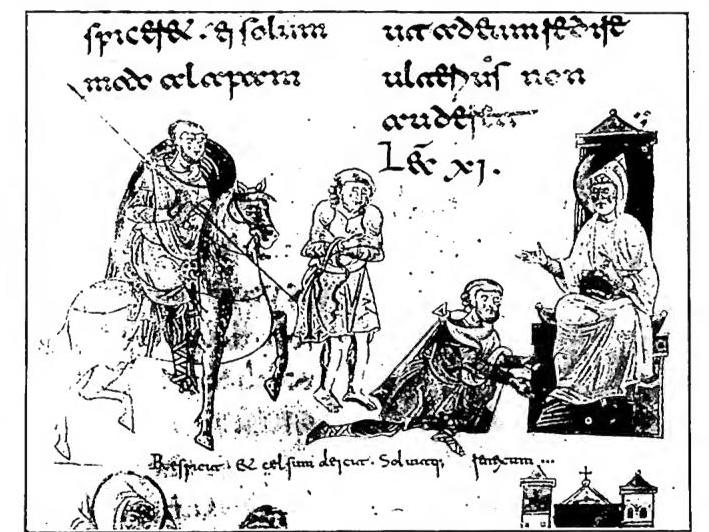
(courtesy of Drs. B. Degenhart)
BENEDETTO, saint — Encounter of s. B. with Totila.
Manuscript from the Cassinese school (ca. 1079) — Vatican Library, ms. lat. 1202.
II. ICONOGRAPHY
Equal to the historical importance and breadth of the work of s. B. was the cult through which peoples have shown him their grateful devotion, comparable only to that accorded to the Apostles; in recent centuries, however, after the devastation wrought by errors and political disturbances, it has considerably declined. Nevertheless, there are still numerous localities and churches in Italy that preserve the name of the Cassinese patriarch, as well as works of art that glorify his image and episodes from his life. We mention here only the oldest painting, from the 8th century (Rome, S. Ermete sulla Salaria vetna), and the celebrated pictorial cycles at Subiaco (S. Speco, 12th–15th centuries), Florence (S. Miniato al Monte, Spinello Aretino, 14th century), Naples (S. Severino, A. Solario detto lo Zingaro, 16th century, and F. De Mura, 18th century), Monte Oliveto Maggiore (Sodoma, 16th century), and Montecassino, irreparably lost through the abbey’s abominable destruction (Luca Giordano, 17th century, and the Beuronese School, 19th century); to these must be added, noteworthy also for the history of costume, the series of miniatures by the Cassinese monk Leone (11th century, cod. Vat. lat. 1202).III. MEDAL
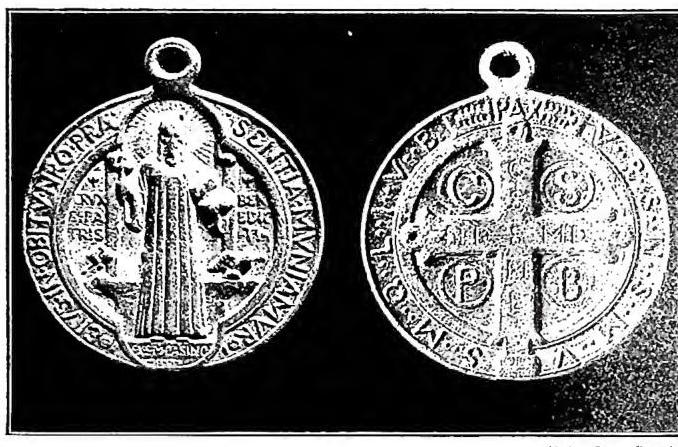
A characteristic form of devotion to St. B. is still today that of the medal, which enjoys widespread popularity among the faithful, surpassed only by that of the Virgin. Its historical origins are obscure, but they must undoubtedly be related to what St. Gregory recounts concerning the efficacy of the cross used by St. B. Its specific element is in fact a square cross reproduced on the reverse with a series of initials; the cross is likewise held in the hand of the Saintwhose figure is reproduced on the obverse. Between the arms of the cross are arranged the four letters C.S.P.B., that is, Crux sancti patris Benedicti; on the vertical arm: C.S.S.M.L.; on the horizontal: N.D.S.M.D.; around it: V.R.S.N.S.M.V. S.M.Q.L.I.V.B. These last three series are the initials of words forming six rhymed hemistichs, containing invocations to the cross and the renunciation of Satan, from whom the cross has freed us, namely: Crux sancta sit mihi lux; Non draco sit mihi dux; Vade retro Satana; nunquam suade mihi vana; sunt mala quae libas; ipse venens bibas. In the Roman Ritual the medal has a special formula of blessing and enjoys many indulgences, which are more numerous for that particular type struck at Montecassino in memory of the fourteenth centenary of the birth of St. B. (1880).
IV. THE RULE.
1) The history of the text. – Since the Rule is the expression of the legislator’s mature thought and summarizes his final, decisively cenobitic experience, its definitive drafting was undoubtedly carried out at Montecassino. Consequently, that sacred mountain was regarded by the entire monastic tradition as the place from which, according to the beautiful image attributed to Urban II, the venerable institution of the monastic Order flowed forth as though from a paradisiacal spring; and medieval writers readily compared it to Sinai.
That the Rule is the work of St. B. has never been seriously doubted. Contrary to the traditional thesis, in recent years a Benedictine of Solesmes, A. Genestout (La Règle du Maître et la Règle de st Benoît, in Revue d'ascétique et de mystique, 21 [1940], pp. 51-112), has considered it later than the Regula Magistri, on which it would therefore depend for the prologue and the first seven chapters. This theory, however, would not diminish the legislative importance of St. B., who in his code would have assimilated these elements as well, along with others already existing, fusing them into the originality of his conception. But the new hypothesis requires more complete demonstration and has encountered numerous opponents (among them, for all, B. Capelle, Cassien, le Maître et st Benoît, in Recherches de théologie ancienne et médiévale [1939], pp. 110-18). That it was written by the patriarch at the express commission of the Apostolic See, which desired to provide monastic life with a codification, just as almost contemporaneously civil life and clerical life were receiving one through the work of Justinian and Dionysius the Little, is what d. Chapmann and, independently of him, Cardinal Schuster have recently maintained.
But it cannot be regarded as having emerged all at once from the author’s pen: rather, it is a code that gradually took shape and was modified on the basis of the requirements of daily practice. Probably, therefore, certain parts,
such as, for example, the section prescribing the liturgical cursus and the one constituting the penitential code, had an independent existence, even preceding the rest, to which they were subsequently joined. The autograph of the Regula (with, at most, the addition of the adjective sancta, which appears to have been the original title) has been lost for several centuries. The Cassinese monks, taking refuge in Rome after the first destruction of their monastery (577), carried it with them. Returned by Pope Zacharias (ca. 742) to the community re-established on the holy mountain, it was again taken away by the monks who escaped the Saracens’ devastating massacre (883) and perished in the fire of the monastery of Teano (896), where they had taken refuge. Only a fragment survived for many centuries at Montecassino as a relic and disappeared amid the disturbances
at the end of the eighteenth century. The manuscripts that remain to us today can be reduced to three types or families: those that reproduce the pure text, those that provide an interpolated text, and finally those that have a mixed text. The first go back to the original text, which perished at Teano, through a copy made from the exemplar that the abbot of Montecassino, Teodemaro, sent to Charlemagne in 787. This copy, preserved in a transcription made around 820 at Aachen by two monks of Reichenau, is contained in the
BENEDETTO, saint – Medal of St. B.
codex of St. Gall (914) and was reproduced at Montecassino in 1900 by d. Germano Morin, who made use of the preceding studies of d. Ambrogio Amelli. Likewise connected with the original text, but independently of the manuscript of St. Gall, is the group of codices constituting the Cassinese tradition. Alongside this text, another was soon formed, slightly modified for practical reasons, that is, for purposes of adaptation and clarification; it is the one reproduced in the oldest manuscript of the Rule to have come down to us: Hatton 48, in the Bodleian Library at Oxford, written at Canterbury around 700. The third group of the text, known as « receptus », also dates from this same period. It appears as early as the eighth century in the commentary of Paul the Deacon and was generally used down to our own day, since it offered the advantage of correcting the original text and making it more intelligible.
The Rule was deliberately written under the influence of Vulgar Latin, and therefore without « quella lima che all'autore sarebbe stata possibile in conformità della sua cultura » (A. Lentini). Yet it, of which St. Gregory rightly says « discretione praecipuum, sermone luculentam », reveals in the classical rhythmic patterns of the cursus the scholar who must spontaneously have « sentire all'orecchio quei vari tipi di chiusa dei periodi e dei metri a cui l'aveva abituato fin da giovinetto la scuola ». Thus, more than the dubious classical reminiscences, this betrays the author’s education: he must have completed at least his studies of grammar and rhetoric in the public schools, and it provides a reliable criterion to be kept in mind when choosing among the various readings of the codices.
2) The content. – Because of the manner in which it gradually took shape, one cannot expect from the Rule a rigorous logical order in the succession of its individual chapters; rather, its broad outlines can be distinguished.
Having laid the foundations of cenobitic and ascetic life in the prologue and chapters I–VII, the following chapters VIII–XVIII contain the norms for liturgical and communal prayer, while chapters XIX–XX indicate the spirit that must animate it together with private prayer. Once the spiritual life has thus been ordered, the text proceeds to establish the organization of the monastery. Chapters XXI–XXX regulate the house in its general lines, while chapters XXXI–LVII govern its material administration. From chapter LVIII to LXI, recruitment is discussed. The following group, chapters LXII–LXVII, arranges the hierarchy and order of the community and its relations with the outside world. The remaining chapters, from LXVIII to LXXII, are later additions intended to clarify particular points of discipline or asceticism, especially in relation to community life. Chapter LXXIII constitutes the epilogue.
In concluding what he calls the « minimam in-choationis regulam », s. B. directs the disciple desirous of further perfection to the teachings of the SS. Fathers and of Sacred Scripture. His code, in Bossuet’s expression, is the compendium of the Gospel and of Christianity. The phrase of s. Gregory, who recognizes in him the spiritual heir of all the just, is to be understood in the broadest sense. Not only did he reproduce in his life, as the biographer demonstrates, the virtues and wonders of the ancient fathers, but in his Rule he recapitulated the ascetical teachings of his predecessors, adapting them to the Latin world. Whatever was vague and imprecise in the earlier monastic legislation received from him a definitive and authoritative ordering. Although proceeding along the great traditional lines, he succeeded in creating an original work: materials that had previously lain scattered came together to form an organic edifice. And, so that this might be open to all, in his spirit of discernment and balance he rejected everything that could be excessive. He therefore legislated exclusively for cenobites, but intended their life to be truly communal, excluding every manifestation of individualism, often an indication of that selfishness which he wished entirely banished. He replaced the arbitrary will of the head of the monastery with the authority of a stable code. Even when permitting other customs, he required that they not differ from the fundamental principles and that the choice be withdrawn from the arbitrariness of individuals and remain reserved to the abbot.
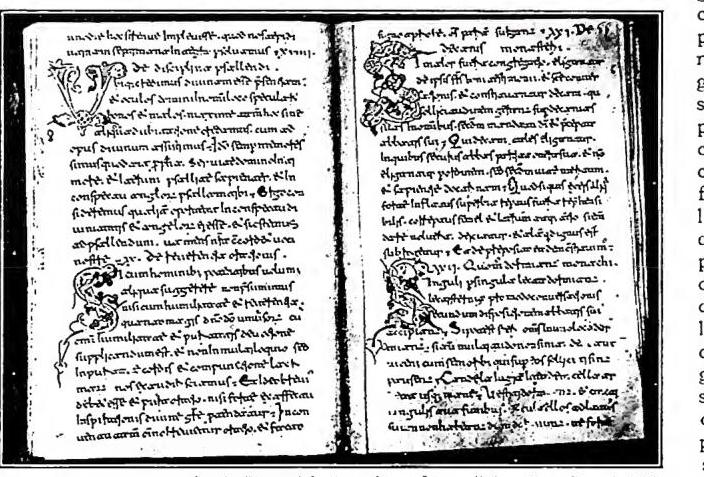
by A. Saco, Atlante palisegrafico e diplomatico, Napoli 1929
BENEDETTO, santo - Regola di s. B. (sec. XII).
Benevento, cod. della biblioteca Capitolare.
(abbas = father), not of a feared authority; and his office, more than the rigid guardianship of discipline and maintenance of order, is the care of souls. Chosen by the community and canonically installed, his office is in itself perpetual, like that of the pastors of the Church and of natural fathers, without other limits than those imposed by the law of God, the dispositions of the Church, and the Rule itself.
If paternal authority gives substance and character to this family, recollection and separation from the world ensure the necessary environmental conditions for devoting oneself without hindrance to the search for God. Every soul, for its part, must indeed strive toward this, tending, in imitation of Christ, toward a complete adherence of its own will to that of the Lord through obedience; toward knowledge of itself through the practice of humility; toward a total renunciation of its own self and of every private material possession through chastity and the most complete personal poverty, by which it must expect what is necessary from the providence of the father of the household; and also through the practice of fraternal love, which will be the life-giving element of this environment, from which every form of selfishness is fundamentally banished. In a word, the disciple must remain continually disposed to live in the presence of God, in a perfect denial of self.
This life of union with God finds expression in prayer, especially in that which constitutes the monk’s principal occupation, though not his end: the work of God, that is, liturgical and communal prayer, the expression of perfect community of life. Here too s. B. allowed himself to be guided by discretion and notably reduced it in comparison with the ancient monks. It would divide the monk’s day together with work, another essential element, which the legislator ennobled and extended, so that ora et labora would thereafter, throughout the centuries, be the concise motto of his Rule. And although work would assume the most varied forms according to times and places, it would always be such as to safeguard the Saint’s sole concern, that of leading souls to God. With this exclusive end in view, the house, as a vera domus Dei, would be «wisely administered», so that «no one there might be saddened or disturbed». It would therefore be necessary for the abbot, since he could not do everything himself, to entrust to others «part of his burdens». If the number of monks were large, they would be divided into groups of ten entrusted to the immediate care of decani; one of them, under the name of preposito, could, if it were truly deemed necessary, directly assist the abbot and act in his place. The Rule also enumerates other offices, whose officials at present also discharge the duties of the ancient deans: the cellarer, who will care for all temporal goods «as a father for the whole community»; the master of novices, «a senior full of solicitude» in examining the dispositions of the candidates; the guest master, «whose soul will be full of the fear of God»; the infirmarian, likewise endowed with fear of God; and the porter, «a wise old man whom age prevents from wandering about».
All these offices are to be exercised according to the directives given by the abbot, who may remove any one of them from office whenever he deems it appropriate. In addition to these assistants, the abbot has two categories of advisers. Although it is his responsibility to regulate and arrange everything in his monastery, s. B. nevertheless wishes everything to be done with counsel, so as not to give rise to useless regrets. Therefore, in ordinary cases the abbot will ask the opinion of the senior brothers, who constitute almost the senate of the monastery. But in more serious matters everyone, as is natural in a family, will be summoned to counsel. Thus the abbot’s discretionary and paternal power is supernaturally tempered, and the form of cenobitic government, fundamentally familial, appears as a felicitous balance among the monarchical, oligarchic, and democratic forms.
From this society no age, condition, or race is excluded: the Goth and the Roman, the nobleman and the slave, the old man and the child, all can find a place in it, since “in Christ we are all one thing.” The profession, made publicly in the oratory with the explicit promise of stability, obedience, and conversion of conduct, or conversatio (the other vows are included in these), is to be preceded by a year of novitiate, in a separate room, and the Rule is to be read there three times in its entirety. Children (oblates) are offered by their parents. Among characters and persons so diverse, discipline is guaranteed more by love than by servile fear. The same penitential code that s. B. had to adopt for the good of the community, to protect and preserve its charity, is incomparably milder than the other monastic rules of the time.
What medieval painting places in the Saint’s hand does not appear to be, as some modern authors nevertheless maintain, a rod, but an instrument for indicating the signals of the hours. This delicate task, which in those days was also not easy, is reserved by the Rule to the abbot. Everything must be done at the appointed hours, according to a timetable fundamentally modeled on the division of the Roman day and, like it, variable, so that every action may take place in daylight. On average, more than eight hours are allotted to sleep, including the afternoon sleep in summer, but the Rule makes no provision for interrupting the night’s sleep through the recitation of the Office. The remaining time is divided among prayer, reading, and work. Among the exercises of communal life, meals occupy an important place; unlike the particularism of other rules, s. B. wishes everyone to take part in them together: silence is to be maintained, with attention given to the reading conducted aloud. The brothers capable of performing this office will take turns weekly, as they do in serving at table and in the kitchen. Meals too are regulated by that spirit of discretion which becomes all things to all people, in order to win all for God. It is this common principle of love, in its twofold form toward God and toward one’s neighbor, that fuses the two aspects of the monastic community—the school, that is, of divine service, and the family—into a single society whose true center is Christ.
The spread of these societies, that is, the propagation of the Benedictine Rule, was enormous (v. BENEDETTINI). This small code, which in the centuries of printing received so many editions that it could be surpassed only by those of Sacred Scripture and of the Imitation of Christ, soon became the “Regula sancta,” the “Regula patrum,” the Rule par excellence, on whose model and according to whose directives all religious life in the West subsequently proceeded. Its influence was so great in every field and under all
Among the Italian translations: [G. Fornari], La Regola dei monaci, Montecassino 1921; P. Lugano, Roma 1929; S. Vismara, S. B. nella sua vita e nella sua Regola, Milano 1929; ancient vernacular versions have been published, among others, by G. De Luca, S. B., vita e Regola, Firenze 1923. An extensive bibliography is also provided by R. Bourreiss, Bibliographie der Benediktinerregel, in Studien und Mitt. zur Geschichte des Benediktiner-Ordens, Reigerri bei Brünn 1940, pp. 3-20.
Among the commentaries on the Rule, extremely numerous from the eighth century to the present day, we cite only: P. Delatte, Commentaire sur la Règle de St Benoît, Paris 1913, with continuous reprintings:
I. Schuster, La Regula monasteriorum, 2ª ed., Alba 1945, and the recent work by G. Herwegen, Sion und Geist der Benediktinerregel, Einsiedeln 1944, rich in erudition but with views that are too markedly personal. For the style of the Rule, besides Linderbauer, S. Benedicti Regula mon. philologisch erklärt, Metten 1922, it is indispensable to bear in mind A. Lentini, Il ritmo prosoico nella Regola di s. B., in Miscellanea cassini, 23 (1942); id., S. B., la Regola, testo versione e commento, Montecassino 1947, constitutes an excellent handbook for the various needs of readers.
For a concise exposition of the principles of the Rule: M. Wolter, Praecipna ordinis monastici elementa, Bruges 1880, Italian translation and abridgment by T. Leccisotti, Montecassino 1937; C. Butler, Benedictine monachium, 2ª ed., London 1924 (French translation by C. Grolleau, Paris 1924); C. Marmion, Il Cristo ideale del monaco, Italian translation by M. Galli, Praglia 1931; G. Morin, L'ordine monastico e la vita della società cristiana nei primi secoli, Italian translation, Sorrento [1934]; D. Gorge, A l'école de St Benoît. La vie intérieure pour notre temps, Paris 1937; Anon., Un giorno nella casa di s. B., 2ª ed., Montecassino 1938; A. Stolz, L'ascesi cristiana, Brescia 1943, which places the Rule within the general asceticism of Christianity.
2) S. Gregorio Magno, Dialogorum liber II. It is entirely devoted to s. B.; essentially a work of edification, it is nevertheless substantially reliable, even in the judgment of modern critics. The most noteworthy edition of our times is that of U. Moricca, in Fonti per la storia d'Italia (ed. Istituto Storico Ital., LVII), Roma 1924. Many other editions exist, including editions of Book II alone. Italian translations, besides those already cited under the names of De Luca, Lugano, and Vismara: A. Fiorini, Vita e miracoli di s. B., 2ª ed., Montecassino 1924; V. ARTOTIRITI, Fioretti degli antichi padri, Milano 1925 (all the dialogues).
3) Another source, independent of the Gregorian collection, is the Carmen de s. Benedicto by the poet Marco, who is said to have been a disciple of the Saint. Some modern scholars, however, would regard it as a later composition, perhaps from the eighth century. But the traditional thesis still has authoritative supporters; among them M. Galdi, Il Carmen di Marco poeta e l'apoteosi di s. B., Napoli 1929, with the text and Italian translation in verse. Another edition: PL 80, 183-84.
II. - For a first introduction to s. B. and his work
we recommend: C. Butler, op. cit.; S. Vismara, op. cit.; Ph. Schmitz Histoire de l'ordre de St Benoît, I, Maredsous 1942. Among the biographies: L. Tosti, S. B., Montecassino 1892, which, although critically outdated, always retains its character as a noteworthy work of art; J. Herwegen, S. B., Italian translation from the 3rd German edition, Montecassino 1932, which is the most interesting modern study of the Saint’s figure and character; L. Salvatorelli, S. B. e l’Italia del suo tempo, Bari 1929, which, despite the author’s rationalistic tendencies, is among the most noteworthy historical reconstructions; J. Chapmann, St. Benedict and the sixth Century, London 1929, a valuable work, but with personal views that are not always acceptable; I. Schuster, La storia di s. B. e dei suoi tempi, 2ª ed., Milano 1943, which, almost in the form of a commentary on the Gregorian account, masterfully sets it within the period in which the Saint lived: this reworking, more than a new edition, of the work
in the sumptuousness of its presentation and the abundance of its photographic illustrations constitutes almost a monumental corpus for the history of s. B.
III. – Regarding the medal, the most recent and comprehensive study is that of B. Danzer, Die Benediktus-Medaille, Ihre Geschichte, Gebrauch und Wirkungen, St. Ottilien 1928; V. also G. Fournier, Sur les origines de la médaille de St Benoît, in Revue liturgique et monastique, 16 (1930–1931), various articles for a study left unfinished owing to the author’s death.