Machine translation of the 1948–1954 Italian original. The original text is authoritative.
SUBIACO. – A town in the province of Rome and an abbey nullus immediately subject to the Holy See. S. is situated 408 m above sea level in the valley of the Aniene, at the confluence with the Fosso dell’Acquaviva. The abbey nullus covers an area of 300 sq km, with a population of 36,672 inhabitants, all Catholics, distributed among 25 parishes served by 44 diocesan priests and
40 religious priests; it has a seminary, 5 male and 11 female religious communities (Ann. Pont. 1953, p. 675).
The name S. derives from Sublaqueum (beneath the lake). Nero dammed the course of the Aniene, forming three artificial lakes called «Simbruna stagna», shortly afterward reduced to two, and built a villa there in which he risked being struck by lightning during a banquet (Tacitus, Annales, XIV, 22). The first settlement is attributed to the Neronian period and is thought to have been made up of the slaves employed in the imperial constructions. S. is the cradle of the Benedictine Order. S. Benedetto (v.), coming from Affile, took refuge there, assuming the monastic habit, and lived in solitude for three years in the Speco; then, after spending some time at Vicovaro, he returned to S. and, as numerous disciples came to him, including members of the highest Roman nobility, settled on the right bank of the first Neronian lake, in a building belonging to the imperial villa. This was the monastery of S. Clemente, later called that of SS. Cosma e Damiano; under this title it is mentioned in the ninth century by the Lib. Pont. (II, pp. 122 and 137, n. 42). It survived until the thirteenth century, when it was destroyed by an earthquake. The place was subsequently called «vinea columbaria».
For his ever-increasing number of disciples, s. Benedetto gradually founded other small monasteries in addition to the monastery of S. Clemente, where he resided. Of these, the only survivor is present-day S. Scolastica; since in the Lib. Pont. (II, pp. 117 and 136, n. 33) this monastery is called that of S. Silvestro, S. Benedetto e S. Scolastica, it must be presumed that its original name was S. Silvestro (cf. R. Morghen, I primi monasteri sublacensi, V. BIBLICA.). The probable names of the other eleven monasteries are: S. Angelo oltre il lago, S. Maria di Morrabotte (S. Lorenzo), S. Girolamo, S. Giovanni Battista (S. Giovanni «ab aquis», on the mountain: Benedictine nuns); S. Clemente al di qua del lago (formerly «Columbaria»), S. Biagio (S. Romano), S. Michele arcangelo sotto il S. Speco, S. Vittorino, at the foot of Mount Porcaro, S. Andrea or S. Donato, Vita Eterna, S. Salvatore di Comunacqua. S. Benedetto left S. in 529 to go to Cassino.
Almost nothing is known of the first two centuries after s. Benedetto. A tradition no earlier than the end of the sixteenth century (Capiscacchi and Mirzio) says that the monasteries of Subiaco were destroyed by the Lombards under Agilulf in 601 and that the monks found refuge for more than a century in Rome, in the monastery of S. Erasmo al Celio. But the double Lombard invasion of the Roman Duchy under Agilulf took place in 591–93 (not in 601), and the monasteries of Subiaco were not destroyed, since s. Gregorio Magno, writing his dialogues between the end of 593 and 594, says that Onorato was still presiding over the monastery at Subiaco (Dial., II, proemium); moreover, neither Gregorio M. himself in other writings, nor the Regesto Sublacense, nor any other source ever mentions destruction by the Lombards. On the other hand, the monastery of S. Erasmo was founded by Greek monks and inhabited by them in the seventh–ninth centuries (cf. F. Camobreco, Il monastero di S. Erasmo sul Celio, in Arch. Soc. R. St. P., 1905, pp. 278–80). It is certain, however, that in the ninth century the monasteries were damaged repeatedly by the Saracens. The monastery of S. Scolastica and the ancient S. Clemente (SS. Cosma e Damiano) were restored and endowed by Gregorio IV (827–44) and Leone IV (847–55), who dedicated two altars in the S. Speco, one in honor of ss. Benedetto e Scolastica, the other in honor of s. Silvestro (P. Egidi and the others, I monasteri di S., cited in the bibliography, I, p. 57), and offered vestments to the churches of the two aforementioned monasteries (Lib. Pont., II, pp. 117, 122, 137, n. 42). The abbey at Subiaco received gifts from Giovanni X (18 Jan. 926), Leone VII (936–39), through the intervention of the Roman prince Alberico II, Giovanni XII (958), Benedetto VII (979), Gregorio V (997), Giovanni XVIII (1005), Benedetto VIII (1015), and Leone IX (1051), who declared: « Hoc monasterium caput est omnium monasteriorum per Italiam constitutorum ». Pasquale II, on 29 Aug. 1109, dedicated in the S. Speco the altar in honor of s. Benedetto and s. Mauro. The abbey flourished especially from the middle of the eleventh century to that of the following century. Great abbots were Umberto (1051–65) and, above all, Giovanni V (1065–1117). In the thirteenth century, the abbots Romano (1193–1216), Lando (1227–43), and Enrico (1245–1273) built a large part of the buildings still existing at the S. Speco and at S. Scolastica. The abbey received protection and assistance from the popes Innocenzo III, Gregorio IX, and Alessandro IV, who had been born at Jenne, a village belonging to the abbey. Clemente III (1187–91) placed the monastery under apostolic protection; it received privileges in 1252 from Innocenzo IV. Callisto III, in 1455, granted the abbey in commendam; the first commendatory abbot was Cardinal J. Torquemada, followed, after Paolo II, who retained the abbey for himself, by Cardinal Rodrigo Borgia, later Alessandro VI, who rebuilt the « Castrum Sublacense » and erected the residence of the commendatory cardinal. With the apostolic letter Sacrosanctae militantis Ecclesiae of 15 Nov. 1638, Urbano VIII established the boundaries of the territory and granted the abbot or commendatory abbot quasi-episcopal ecclesiastical jurisdiction; with the constitution of 7 Nov. 1753, Benedetto XIV removed temporal jurisdiction, leaving ecclesiastical and spiritual jurisdiction unchanged. Pio VI was commendatory abbot; the abbey was suppressed by the French government but restored by Pio VII. In 1873 the Italian government declared S. Scolastica a national monument, and from 1897 twelve monks were recognized as canons. With the apostolic constitution Coenobium Sublacense of 21 March 1915, Benedetto XV restored the abbey to its original
(photo: Superintendency of Monuments of Lazio)
SUBIACO - Detail of the frescoes in the transept (15th century), discovered in the attic of the medieval church - Subiaco, monastery of S. Scolastica.
abbey, with the same regimes, privileges, honors, and faculties as the nullius abbey of Montecassino, with quasi-episcopal jurisdiction and the temporal rights of the abbatial mensa; he established that the secular Chapter of the cathedral church of S. Andrea and the Seminary of the secular clergy should be dependent upon the ordinary abbot of S. Scolastica; furthermore, that the abbatial church of S. Scolastica, with its regular Chapter, should have the title, privileges, and honors of a cathedral « cum iure potioritatis super ecclesia et canonicis s. Andreae », the latter being a co-cathedral (AAS, 7 [1915], pp. 197–200). The monastery of S. Scolastica is situated
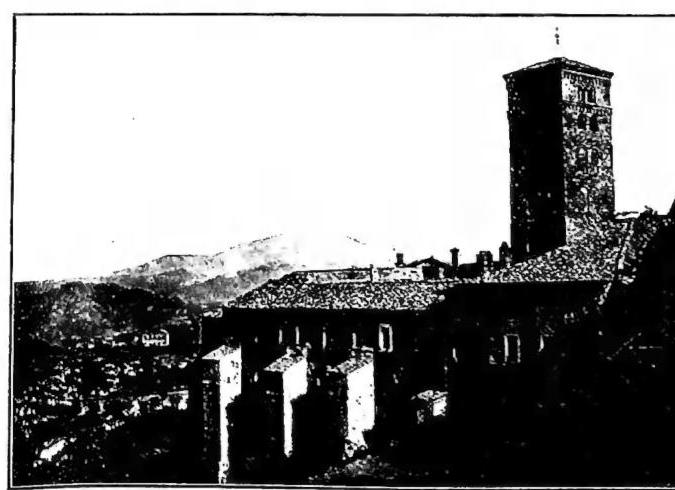
(phot. Anderson) SUBIACO - The monastery of S. Scolastica and the surrounding landscape - S.on the slope in a ravine. The first cloister dates from 1580; it was bombed in 1944 and has now been rebuilt. The second cloister dates from the 13th century; an inscription was later carved into a rough bas-relief commemorating the consecration of the church (981); another stone records the abbey’s possessions in 1052. The third is a Cosmatesque cloister with a rectangular plan: the inscriptions attest that three sides are the work of Cosma and his sons Luca and Jacopo (1227–43), while the southern side was executed by Jacopo, Cosma’s father. The abbey church was consecrated by Benedict VII in 981; it was rebuilt in the Cistercian style in the 13th century and then transformed by G. Quarenghi in 1769. The Romanesque bell tower was erected in 1052 by Abbot Umberto on the foundations of a massive Roman tower (Neronian?). In the underground rooms is the Chapel of the Angels, with frescoes from 1426, redone in 1855. The oldest part of the monastery dates from the 13th century. Its Library and Archive are of great value; they contain a Rule of s. Benedetto from the 10th century; an 11th-century psalter; Alcuin’s Treatise on the Trinity (10th–12th centuries), the 11th-century register, papal bulls, and imperial and royal diplomas.
At an elevation of 640 m stands the monastery of S. Benedetto or S. Speco, with two superimposed churches situated above a series of nine arches. The first corridor is partly excavated in the rock; frescoed there are ss. Gregorio I, Agatone I, Leone IV, and s. Benedetto; on the door one reads: « Sit pax intranti sit gratia digna praecanti »; and the signature of Lorenzo with his son Jacopo. In the second corridor are frescoes of the Crucifixion and saints, from the 14th century, as well as Christ with the four Evangelists and the Madonna with Child, from the school of Perugino. A third corridor leads to the upper church, composed of several rooms. The first has a cross vault and scenes of the Passion and Resurrection, Ascension, and Pentecost, from the Sienese school of the 14th century; it contains a pulpit from the first half of the 13th century. The second room is decorated with frescoes of the life of s. Benedetto; in the third room are two chapels with a fresco depicting the meal of s. Benedetto and s. Scolastica. A staircase leads to the lower church. Above a fresco by maestro Consolus from the second half of the 13th century is painted the scene of Innocenzo III (v.) handing s. Benedetto a bull; other frescoes by the same painter depict episodes from the life of s. Benedetto. The grotto of S. Benedetto has been converted into a chapel; s. Benedetto is represented there praying above a boulder (sculpture by A. Raggi). Beside it, a small staircase leads to the Chapel of S. Gregorio, where there is a fresco depicting s. Francesco (with the inscription « Frater Franciscus »), who visited the site ca. 1223. Also depicted there are s. Gregorio, Job, Christ among the princes of the Apostles, s. Onofrio, and Ugolino, bishop of Ostia (later Gregorio IX), consecrating the chapel. On another staircase, called the holy staircase, painters of the Sienese school at the end of the 14th century depicted on the walls the triumph and contemplation of death, and in the adjoining chapel episodes from the life of the Madonna. A fragment of a fresco from ca. the 9th century is found in the lower grotto called that of the shepherds. In the little garden, a clump of roses is said to have grown in place of the brambles into which, according to s. Gregorio (Dial., II, 2), s. Benedetto threw himself as a penance. S. Speco is a sanctuary unique of its kind, and Petrarch called it « Paradisi limen » (De vita solitaria, II, 3, 9). The church of S. Francesco, beyond the medieval bridge of the same name, was built in 1327 over the original oratory of S. Pietro nel deserto. It has a single nave, with a carved wooden ceiling executed in 1736. On the high altar is a triptych by Antoniazzo Romano dated 2 March 1467, representing the Madonna with Child between s. Francesco and s. Antonio di Padova; above it is a later second triptych with the S.ma Trinità; in the predella are the ss. Pietro, Paolo, Bonaventura and Luca d’Angelo, s. Francesco receiving the stigmata, the Nativity of the Madonna, and the miracle of the mule kneeling before the S.mo. The wooden choir, with carving and inlay, bears the signature of a Rheatinus and the date 1504. Frescoes attributed to Sodoma are in the third chapel on the left. The churches of S. Pietro and S. Giovanni also have Romanesque bell towers. The co-cathedral of S. Andrea has a Latin-cross plan with three naves and a Neoclassical façade from 1795.
BIBL.: M. Cherubino, Cronaca Sublacense, there 1885; L. Alledi, Invent. dei manoscr. della bibl. di S., Forlì 1891; id., Della proto-badia sublacense. Criterii sulle sue origini, in Riv. stor. bened., 8 (1913), pp. 89-102; id. - G. Levi, Il Regesto sublacense del sec. XI, Roma 1885; B. Albers, Une nouv. éd. des « Consuetudines Sublacenses », in Rev. bénéd., 19 (1902), pp. 183-204; id. Consuetudine Sublacenses, in Consuet. monasticae, II, Montecassino 1905, pp. 119-26; P. Egidi - G. Giovannoni - P. Hermanin - V. FEDERICI, GIACOMO, I monasteri di S., 2 vols., Roma 1904; P. Fr. Kehr, Italia Pont., II, Berlino 1907, pp. 83-98; B. Trifone, Docum. sublacensi, in Arch. Soc. rom. di st. patria, 31 (1908), pp. 101-20; id., Chron. Sublacense (593-1360), in RIS. XXIV, vi, Bologna 1927; E. Canisi, Cenni stor. sui monast. sublacensi, in Paleographia lat., 3 (1924), pp. 60-62; P. Pistone, Guida stor. artist. dei monast. sublacensi, Subiaco 1925; R. Morghen, I primi monast. sublacensi, in Bull. dell'Ist. stor. ital., 44 (1926), pp. 259-68; id., Gli Annalesi Sublacenses e le note obituarie e stor. dei codici F. 25 di Perugia e Chigiano CVII, 177, ibid., 47 (1929), pp. 1-16; id., Le relax. del monast. sublacense col Papato, la feudalità e il comune nell'alto medioevo, in Arch. Soc. rom. di st. patria, 51 (1928), pp. 181-262; P. Lugano, L'Italia bened., Roma 1929, pp. 87-151; id., Statuti della provincia romana, pubbl. dell'Istituto stor. ital., there 1929; G. Drinkwater, History of the Monastery; id., Subiaco 1500, Chicago 1932; D. Federici, Primordi benedettini e origini comunali in S., Subiaco 1938.
PRINTING. – In the small locality of S., the first Italian printing press was established, and the first printed books to appear in Italy were produced there. Its founders were two Rhenish printers from the dioceses of Mainz and Cologne: Corrado Sweinheim (Sweynheim) and Arnoldo Pannartz, probably refugees from the Sack of Mainz in 1462, who came to Italy at the invitation of Benedictine monks, their compatriots residing in the monastery of S., as tradition has II.
Once there, the two partners spent a considerable time equipping the workshop and casting those elegant and original semi-Gothic types, which were never used again. Four books, according to direct and indirect evidence, were certainly printed in the monastery of S., namely: 1) Donatus pro puerulis, the first printed book to appear in Italy, « unde imprimendi initium sumpismus », as the printers themselves stated (it is the Ars minor of Aelius Donatus, very widely used in medieval schools); it was printed in 300 copies, presumably in 1464; no copy or fragment has survived; 2) Cicero, De oratore, without place, printer, or date, but printed before 1 October 1465 in 275 copies, as confirmed by a handwritten note bearing that date in a copy of the work held by the Kunstgewerbemuseum in Leipzig; 3) Lactantius, De divinis institutionibus, printed on 29 October 1465 « in venerabili monasterio Sublacensi », in 275 copies; the only book bearing an indication of place, and the first dated book to appear in Italy; 4) Augustinus, De civitate Dei, printed on 12 June 1467 in 275 copies. All are first editions. The surviving copies of the Sublacense editions currently held in Italy number 34, namely: 5 of De oratore, 16 of Lactantius, and 15 of St Augustine.
At a date no later than September 1467, the two partners published in Rome Cicero’s Epistolae ad familiares, beginning their Roman activity with this book. - Vedi tav. CIV.
BIBL.: C. Fumagalli, Dei primi libri a stampa in Italia, Lugano 1875; P. Egidi, Le stampe sublacensi, in I monasteri di S., I, Rome 1904, p. 245 agg.; K. Haeber, Die Drahtchen Buchdrucker des XV. Jahrb. im Auslande, Munich 1924; L. De Gregori, La stampa nel sec. XV, Rome 1933, pp. 5-7 and 33-34; R. Brun, Rome su S.?, in Les Terrors des biblioth. de France, 6 (1938), pp. 70-80; G. Bach, Die Drahtchen in S., in F.I.D., Communications, 9 (1942), n. 2, pp. 22-25; L. De Gregori, I tipi sublacensi, in Studi e ricerche di st. della stampa del Quattrocento, Milan 1942, pp. 47-61; C. Scaccia Scarfoni, Esemplari ancora superstiti in II. delle più antiche ed. di Sweinheim e Pannartz, ibid., pp. 227-241; G. Avanzi, Il primo libro stampato in It., in L'II. de serice, 29 (1946), pp. 113-14; E. von Rath - R. Juchhoff, Buchdruck und Buchillustrat. bei zum Jahre 1500, in Hondo, der Bibliothekswissenschaft, I, nuova ed., Stuttgart 1950, § 132 Italien, S., pp. 432-53.
Cite this article
“SUBIACO.” Enciclopedia Cattolica, vol. XI (1953), p. 892. Azione Romana digital edition, https://azioneromana.com/article/subiaco.