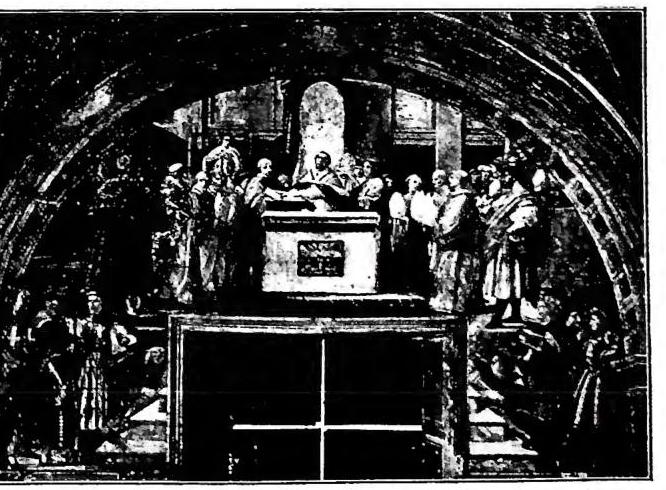
LEONE IV, POPE, saint. - He was ordained priest by Sergio II, who also raised him to the cardinalate, with the title of SS. Quattro Coronati; he was elected pope on 27 Jan. 846 and consecrated at Easter (10 Apr.), without the ratification of Emperor Lotario, for which the gravity of the Roman situation was offered as an excuse, also because of the very recent Saracen raids (846). To avert these, L., resuming an old project, caused the restoration of the walls around the Vatican as far as Castel S. Angelo to be begun (848), creating what was called after him the Leonine City, solemnly inaugurated on 27 June 852. Following the victory over the Saracens (won in 849, near Ostia, by the ships of Napoli, Amalfi, and Gaeta, which L. had blessed, thus setting out on the path that would lead to holy war), the Pontiff was able to have a new port (Leopolis) built to replace Centumcellae, destroyed by the infidels.
L.’s relations with the emperors cannot have been very good, since he disliked imperial interference in the Holy See: indeed, after having consecrated Ludovico II (Apr. 850), he obtained from the Carolingians the restoration of the canonical provisions concerning papal election. Other and more serious frictions are revealed by the sudden arrival in Rome of Ludovico II (855), who came in order to prevent the party hostile to the pre-eminence