
OSTIA. — City and suburbicarian see in the province of Rome. By decree of the S. Congr. Concistorial of 22 May 1948, the area of the diocese is limited to the ancient city and the castle of O. (AAS, 40 [1948], pp. 341–42). It has a population of 3,700 inhabitants gathered in one parish; it has one male and one female religious community.
At the Roman Council of 313 the bishop Maximus took part (PL 8, 747); in the time of Pope Gelasius there was the bishop Bellator (494–95). Pope Eugene III united the see of O. with that of Velletri in 1150, and it remained so until 5 May 1914, when b. Pius X, by motu proprio, separated it again and assigned it to the dean cardinal (AAS, 6 [1914], pp. 219–20). Napoleon I had sought to suppress the diocese by a decree of 5 Aug. 1810. The following bishops of O. became popes: Oddone di Lagery, later b. Urban II (1088–99); Lamberto di Fiagnano, later Honorius II (1124–30); Ubaldo Allucingoli, later Lucius III (1181–85); Ugolino dei conti di Segni, later Gregory IX (1227–41); Rinaldo dei conti di Segni, later Alexander IV (1254–61); Pietro di Tarantasia, later b. Innocent V (1276); Niccolò Boccasini, later b. Benedict XI (1303–1304); Stefano Aubert, later Innocent VI (1352–62); Giuliano della Rovere, later Julius II (1503–13); Alessandro Farnese, later Paul III (1534–49); Gian Pietro Carafa, later Paul IV (1560–65).
In O. the Hieronymian Martyrology lists on 20 LAUREA (v.), whose Passio has no value (BHL, 810); on 16 July Ilarnio, unknown; on 23 Aug. Cyriacus and Archelaus; on 19 Oct. s. Asterius, mentioned in an inscription in the Lateran Museum (O. Marucchi, I monumenti del museo Pio Lateranense, Milano 1910, pp. 11, 28; the basilica of Asterius is mentioned in the Libellus precum [O. Guenther, Epistolae imperatorum et pontificum, etc. in CSEL, XXXV, II, p. 29], was restored in 687 by Sergius II [Lib. Pont., I, pp. 376, 380] and later by Leo III [ibid., II, p. 14]). On 22 Nov. and 22 Dec. Felice, Demetrio, and Onorato are commemorated. According to the statement inserted in the biography of Pope Mark in the Lib. Pont. (I, pp. 80–81; 202), the bishop of O. was entitled to use the pope (v.). The anointing with oil in the consecrations of emperors was likewise performed by the bishop of O. The Cathedral was originally the church dedicated to the apostles Peter, Paul, and John, attributed to Constantine in the Lib. Pont. (I, p. 183); later it was the church of S. Aurea, which was already in poor condition and without a roof in the time of Sergius I (687–701), who restored it (ibid., I, pp. 376, 380); Leo III (795–816) also rebuilt the roofs (ibid., II, p. 14); the building is also mentioned in the biography of Leo IV (847–55; ibid., p. 118). O. was devastated in 408 by Alaric and in 536 by Vitiges; Gregory IV surrounded it with walls (Gregoriopolis) around the year 830 (ibid., II, p. 164). The abandonment of O. was due to the loss of maritime and commercial traffic, which had supplied the city of Rome. The silting produced by the Tiber
amounts to approximately 4 m. per year; at present the shore is 6 km. from the Roman city. On 26 May 1159 the people of O., represented by a procurator, promised Pope Adrian IV to provide the Pontiff each year with two boatloads of wood, one for Christmas and the other for Easter, depositing them at the Marmorata or at Ripa.
Enrico Josi
ARCHEOLOGY. -
The first military
colony of Rome,
the Castrum (Livy, I,
33; VII, 25; CIL, I,
(fot. Fides)
OSTENSORIO – O., work by Nema Yaho, Ivory Coast (French Africa) – Rome, Exhibition of Missionary Art, 1950.
Cicerone, Rep., II, 5, 33; Servio, Aen., VI, 816; s. Giro-
lamo, Chron., p. 334). La possibilità d'una colonizzazione
preesistente al Castrum è ammessa da alcuni storici mo-
derni come il Carcopino, de Sanctis, Frank, ecc. La sua
posizione alla foce del Tevere, da cui trae il nome (Stra-
bone, III, 145; Livio XXII, 11), agevolò il rapido svi-
luppo commerciale della città distante dall'Urbe ca. 16
miglia. Tra il 100-106 d. C. Traiano con ardito progetto
creò il porto di O. (Plinio, Paneg., 29; Giovenale, 12, 75;
Notizie degli scavi, 1925, p. 54), già iniziato da Claudio
(Svetonio, Claud., 20; Cassio Dione, 60, 11; Plinio, Nat.
hist., XVI, 76; XXXVI, 14), accrescendo notevolmente
l'importanza della città, divenuta sede di vaste organiz-
azioni annonarie, corporative, amministrative e religiose.
Costantino le tolse i diritti municipali assegnandoli al suo
porto divenuto « Portus Romae » (v. Notizie degli scavi,
1925, p. 73; CIL, XIV, 612). L'invasione dei Vandali
nel 455 costituì per O. un colpo grave, segnando la sua
decadenza.
Gli scavi compiuti a intervalli dal Visconti, da D. Va-
glieri e dal prof. Guido Calza (1913-46) testimoniano il
crescente sviluppo della città nei suoi edifici pubblici,
abitazioni, templi, magazzini e nella rete stradale. La ric-
chissima collezione epigrafica raccolta nel XIV del CIL
e nel supplemento del Wickert (1930), con molte altre
iscrizioni pubbl. da G. Calza, in Notizie degli scavi e in
Epigraphica, e i fasti ostiensi pubbl. da A. Degrassi (Fasti
et elogia, Roma 1937), aggiunti a un vastissimo patri-
monio artistico pubbl. da G. Becatti, R. Calza, G. Ricci
e M. Squarciapino, in Bull. d'arte, Bull. comunale, Notizie
degli scavi, accrescono l'importanza di O. per lo studio
dell'antichità classica (G. Calza, in Pauly-Wissowa, XVIII,
II [1942], coll. 1654-64; R. Calza, Scavi di O., Topografia
generale, Roma 1952).
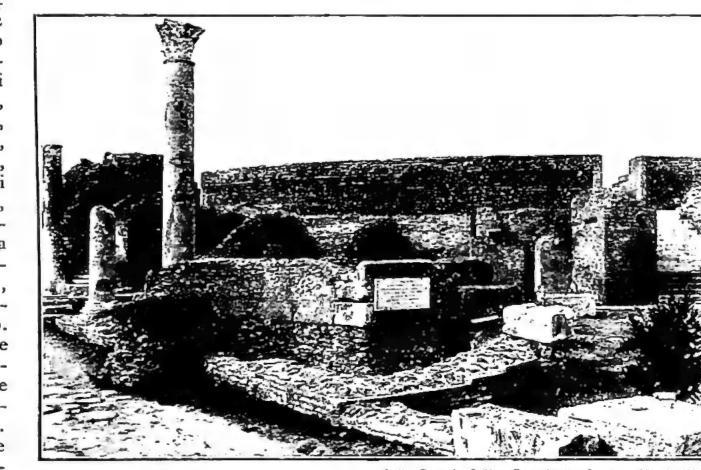
dei secc. v-vi, costruito « in loco martiri » presso il tea-
tro scoperto nel 1910 (D. Vaglieri, in Nuovo bull. d'arch.
crit., 16 [1910], p. 57 sgg.; J. Carcopino, in Journal des
savants, 9 [1911], p. 46; F. Fornari, in Mélanges d'arch.
et d'hist., 36 [1916-17], p. 37 sgg.). Nell'oratorio fu trovato
un sarcofago del sec. III, il cui coperchio porta l'epitafio
cristiano « Hic Quiriacus dormit in pace ». Un mano-
scritto del sec. XII, scoperto di recente dal p. A. Casa-
massa, attesta che il luogo era ancora noto.
Due altri ambienti di epoca tarda, anche essi sul
decumano massimo (prima di giungere al Foro), uno per
la costruzione a forma di croce greca e l'altro per il ritro-
vamento d'una colonnina con la figura del Buon Pastore
(G. Moretti, in Notizie degli scavi, 1920, p. 41; R. Calza,
Museo ostiense, Roma 1947, n. 151), dovevano essere adi-
biti al culto cristiano. Importante è la scoperta d'una
ampia basilica cristiana, con annesso battistero (G. Calza,
2, p. 257), fondata in-
torno al 335 a. C.
(J. Carcopino, Vergile
et les origines d'Ostie,
Parigi 1919). Le sue
mura in tufo, alte m.
5, 40 (G. Calza, in
Notizie degli scavi,
1914, p. 246; 1923,
p. 178 sgg.; T.
Frank, in Am. Journ.
of Arch., 1918,
p. 182) segnano un
rettangolo di m.
193 × 120 entro la
città imperiale. La
tradizione leggenda-
ria fa risalire la
fondazione di O. ad
Enea (Virgilio, Enei-
de, VIII) ed alcuni
storici antichi l'at-
tribuiscono ad An-
co Marzio (Dionigi
Una basilica di età costantiniana scoperta ad O., in Rend.
Accad. pont., 1940, p. 63 sgg.; ibid., 1941-42, p. 135 sgg.).
Che l'edificio fosse addetto al culto cristiano è confermato
dall'iscrizione sulla trabeazione dell'ingresso al battistero,
che dice: IN GEON FISON TIGRIS EUFRATA CRISTIA-
NORUM SUMITE FONTES. Il Calza, che l'attribui al sec. IV,
volle riconoscere in essa la basilica dei SS. Pietro, Paolo
e Giovanni, donata da Costantino alla città di O. (Lib.
Pont., I, p. 376). La datazione ha sollevato tuttavia molte
riserve e obiezioni e per il tipo dei capitelli non corri-
spondente all'epoca e per l'inorganicità e povertà della
costruzione, che non si addicono né all'epoca né a una do-
nazione imperiale (H. Fuhrmann, in Epigraphica, 3 [1941],
p. 103 sgg.; G. Becatti, Case ostiensi del tardo Impero,
Roma 1948, p. 201). Privi di fondamenti convincenti sono
le ipotesi di A. V. Gerkan (Die christl. Anlage in O., in
Röm. Quartalschrift, 47 [1939], p. 15-23) che vuol ve-
dervi una scuola di catecumeni, mentre Th. Klauser (Die
Inschrift der neugefund. altchristl. Bauanlage im O., ibid.,
p. 25-30) la considera come una biblioteca cristiana. Ri-
mane però un enigma a chi potrebbe essere dedicata la
Basilica, giacché fra le chiese note come esistenti ad O.
si deve escludere quella di S. Lorenzo (Acta SS. Iunii,
V, Parigi 1867, p. 38), che fu costruita « in porta quae
nunc usque Laurentia nuncupatur », e quella di Asterio
il quale insieme con i suoi compagni di fede fu marti-
rizzato « foras muros Ostiae civitatis ».
Sotto il lato ovest di S. Aurea, l'attuale basilica di O., è
stato portato alla luce tra l'altro anche un ambiente absidato
con sepolcri, con le caratteristiche di una costruzione cri-
stiana. Scoperta preziosa fu il ritrovamento di una colon-
nina spezzata alta cm. 70 con il nome frammentato di s.
Aurea S. ad con ductus del secc. v, ciò che conferma l'esi-
stenza della chiesa antica sotto quella attuale. Nel marzo del
1945, nel cortile attiguo, casualmente tornò in luce il ricor-
do di s. Monica, morta ad O. nel nov. del 387 (s. Agostino,
Confessioni, IX, 8-12); si trovò poco più di un terzo del-
l'iscrizione metrica già nel sepolcro di s. Monica composta
al principio del sec. v dal proconsole A. Auchenio Basso
e di cui il testo si è conservato attraverso ca. 12 codici
(A. Casamassa, in Rend. Acc. pont., 1945, p. 15 sgg.).
Di un altro edificio cristiano si è trovata di recente
un'ampia abside costruita nel frigidarium di un edificio
termale di età adrianea sulla Via della Foce (G. Calza,
Nuove testimonianze del cristianesimo ad O., in Rend.
Acc. pont., 1949-51, p. 12) e sovrastante un mitreo
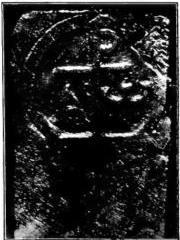
sotterraneo. Nell'ambiente si è trovato un inciso su
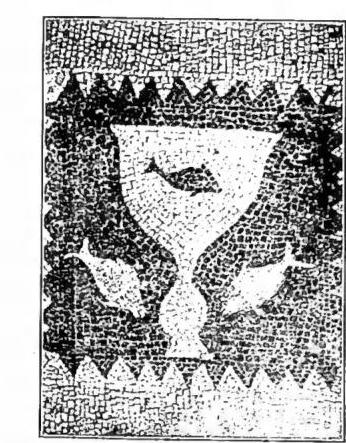
due pilastri. Una domus signorile nella zona del cardo
maximus sulla Via della Caupona ha l'ingresso setten-
trionale ornato d'un mussico rappresentante un calice con
un pesce: due altri affiorano alla base della coppa (G.
Calza, Nuove testi-
monianze, cit., p. 126
sgg., fig. 3); un
altro pesce, scolpito
entro una grande
vasca del cortile,
fece pensare che essa
fosse usata come
battistero (G. Be-
catti, Case ostiensi,
cit., p. 121). Intor-
no alla cappella di
S. Ercolano (attigua
all'attuale cimitero
di O.), suggestiva co-
struzione del sec. v-
vi, furono ritrova-
te ca. 100 iscri-
zioni cristiane, con-
validando l'ipotesi
che tale zona facesse
parte dell'antico nu-
cleo cimiteriale cri-
stiano ostiense (G. B.
De Rossi, in Bull.
d'arch. crist., 1866,
p. 49; L. Paschetto,
(fot. Scavi della Soprintendenza di Ostia)
OSTIA - Monogrammatic cross on a
small pillar of an oratory on the Via
della foce.
O., Roma 1912, p. 180). They bear the distinctive Ostian formula “dormit in pace” or “cum Deus voluerit, volet, permiserit”.
Other Christian monuments of O. are represented by several sculptures, fragments of sarcophagi, and minor objects, such as a sarcophagus (similar to the one found in the oratory near the theater) from the area of S. Ercolano, bearing a Christian epitaph (P. E. Visconti, Dichiaraz. di un sarcofago in O., in Atti Pontif. accad., 15 [1864], pp. 159–71), nos. 1875, 1937, 1975, 2009–10a of CIL, XIV, and nos.
might have been intended for liturgical use or for Christian agapes. A type of marble sign (R. Calza, Museo ostiense, cit., no. 130), found in 1939 in a kind of public hall surrounded by benches and pillars in the center, may also have had Christian content. In the foreground it depicts two notaries seated before large books, stylus in hand, and an orator who has mounted the podium; in the background, against the backdrop of a tent, is a group of listeners who, through various gestures, express their admiration for the orator’s words. It may have been a meeting place for theological discussions (H. Marrou, St Augustin et la fin du monde antique, Parigi 1939, p. 404, with the ancient texts on the subject) or a school for catechumens. Also deriving from the most recent excavations is a togate statue from the beginning of the 5th century, for which it has been hypothesized that it represents either C. Aurelio Simmaco, the celebrated prefect of the grain supply and an Ostian landowner (R. Calza, in Bull. Com., 1941, p. 113 ff.), or his bitter opponent in matters of faith, Ragonius Vicentius Celsus, a personage well known in O. and Porto (G. Becatti, op.cit., p. 216; R. Calza, Museo ostiense, cit., p. 13, no. 55).
O. is not lacking in objects of the minor arts, such as lamps bearing Christian symbols, for the most part of local manufacture, by a certain Annio Ser... (G. B. De Rossi, in Bull. arch. crist., 2nd series, 1 [1870], p. 80 ff.), frames for small lead mirrors, and bronze rings or glass objects bearing clear allusions to the symbols of the Christian faith. To the finds of a specifically Christian character must be added the very few Jewish ones. The latter include a large fragmentary inscription, found in 1905 near Castelporziano, attesting to the presence of a large Jewish community (gerusia) in the territory of O. (E. Ghislanzoni, in Notizie degli scavi, 1906, p. 115 ff.), and a tomb discovered in the cemetery of Porta Laurentina in 1936, which may have belonged to a Jew, judging from the name “M. Baenit,” analogous to that mentioned in the Corpus Inscrip. Jud., Città del Vaticano 1936, 671 (G. Calza, in Notizie degli Scavi, 1938, pp. 36, 48). - Vedi tav. XXX. Raissa Calza