
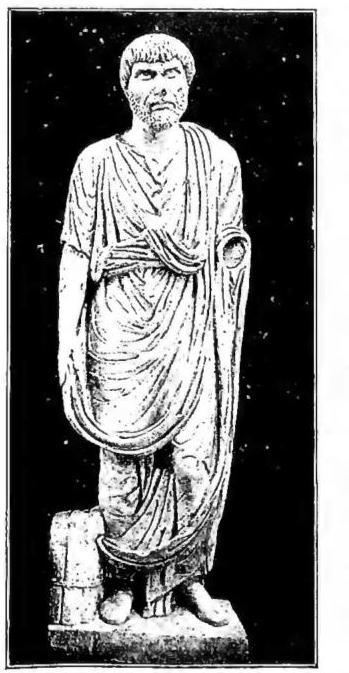
SIMMACO (Q. Aurelius Symmacus). — Rhetorician and politician, born in Rome in 345, died in 405, he was one of the most prominent figures of moribund Roman paganism. Prefect of Rome in 384 and consul in 391, the offices he held are listed in the inscription of CIL, VI, 1699. There remain of his works the Panegyrics addressed to Valentinian I and to his son Gratian, 10 books of Letters composed with literary intent but empty of content, and 49 Relationes addressed as praefectus urbi to the Emperor during the years 384–85.
The two great events of his time—the triumphant advance of Christianity and the barbarians looming over the Empire—seem not to have interested him, judging from his writings, as he was entirely
devoted to the glories and memories of his pagan Rome, dear to him as they were to the old aristocratic families whose prestige was bound up with those memories and glories.
Among his Relations, the third, which he wrote and delivered concerning the altar (not the statue) of Victory, deserves particular attention. The altar stood at the entrance to the curia, and every senator paid it an act of worship on entering; the statue of Victory, war booty taken from Tarentum, stood instead at the back of the hall on a pedestal brought to light by the excavations carried out during the restoration of the curia. Augustus himself had placed it there (29 B.C.). Gratian, the son of the tolerant Valentinian I, among his other anti-pagan measures, had ordered the removal of the altar, renewing a measure already taken by Constantius and annulled by Julian, who had had the altar restored to its place.
The Senate, composed mainly of pagans, sent S. to Milan in 382 to obtain the revocation of the order, but Gratian, forewarned through s. Ambrose by Pope Damasus, did not receive the envoy. After Gratian was assassinated (383), S. renewed the attempt with Valentinian II, who had succeeded his brother. He was received, and presented the cause of old pagan Rome with moving effectiveness, making the city itself speak. But the Emperor, persuaded by s. Ambrose, his adviser, who had meanwhile drafted a counter-response, denied permission to restore the altar (384); the statue remained in its place and was perhaps destroyed in Alaric’s fire (410).
S.’s failed mission gave the poet Prudentius the occasion to compose two poems against him (Contra Symmachium, I–II), in which, after describing the nature of the pagan divinities and worship (I), he has Rome deplore the ill-timed request of the senator, sent on the advice of the haruspices and not by his homeland, while the city asks: «ne quis Romuleas daemon iam noverit arces, sed soli paci Domino mea serviat aula» (II, 767–68).
N. Turchi, La religione di Roma antica, Bologna 1939, p. 306; A. Paredi, S. Ambrogio e la sua età, Milan 1941, chap. 11, pp. 279–302. Nicola Turchi
PAPA, saint. — He is commemorated in the Roman Martyrology on 19 July, introduced by Usuard, but there is no evidence that he was venerated in antiquity. A Sardinian by origin, he was the son of a certain Fortunatus; he went to Rome, where he was baptized and entered the clergy.
Upon the death of Anastasius II, he was elected pope by the majority of the clergy and consecrated in the Lateran Basilica (22 November 498), while a minority, supported by the Senate, elected the archpriest Lorenzo, who was consecrated in the basilica of S.
Mary Major. Disorders and riots then broke out, fomented by the senators Festus and Probinus, to such an extent that Theodoric decided to summon the two contenders to Ravenna. S. was readily recognized and returned to Rome, where in March 499 he held a Synod at which it was established that no one could legitimately concern himself with the election of the pontiff while he was still alive, nor could anyone form a party. Lorenzo also took part in the Synod and signed himself as archpriest of S. Prassede; shortly afterward, he was appointed bishop of Nocera. Meanwhile, S.’s enemies did not lay down their arms, and, unable any longer to challenge his election, resorted to accusations and calumnies. A libel was sent to Theodoric accusing the Pope of having squandered ecclesiastical property, of living disorderly, and of having violated the Nicene canon concerning the celebration of Easter. S. was summoned to Ravenna, but while he was at Rimini he learned the true aims of his accusers. He therefore secretly returned to Rome and shut himself up in S. Peter’s. Theodoric was displeased by this and sent an apostolic visitor to Rome, who celebrated the feast of Easter anew and took possession of all the churches and ecclesiastical property. The situation became increasingly tragic; in order to restore peace, a synod was summoned to judge the Pope’s conduct. It opened in May 501, and S. agreed to submit to its judgment, but requested that the apostolic visitor meanwhile be removed from Rome. The second session was to be held at S. Croce, but while the Pope was going there from S. Peter’s, he was attacked by a group of rioters, and some of the clergy in his retinue were killed and wounded. He then withdrew once more to S. Peter’s and refused to leave it despite the pressure brought to bear upon him. The Synod meanwhile held further meetings, and at the last (October 501) decreed that the Pope could not be judged by an earthly tribunal and that he therefore had to be regarded as the legitimate shepherd whom all were obliged to obey. The synodal decisions pleased neither Theodoric nor the Laurentian party, and the two leading senators, Festus and Probinus, exerted themselves so vigorously that they obtained Lorenzo’s return to Rome. For four years the city was the scene of riots, slaughter, and massacres. Meanwhile, neither party remained inactive: while the schismatic side published a libel against the decisions of the Synod of 501, the Symmachian side produced a series of writings known as the Symmachian Forgeries, intended to justify the Pontiff’s actions through historical precedents, though invented ones.
He himself then held a Synod in S. Peter’s in November 502, attended, together with the Roman priests, by many bishops of Italy. At it, the decree of 483 concerning the alienation of ecclesiastical property—which had been the means employed by his enemies in their struggle—was annulled, and Lorenzo and the apostolic visitor Pietro of Altino were condemned.
Finally, in 507, the Alexandrian deacon Dioscorus (v.) succeeded in persuading Theodoric to bring the schism to an end. The senator Festus was ordered to cease his opposition to S.; Lorenzo was compelled to surrender all the churches and property he had occupied and retired to a private villa, while S. was universally recognized as the sole and legitimate shepherd.
The final years of his pontificate passed peacefully, and he was able to devote himself to works of piety and moral and material restoration. He built several churches in Rome and embellished others: the oratory of SS. Cosmas and Damian near S. Maria Maggiore, the oratory of S. Andrew near S. Peter’s, SS. Silvester and Martin, S. Agatha, and S. Pancras on the Via Aurelia; he renovated S. Agnes, and especially S. Peter’s; he expelled the Manichaeans, whose writings he had burned in the public square; he assisted the bishops exiled or taken prisoner by the Vandals in Africa and Sardinia; he redeemed many prisoners in Liguria and Lombardy; and he established that the Gloria should be sung at Masses on Sundays and on the feasts of martyrs. He died on 19 July 514 and was buried in S. Peter’s.
Roma 1930, pp. 7-9, 29-37; Martyr. Romanum, p. 296; Fliche-Martin-Fruta, IV, pp. 336-47; O. Bertolini, Roma di fronte a Bisanzio ed ai Longobardi, Bologna 1941, pp. 48 sp. 69-76, 208 se.; A. Alessandrini, Teodorico e papa S. durante la scisma laurenziana, in Arch. Deput. rom. di stor. patria, 67 (1944), pp. 152-207. Agostino Amore