
PRUDENZIO. – Latin Christian poet (born in 348, died after 405). Of Saragossa and Calahorra, both of which claim to have given him birth, preference should be given to Calahorra, because Valerianus, whom P. greets as his guide (Peristeph. hymn., XI), was, according to the Albeldense and Emilianense codices, a bishop of Calahorra. P. speaks of his poetic work in a brief autobiography, as a purification and crowning of his life: he recalls his childhood, remembers his skill at lying, joined to other vices learned from the toga, deplores the faults of his youthful years, recalls offices held in the government of noble cities, his military ranks, and perhaps also that of comes primi ordinis, that is, count in the emperor’s retinue. Through his songs he intends to atone for his failings: Atqui fine sub ultimo - Peccatrix anima stultitiam exuat; – Saltem voce Deum concelebret si meritis nequit (Proem. 34-35); then he gives a general enumeration of his songs: Hymnis continuet dies - Nec nox ulla vacet, quin dominum canat (Cathemerinon) – Pugnet contra haereses (Apotheosis) – Catholicam discutiat fidem (Hamartigenia) – Conculcet sacra gentium (Psychomachia) – Labem, Roma, tuis inferat idolis (Contra
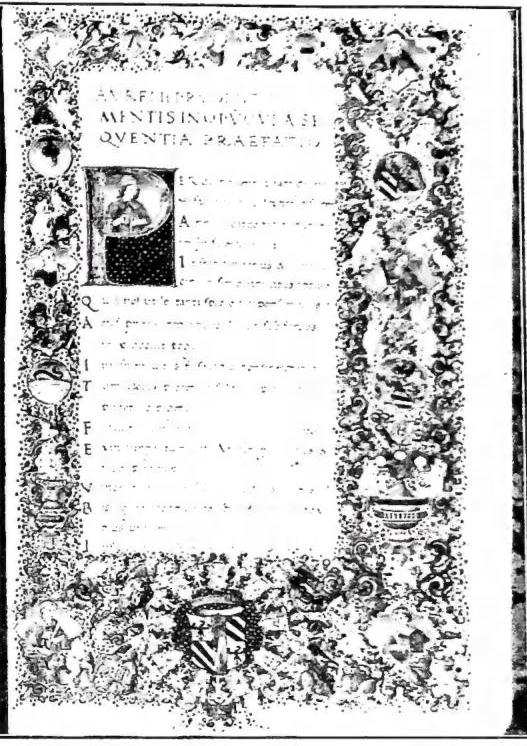
PRUDENZIO - Preface to the Carmina: PL 59, 767–70. Manuscript written by Antonio Sinibaldi of Florence, perhaps on behalf of Vespasiano Bisticci, completed on 20 November 1481 - Vatican Library, cod. Urb. lat. 666, f. 7.
Symmacum - Carmen martyribus devoceat, laudet apostolos (Peristephanon, Proem., 37–42).
P.’s work is lyrical and didactic.
The lyrical works are: 1) the Cathemerinon, or hymnal of the day, with 12 hymns that poetically and mystically render the various moments of the day, containing stanzas that have rightly become famous, such as those devoted to the Holy Innocents: «Salvete, flores martyrum» (vv. 125–32); 2) the Peristephanon, or poem of the crowns: 14 compositions in 3,500 lines, in various metres. It is P.’s most characteristic work, in which he is truly the singer of martyrdom. P. had no predecessors in this genre, and Damasus’s stereotyped Tituli cannot bear comparison with the pathos of his inspiration, although here and there P. develops and transforms passages from them. A poet rather than a critic, he often took the subject matter of his lyric poetry from legends already far removed from the objectivity of the primitive documents. Literary tact and good taste do not always accompany the author in this gallery of brilliant pictures, radiant with an exultant, impassioned lyricism and rich in metres and technical virtuosity.
The didactic works, on the other hand, are: 1) the Apotheosis, a defence of the Trinity and of the divinity of Christ against the heresies and opposing errors of the Patripassians, Sabellians, and Jews. It is the dogmatic formulation of tradition, especially that of Tertullian, whose concepts acquire fully achieved plasticity in 1,084 hexameters worthy of Lucretius. 2) The Hamartigenia, that is, the origin of sin, in 63 iambic trimeters and 966 hexameters on the particularly crucial problem of that time. Here too the doctrine is that of Tertullian’s Contra Marcionem; the form, moreover, is P.’s greatest merit, for he is a master at rendering the truths of the faith in vivid poetic form and at expressing in the soul their ardour and communicative power. The presentation of the demon as the sworn antagonist of human nature and the description of hell are of universally celebrated beauty. 3) The Psychomachia, or struggle for the soul, is the first allegorical poem
(courtesy of Fr. d. Wulz, O.P.)
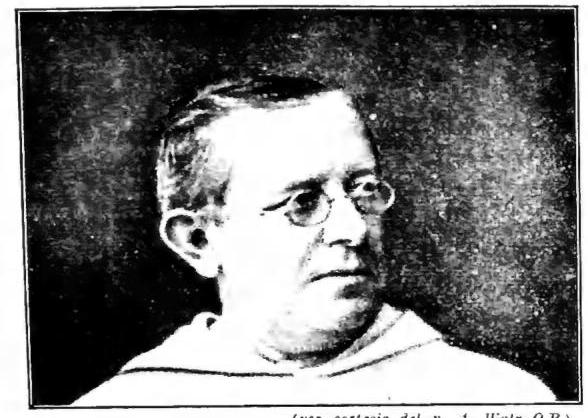
PRÜMMER, DOMINIKUS. – Portrait.
68 iambic trimeters, typologically describes the life of
Abraham, the struggle of Faith (Christ) against the kingdoms of
Sodom and Gomorrah (the vices), which tempt Lot (the human
soul). This is followed by the grandiose picture of the poem in 915
intensely dramatic hexameters: the struggle between Christian
virtue and the vices of paganism. Although antiquity does not
lack partial models of this kind of personification
of abstract entities, nevertheless the harmonious conception
of an allegorical epic with its scenographic setting,
animated by a poetic expression of Virgilian nobility,
is P.’s authentic glory. None of his works left
a deeper and more lasting mark. Medieval art
made use of this living allegorism: miniatures, codices,
and Romanesque capitals gave form to the fantastic world of the
Spanish poet.
A late echo of the struggle of S. Ambrogio against Sim-
machus (d. in 402), when this prefect of Rome requested
that the Altar of Victory be restored in the Senate, resounds
(384) in P.’s two books Contra Symmachum. The Ditto-
chaeum (double nourishment) is a series of 49 tetrastic epigrams
in hexameters, intended to illustrate an equal number of wall
paintings in some Christian basilica in Spain, representing
figures and scenes from the Old and New Testaments.
Within P.’s literary heritage lies the creation of
Christian lyric poetry and its artistic independence, extending
the narrow limits of liturgical metre and the almost
mathematical symmetry of S. Ambrogio and giving inspiration
new wings. P., however, is meant to be read; indeed, his
overwhelming versification excluded his odes from the liturgy,
apart from a few fragments. Better than anyone else he made use of
the classics: Lucretius, Virgil, Horace, without losing any of
his originality.
The pomp of his southern rhetoric and the
mystical, extended symbolism of his works sometimes obscure
the substance and leave the outlines of their content
uncertain; despite his defects, however, he remains
a great poet, leaving a deep and lasting mark.
du poète P., Paris 1933; S. Colombo, Note critiche su P., in
Studi dedicati alla memoria di P. Ubaldi, Milan 1937, pp. 171–
176; I. Rodríguez Herrera, Poëta christiana, Monaco 1938;
R. García Villoslada, Los orígenes del patriotismo español, in
Razón y Fe, 116 (1939), pp. 341–57; M. Alamo, Un texte du poète
P. - Ad Valerianum, episcopum, in Rev. d'hist. eccles., 35 (1939),
pp. 750–56; P. De Labriolle, Hist. de la litt. lat. chrétienne,
3rd ed., Paris 1947, pp. 695–721; J. Madoz, P., in Hist. gener. de
las literat. hispan., I, Barcelona 1949, pp. 95–103; R. Altaner,
Patrologie, Freiburg in Br. 1950, p. 360 (with extensive bibliography).