
INNOCENTI, MASSACRE OF THE HOLY. -
I. SACRED SCRIPTURE
After the flight into Egypt, Mt. 2, 16-18 describes the vengeance of Herod the Great, which fulfilled a prophecy of Ier. 31, 15. “Herod, seeing that he had been deceived by the Magi,” who, obedient to the angel’s voice, had returned to their own countries by another route, “was exceedingly enraged” at the mockery he had suffered and for fear of disturbances in favor of the new king of the Jews, and sent men to slaughter all the children who were in Bethlehem, from two years old and under, according to the time which he had carefully ascertained from the Magi” (Mt. 2, 16). Indeed, he had “carefully inquired of them concerning the time of the appearance of the star” (ibid. 2, 7). From his diligent inquiries Herod had concluded that the Child had not yet exceeded two years of age. Apparently, however, he supposed that He had reached at least one year, otherwise it is not clear why, cruel though he was, he had extended the massacre to all children below the age of two (v. Testamento*).The number of children massacred cannot be established with precision. The symbolic number of 144,000 given by Apoc. 14, 1, which alludes to the army of Christian ascetics, is evidently of no value in this respect. Nevertheless, this passage, which is read in the Ambrosian, Roman, Byzantine, and Ethiopian liturgies on the feast of the holy I., has led some ancient and a few belated modern preachers to exaggerate the number of the I. up to that figure.
Calculations based on demographic statistics are better founded. Here too, however, the variations are considerable, both because the number of inhabitants of Bethlehem and its surroundings at the time of Christ is unknown, and because the birth rate and infant mortality rate are unknown.
U. Holzmeister maintains that Bethlehem then had approximately 3,000 inhabitants, that about 120 children were born there each year (40 per thousand, half of them male). Assuming that one third of the 120 boys born in two years died, the survivors would have numbered 80. Extending the calculations to the surrounding area and allowing even for a mortality of 2/5 among those born in a two-year period, he concludes that the number of Herod’s victims was between 65 and 80. Other commentators, who reduce the population of Bethlehem to about one thousand, the birth rate to 30 per thousand, and mortality to half of those born, give much lower figures. Some limit themselves to 10-12 killed (A. Bisping, P. Schegg), others to 12-15 (P. Schanz, J. Knabenbauer), while many favor about twenty (Pöltzl-Innitzer, A. E.
The first Gospel continues: “Then was fulfilled the word of the prophet Jeremiah, who says: A voice was heard in Ramah, weeping and great lamentation, Rachel weeping for her children, nor would she be comforted, because they are no more” (Mt. 2, 17-18; cf. Ier. 31, 15). In the figurative literal sense, using the rhetorical figure called prosopopoeia, Jeremiah imagined that Rachel (v.), one of the great mothers
(from Wilpert, Sarcofagi, pl. 29, 2)
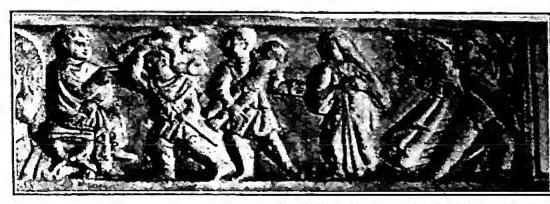
INNOCENTI, massacre of the holy - Detail of the lid of the sarcophagus of St-Maximin (4th cent.).
of the Israelites, buried near Bethlehem, rose from the tomb to weep for her children, the Jews, who at the time of the fall of Jerusalem were being deported from Ramah into Babylonian exile. St Matthew discerned in Rachel’s weeping a typical sense (or at least a figure) of the weeping of the women of Bethlehem on the occasion of the massacre of the holy I.
The historicity of this episode is questioned by D. Strauss and by several non-Catholics because Flavius Josephus (v.) does not mention II. But Flavius Josephus records many other episodes of Herod’s cruelty. He could well have passed over in silence the massacre of a few children of Bethlehem, all the more so because, as a matter of principle, he sought to avoid everything concerning Jesus and Christianity.
Pietro de Ambrogg
II. ARCHAEOLOGY
The representation of the massacre of the Holy Innocents is rare in early Christian art. In the field of relief sculpture, the scene is found on the lid of a sarcophagus in the crypt of St-Maxi-(courtesy of Prof. E. Josi)
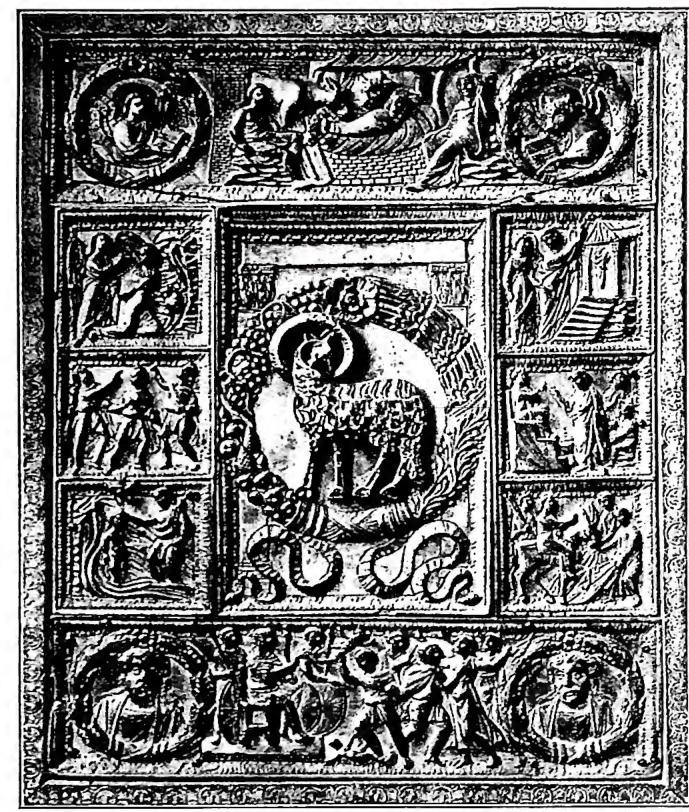
INNOCENTI, strage dei santi — Ivory from the sixth century. The scene of the massacre of the Innocents is found below — Milan, Treasury of the Cathedral.
min in Provence and on a fragment of a similar lid near Aix-en-Provence. The two examples probably belong to the same period (fourth–fifth centuries) and to the same school. Among the ivories, two Gospel-book covers in Milan Cathedral, an example from the fifth century in the Musée national in Paris, and one in the South Kensington Museum in London should be recalled.
In all these representations, the scene follows well-defined compositional rules, despite the diversity of technique and execution of details. Characteristic is the executioner’s gesture: having seized the small victim by one leg, he swings it through the air and then smashes it against the ground. A figure seated on a throne, almost certainly Herod, witnesses the execution; the mothers look on in despair. More complex, but based on the same patterns, is the depiction in the Gospel Book of Rabbùlà and in the Purple Codex of Munich. Noble and inspired is the scene forming part of the fifth-century mosaic decoration on the triumphal arch of the basilica of S. Maria Maggiore in Rome, in which the mothers of Bethlehem, holding their children in their arms, appear before Herod’s tribunal; the group is artistically noteworthy for its use of perspective. Particular mention should be made of a fresco in the underground church of Deir Abù Hannis, near ancient Antinoe (Middle Egypt), which depicts various moments of the massacre and the episodes associated with II. The paintings in the church, all in the same style and from the same period, date from the fifth to the sixth century.
III. ART
In the 10th century, the massacre of the Innocents appears as a representation of atrocious episodes of cruelty in the Codex of Egbert (Künste, V. BIBLICA., I, p. 374) and in other codices of the same period. In the 11th century, the scene became notably widespread in Italian art. It can be seen in the paintings of S. Urbano alla Caffarella, those of S. Angelo in Formis, near Capua, and those of Ferentillo, as well as, still during the Romanesque period, in the ivory frontal of the cathedral of Salerno. But toward the end of the 12th century, Bonanno Pisano gave the narrative, on the bronze door known as that of S. Ranieri in the cathedral of Pisa, considerable decorative vivacity through slender, almost vegetal rhythms, which partly reflect Byzantine and Teutonic influences. The subsequent evolution of the composition, enlivened by a Gothic spirit, is documented by the relief, with approximately sixty figures and powerful dramatic motifs, adorning the pulpit of the cathedral of Siena, sculpted around 1268 by Nicola Pisano and his collaborators. And, at the beginning of the 14th century, two great painters of very different temperaments established for the iconography of the massacre of the Innocents figurative schemes of undeniable prestige: Duccio di Boninsegna in the famous Maestà (Museo dell'Opera del Duomo, in Siena), and the Florentine Giotto in the mural cycle of the Scrovegni Chapel in Padua. In the same century, mention should be made of the refined relief on the third pillar of the façade of the cathedral at Orvieto, by a collaborator of Lorenzo Maitani, and Spinello Aretino’s fresco in S. Maria Maggiore, in Florence. From the beginning of the 15th century onward, it seems that sculptors abandoned the representation of this episode, while it continued to interest the Sienese colorists, narrators par excellence, such as Andrea di Bartolo, Benvenuto di Giovanni, Matteo di Giovanni, and Andrea di Niccolò; as well as Antonio da Viterbo, known as il Pastura. Superior to all of them was the Ferrarese Ercole de' Roberti, who in the Madonna enthroned of the Pinacoteca di Brera (1480) treated the episode in the form of a simulated bas-relief. A few years later, Ghirlandaio composed the scene in agitated but rhetorical forms in the choir of S. Maria Novella, in Florence. Having reached its greatest luxuriance, classicizing Renaissance art employed this subject above all to display graceful anatomies. Thus we see the Bolognese engraver Marcantonio Raimondi, after a drawing by Raphael, composing a harmonious yet academic theatrical action, with the executioners completely nude and the children massive, almost marble-like. A few years later—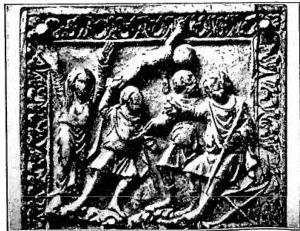
some Ferrarese painters of the 16th century instead expressed themselves through the display of brilliant tonalities: thus Benvenuto Tisi da Garofalo in the scene in the Pinacoteca di Ferrara, and Ludovico Mazzolino in the small paintings of the Uffizi, the Museum of The Hague, and above all in the bizarre composition in the Doria Gallery, in Rome, where the shining, rounded figures have the flavor of an Oriental fairy tale. In the Venetian school of the 16th century, mention should be made of the works of the Veronese painters Giovanni Francesco Caroto (Museum of Bergamo and Galleria degli Uffizi), Bonifazio dei Pitati (Accademia of Venice), and Paolo Farinati (choir of S. Maria in Organo, in Verona); but it was to be the inspired Tintoretto who infused an unprecedented tempestuous breath into the traditional carnage with the gigantic canvas of the Scuola di S. Rocco, in Venice. During the Baroque period the composition appeared only rarely; nevertheless, in the dignified painting in the Pinacoteca di Bologna, Guido Reni achieved sincere eloquence in the foreground figure of the kneeling mother, whose eyes and lips implore divine grace. Later, the other Bolognese painter Giuseppe Maria Crespi, known as lo Spagnolo, attained greater breadth of conception and freedom of stylistic movement with the canvas in the Galleria degli Uffizi, where the most imaginative element is formed by the flight of the little angels through the dark air—that is, the souls of the little martyrs ascending to Heaven. - Vedi tavv. I-II.