
BETLEMME (Hebr. Beth-lehem = “house of bread”; more commonly in Greek Βαβλέη and Βηβλέη; Vulg. Bethlehem; Arab. Bajt-lahm = “house of meat”). — City of the tribe of Judah, in which Jesus Christ was born. It is situated 8 km south of Jerusalem, on two hills at an elevation of 777 m above the level of the Mediterranean and 1267 m above the Dead Sea.
SUMMARY:
I. History
II. The Basilica of the Nativity
III. The Grotto of the Nativity.I. HISTORY
In the el-Amarna letters (290, 16, ed. J. A. Knudtson) there is mention of a city in the vicinity of Urusalim (Jerusalem) called Bit-ilu-NIN-IB; and since in a list of Babylonian divinities NIN-IB is synonymous with Laham(u), the hypothesis has been advanced (cf. O. Schroeder, Orientalistische Literaturzeitung, 18 [1915], col. 294 ff.), and accepted by many, that the name of B. derives from Bit-ilu-laham = house of the god Laham.Of B. we know only what the sacred texts tell us. It can nevertheless be stated that the ancient city stood on the summit of the north-western hill, and that its movement towards the south-east is explained by the attraction exerted by the sanctuary of the Nativity. B. is surnamed Ephrata, a name more properly applied to the region inhabited by the Ephratite clan composed of the families of the three sons of the Calebite Hur—Sobal, Salma, and Hariph—called respectively the “fathers” of B., Cariathiarim, and Bethgader (cf. I Par. 2, 51, 54; 4, 4; Eusebius, Onomasticon, 42, 10; 82, 10; ed. Klostermann); that is, the Ephratite stock of Caleb settled in those cities and gave the name Ephrata to the region. Thus the Ephrata of Ps. 131, 6 probably refers to the Ephratite Cariathiarim.
In the Bible B. is mentioned for the first time in connection with the death of Rachel (Gen. 35, 19; 48, 7), but here too the reference is to Ephrata, whose identification with B. is regarded by many as a gloss. In Ruth 1, 1-2; 4, 11, as in Mi. 5, 2, the identification of Ephrata with B. is absolutely certain, because it is required by the context and by the parallelism of the phrases; it should nevertheless be noted that even in these passages Ephrata does not entirely lose its character as a region. More frequent is B.’s surname “of Judah” (Iudc. 17, 7, 9; 19, 1-18; Ruth 1, 1, 2; I Reg. 17, 12; Mi. 2, 1, 5, 6), to distinguish it from another B. in the tribe of Zabulon (Ios. 19, 15). The name of B. is absent from the list of the cities of Judah given by the Masoretic text in Ios. 15, 21 ff.; it is found, however, together with ten other cities, in the addition of the Septuagint (cf. Ios. 15, 59 a).
In Iudc. 17, 7-13 the story is told of a young Levite from B., from the family of Micha; there is, however, no reason to suppose that B. was a Levitical city: it is absent from the list in Iudc. 21 and I Par. 6, 54-81. The wife of the Levite from Ephraim who was cut to pieces by her husband after the inhabitants of Gabaa had abused her was also from B. (Iudc. 19); but B.’s renown in ancient Israel derives from its having been the homeland of the line of David (Ruth 4, 17-22), who was anointed king there by Samuel (I Reg. 16, 13), and for this reason it is also called the city of David (I Reg. 20, 6; Lc. 2, 4, 11). During the continual warfare between David and the Philistines, the latter succeeded in taking possession of B., which at that time appears to have been organized for defence (II Reg. 23, 14 ff. = I Par. 11, 16 ff.); but the Philistine occupation must have lasted only a short time. Later it is mentioned among the cities fortified by Roboam (II Par. 11, 6), and among the localities that, after the exile, saw the remnants of their inhabitants return (Esd. 2, 21 = Neh. 7, 26).
From then on the glories of B. seemed to have set, reduced as it was to a small village; but according to the prophecy of Isaiah, “from the trunk of Isai, that is, from the family of David, a shoot will one day spring, and from its root a branch will blossom, and on that day the root of Isai will be like a banner to the peoples” (Is. 11, 1. 10); and in B., according to the oracle of Mi. 5, 2 ff., the Saviour of the world will be born (cf. Mt. 2, 1. 5 ff.; Lc. 2, 4 ff. 15; Io. 7, 42). The glory of having given birth to the Messiah will be everlasting, and its name will never be erased from history.
Indeed, the memory of the place of Jesus’ birth at B. remained ever alive in the primitive Christian tradition. Thus, towards the middle of the second century, the Protoevangelium of James (17, 3), together with other apocryphal writings, and St. Justin Martyr (Dialogus cum Tryphone, 78, 5) indicate the place of Christ’s birth as a cave situated near the city—a detail not recorded in the Gospel. The same is true of Origen (Contra Celsum, I, 51), who adds that the fact was well known and widely reported even among the pagans. Later, St. Jerome (Epist., 58, 3) and St. Paulinus of Nola (Epist., 31, 3) speak to us of the desecration carried out in the Holy Grotto by the emperor Hadrian (117-38), who introduced there the worship of Adonis-Tammûz, together with a sacred grove. The piety of Constantine and St. Helena reconsecrated the Redeemer’s cradle and fixed for future generations the ever-living memory of the Grotto of the Nativity through the erection of a splendid basilica (cf. Eusebius, De laudibus Constantini, 9, 17; Vita Constantini, III, 41-43), completed as early as 333 (cf. Itinerarium Burdigalense, ed. Gever, p. 25, 3-5). Monastic life soon flourished around the Constantinian basilica, particularly in the time of St. Jerome and his Roman female disciples.
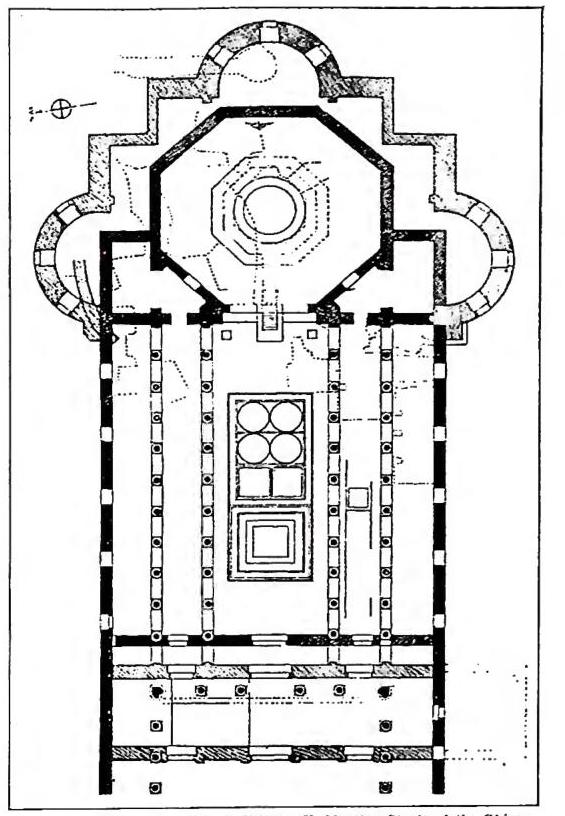
(from A. Flicke - V. Martin, Storia della Chiesa, Italian translation, III, Turin 1918, fig. Q)
BETLEMME – Plan of the Basilica of the Nativity.
The parts shown in black are of Constantinian date (333).
The remainder dates from the time of Justinian and from later periods.
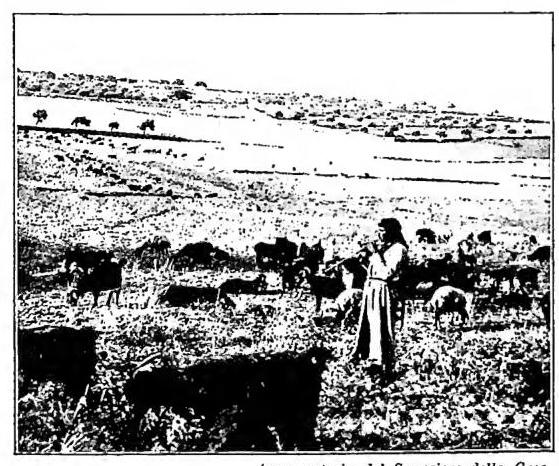
(courtesy of the Superior of the House of Retreats of the Sacred Heart, S. I. – Rome)
BETLEMME – The shepherds’ field in the locality of Bethsur (Lc. 2:8–15).
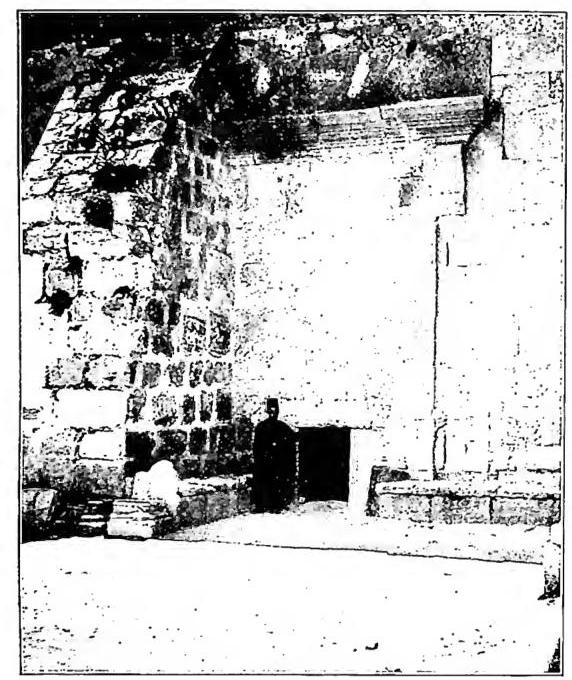
(courtesy of the Superior of the Casa degli Esercizi del Sacro Cuore S. I., Rome)
BETLEMME – Basilica of the Nativity.
One of the ancient entrances, now walled up.
some Protestants, and a few hundred Muslims. In addition to the Franciscan Fathers, who have the parish, schools for children, and the “Casa Nova” for pilgrims, there are several institutions of religious men and women, devoted particularly to education and charitable work.
II. THE BASILICA OF THE NATIVITY
The old problem that had set two theses against one another, both defended by distinguished archaeologists (the wholly Constantinian origin of the present Basilica, or its reconstruction in the time of Justinian in the sixth century), received a decisive answer, favorable to the second thesis, after the explorations carried out both in the area of the primitive atrium (1932) and within the basilica itself, especially underground (1934), the former under the direction of E. T. Richmond and R. W. Hamilton, and the latter under that of E. T. Richmond and W. Harvey.1. The Constantinian basilica
The results of these systematic explorations make it possible to reconstruct with sufficient accuracy the Constantinian buildings, the whole of which consisted of three principal parts: an octagonal building above the Grotto of the Nativity, the basilica proper, and the atrium.The octagon, 7.80 m. on each side and 18 m. along the major axes, stood like a crown around the sacred site of the Nativity, and had at its center a circular opening, 4 m. in diameter, reached by two steps that followed the entire octagonal outline of the building. This opening, surmounted by a precious canopy and protected by a small parapet, enabled the faithful kneeling around it to see and venerate from above the Holy Grotto and the altar erected over the place of Christ’s Birth. On the western side of the octagon, which opened through a triumphal arch, stood the basilical hall, formed by a square approximately 27 m. on each side and divided into five naves (the central one 9.20 m. wide and the other four 3.40 m.) by four rows of monolithic columns, ten in each colonnade. The outer longitudinal walls of the Basilica extended eastward for 7 m. beyond the basilical square, then meeting at right angles the northern and southern sides of the octagon respectively. Thus, between the octagonal building and the lateral naves of the Basilica, two spaces were obtained, one on each side, of an almost triangular shape, necessary for liturgical uses; at the same time, a more harmonious solution was given to the union of the octagon with the Basilica. Beneath the triumphal arch opened a staircase leading to the Holy Grotto, while two others, on the north and south sides of the upper altar, facilitated the circulation of the faithful.
In front of the façade of the Basilica, which was entered through three doors corresponding to the three middle naves, extended the immense four-sided atrium, 73 m. long and 26 m. wide. The covered galleries were of proportions equal to those of the outermost naves of the Basilica, whose lines continued as far as the western portico, but with wider intercolumniations. The extraordinary and architecturally disproportionate breadth of the Constantinian atrium is readily explained by the need to provide adequate shelter for the enormous crowd of pilgrims who flocked to B. for the solemnity of Christmas. At the outer southeastern corner of the atrium there most probably stood the Baptistery, but this has not been confirmed.
The considerable remains of the mosaic pavement brought to light, particularly in the central nave and on the northern side of the octagon, show, in their composition, design, and execution, a technique later than the Constantinian period, which may be assigned to the end of the fourth or the beginning of the fifth century. The same conclusion is reached by comparison with other Palestinian mosaics of undisputed date, as well as by a careful study of the manner in which the mosaic was adapted to the worn parts of the thresholds of the Basilica and the Grotto.
2. Reconstruction by Justinian
Following an extremely serious fire, probably suffered during the Samaritan revolt, the basilica of B. was almost entirely destroyed. The Emperor Justinian ordered its reconstruction, which was conceived according to new architectural principles, especially under liturgical influence. The basilical area was enlarged and given complete unity by eliminating the octagonal building and shifting the inner façade several meters farther west, with the addition of the narthex.After the complete removal of the octagon, a transverse nave, as wide as the central nave, was created east of the ancient basilical square; it was closed at either end by two semicircular apses projecting beyond the vanished ancient longitudinal walls. A third apse, symmetrical with those of the transept, was built at the end of the central nave, 8 m. beyond the ancient octagon, in order to obtain the proper proportions. The free arms of the three apses were joined by walls forming two right angles. Beyond the crossing the naves reappear: the outer lateral ones with a single bay, and the central one with two bays of different widths. The ideal center of the Sanctuary underwent no significant changes: the circular opening over the Holy Grotto was preserved, as was the central staircase, raised somewhat—by only three or four steps—because of the difference in the new level, together with the two lateral staircases.
At the western end of the basilical square, after the ancient façade had disappeared entirely, a new bay, somewhat wider than the others, was added; this was followed by the narthex or vestibule, 5.50 m. wide, so that the new façade came to lie approximately 10 m. farther west than the old one. The atrium was reduced by about half in the longitudinal direction, owing to the restrictions imposed by the aforementioned constructions (approximately 10 m.) and by a shortening of approximately 27 m. in the western section. The need to provide a solid foundation for the basilical colonnades led to the construction of continuous walls in the manner of a stylobate, approximately 1 m. high; hence it was also necessary to raise the pavement to the level of the column bases, with the result that what remained of the ancient and precious mosaics was covered by a layer of approximately 80 cm. of heterogeneous fill material.
Such, in the light of the recent excavations, are the principal modifications undergone by the ancient Constantinian Basilica in Justinian’s reconstruction.
3. Present condition
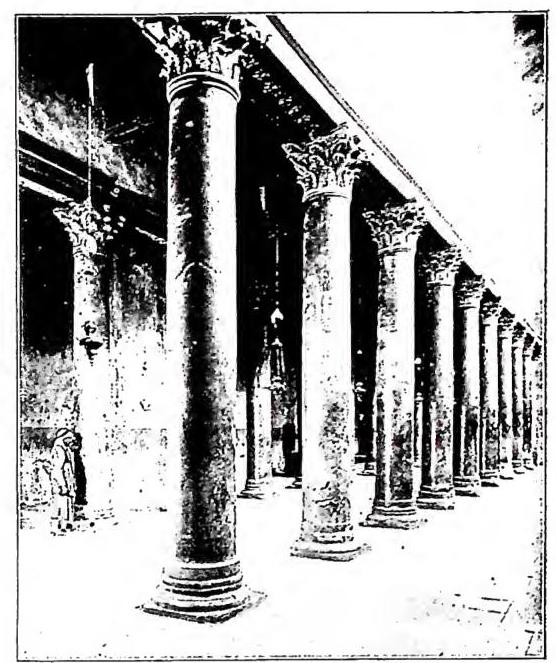
This is also the general architectural appearance of the interior of the Basilica today, although it is bare and neglected. In fact, no changes of any kind were made in the interior during the Crusader period. Special mention should nevertheless be made of the splendid mosaic and painted decoration of the interior walls and columns, executed in the time of Amalric I, king of Jerusalem (1163–73), and Manuel Porphyrogenitus Comnenus, Byzantine emperor (1143–80), and completed in 1169. Of this outstanding work, only a few wretched remnants remain. At an uncertain date, the staircase that led from the central nave, beneath the crossing, into the Grotto of the Nativity disappeared. As for the exterior, the façade already underwent further alterations in the time of the Crusaders, probably for reasons of greater security, which disrupted the harmony of the whole: the side doors were closed, the central one was considerably reduced, and the narthex was divided into three compartments covered with groined vaults. Later, the same defensive considerations, together with the encroachment of the neighboring convent buildings, further disfigured and almost completely concealed what remained of the façade. Finally, the atrium disappeared altogether, making way for a simple open space.III. THE GROTTO OF THE NATIVITY
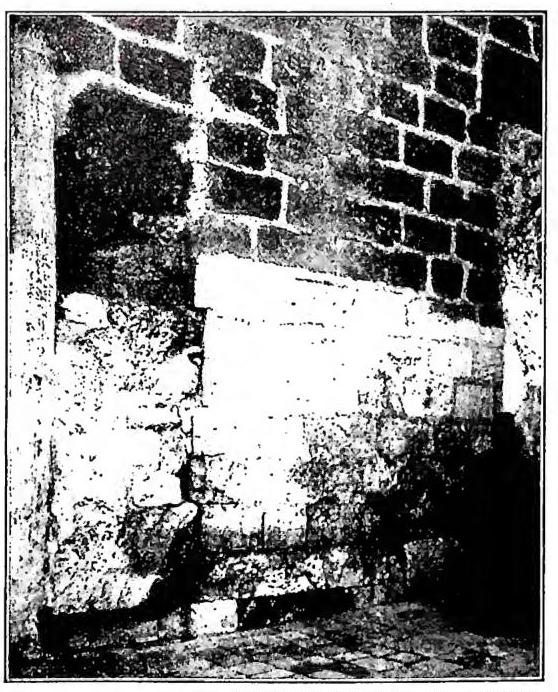
Today it is accessed by two irregular stairways situated on the north and south sides of the present choir of the Greek Orthodox. The Holy Grotto is an irregular rectangle, 12 m long and with an average width of 4 m, hewn out of very soft limestone, with the walls reinforced by masonry, as is the entire vault. In the(courtesy of the Superior of the House of Exercises of the Sacred Heart, S.I., Rome)
BETLEMME – Detail of the interior of the Basilica of the Nativity (6th century).
Dalla partenza dei Canonici regolari di s. Agostino nel sec. XIII, i figli di s. Francesco sono stati i gelosi custodi dei diritti della Chiesa cattolica sul luogo della nascita di Cristo; ma nella guerra implacabile che i greci ortodossi mossero a più riprese contro i cattolici, specialmente dalla metà del sec. XVI in poi, ogni loro diritto, spesso suggellato da sangue generoso sparso sulla culla stessa del Principe della pace, fu sopraffatto con intrighi, soprusi, falsi firmani, feroci persecuzioni e perfino con attacchi a mano armata. Lasciati spesse volte soli ed indifesi quando più necessario si fece sentire l'intervento delle potenze cattoliche europee, i Francescani si videro, col dolore impotente, strappati uno dopo l'altro i diritti dei cattolici da loro rappresentati e strenuamente difesi sino all'ultimo. Oggi non resta di loro esclusivo diritto se non il santo presepio e l'altare dei Magi con le grotte adiacenti a quella della Natività, dove tutti i giorni si celebra una devota processione commemorativa. A fianco della chiesa di S. Caterina e del prezioso claustro medievale, la basilica della Natività, pur maestosa ancora nel suo insieme, rispecchia nel suo squallore, nella sua spoglia freddezza e nel suo abbandono una miseria spiri-
tuale indegna del luogo ove apparve in carne mortale la Luce del mondo.