
ROBOAM. — King of Judah for 17 years (932–915 B.C.), son and successor of Salomon (v.). At the beginning of his reign, the schism of the northern tribes took place, with the foundation of the autonomous Kingdom of Israel Ieroboam I (v.).
To secure the loyalty of the northern tribes, which already in the final years of Salomon’s reign had harbored hostile prejudices against the Davidic dynasty because of increased taxation, he summoned the representatives of the tribes of Israel to Sichem; in response to their request for tax relief, R. asked for three days in which to answer. Then, following the advice of his inexperienced contemporaries, he displayed uncompromising harshness (I Reg. 12, 4–14). The northerners then repudiated the Davidic dynasty and IEROBOAM I (v.), who had been recalled from Egypt, where he had taken refuge to escape Salomon’s persecution. When R. sent to the rebels, in order to bring them back to obedience, that Adonitam who had been collector of forced labor during the final years of David and throughout the reign of Salomon (II Sam. 20, 24; I Reg. 4, 6; 5, 13), the royal messenger was stoned by the furious people.
Some time later R. planned an armed reconquest; but, by God’s command, the prophet Semeia dissuaded him from fratricidal war. Thus the Israelite nation remained forever divided into two kingdoms. Only the tribe of Judah remained loyal to R.; in practice, however, it also incorporated the tribe of Simeon and part of Beniamin, with a small territory limited to the southern part of Cisjordan; the other ten tribes, under Ieroboam, formed the new northern Kingdom, also called “of Israel,” “of Ephraim,” or “of the house of Joseph.”
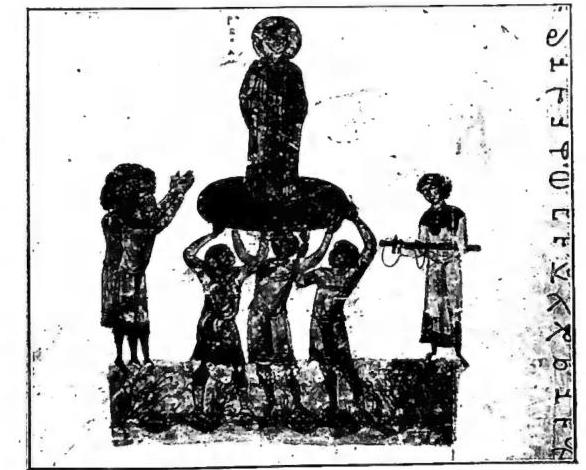
(phot. Ewe. Catt.)
ROBOAM - R. proclaimed king and raised upon the shield. Twelfth-century miniature in cod. Vat. Greek 333 (f. 98°), containing the Book of Kings - Vatican Library.
then compelled to replace them with others made of copper (I Reg. 12). Following the Egyptian invasion, R. fortified numerous localities in his kingdom, including Lachish and Azekah, and placed his sons in command of their respective garrisons (II Par. 12, 5-12; but the sequence of events does not seem to follow chronological order).
Like Ieroboam I, whose enemy he always remained, though to a lesser degree, R. departed from the purity of the Yahwistic religion and permitted the erection of “altars and pillars and sacred poles upon every high hill and beneath every luxuriant tree,” and allowed the qédhēlim (Vulg. effeminati) to perform their abominable rites there (I Reg. 14, 22-24).