
SALOMONE - Ferrarese miniature (second half of the 15th century), attributed to Guglielmo Giraldi Magri or del Magro - Cleveland (Ohio), Museum of Fine Arts.
to Jerusalem, even to Calvary. She was among the first to receive the message of the Resurrection (Mt. 27, 55 ff.; Mc. 15, 40 ff.; 16, 1).
Divergent opinions regarding S.'s kinship are set forth by ecclesiastical writers. S. Epifanio believes that S. was the daughter of s. Giuseppe, born of a first marriage (Haer., 78, 9: PG 42, 712); Egesippo considers her the daughter of Cleofa, brother of s. Giuseppe (Eusebio, Hist. eccl., 3, 11; 4, 22: PG 20, 248, 380); Niceforo maintains that she was the daughter of the priest Zaccaria, father of Giovanni Battista and brother of s. Giuseppe (Hist. eccl., 2, 3: PG 145, 760). Nothing certain can be said on the matter. Equally untenable seems the interpretation given by certain Protestants to the text of Io. 19, 25, thus paraphrased: “Near the cross of Jesus stood his mother and the sister of his Mother [S.], Maria [wife] of Cleofa, and Maria Maddalena.” Since the New Testament never alludes to any kinship between the sons of Zebedeo and Jesus, whereas it emphasizes that of Giacomo il Minore (v.) Giuda Taddeo (v.), called “brothers (that is, cousins) of Jesus,” the insertion of S. at the indicated point is arbitrary. The correct paraphrase is: “the sister of his Mother, [that is] Maria [wife] of Cleofa.”
Egiziani (v.), Pistis Sophia (v.), and among the Carpocratians, S. enjoyed great authority.
Pietro De Ambroggi
SOLOMON (Hebr. Šēlōmōh “perfect, fortunate,” Gr. Σαλομῶν, Σολομῶν). - Third king of Israel (between 970 and 932 B.C.) of the united period, remembered in popular tradition as the archetype of the wise and magnificent king. The history of his reign is recounted in I Kings 1-11 and II Chronicles 1-9.
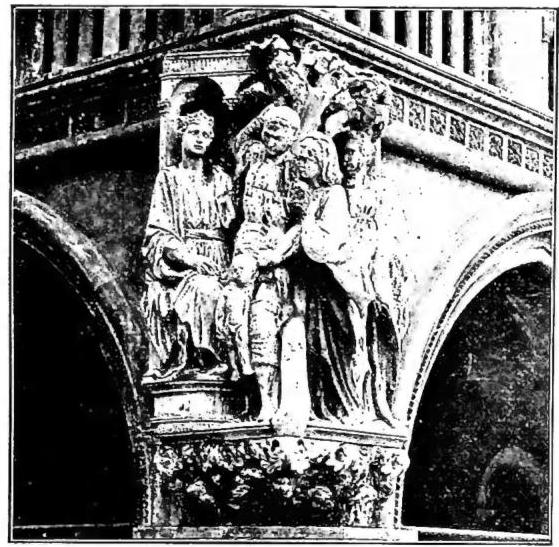
SALOMONE - The Judgment of S. Capital of the Doge's Palace (15th century) - Venice.
S. began by securing his throne, also in execution of the wishes expressed to him by the dying David, who had told him to reward certain individuals to whom he was indebted and to punish others. He had the potential rival Adonia killed, along with his principal supporter, the military commander Ioab; he deposed the high priest Abiathar, replacing him with Sadoc.
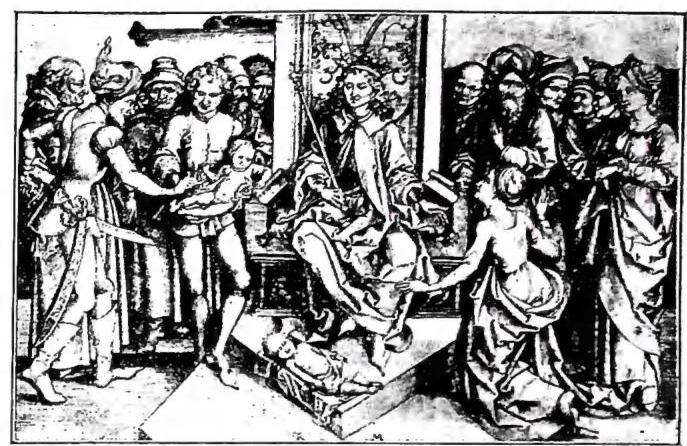
The religious inauguration of his reign with a sacrifice of 1,000 victims at Gabaon, where the Mosaic tabernacle then stood (II Par. 1:3), revealed the fundamental theocratic conception that the new sovereign had of his authority, and his character as one who loved solemn cultic manifestations. On that occasion, God, appearing in a dream to the King, granted his request for a "docile mind to govern his people, to discern good from evil," bestowing upon him "a wise and perspicacious mind" as well as other goods he had not requested: a long reign and riches (I Kings 3:4-14). The famous "judgment of S." soon thereafter provided an example of the King's wisdom (ibid. 3:16-28), which became proverbial.
Of this wisdom, celebrated as superior to that of every other man and "of all the Orientals and the Egyptians," whose vast sapiential literature is partly known, the King gave distinguished literary proofs with the composition of "3,000 proverbs," sententious and moral sayings, and "1,005 songs" or lyrical compositions, utilizing his extensive knowledge of plants and animals (ibid. 4:29-34). Sayings of the mālāl genre partly flowed into the book of Proverbs (v.), where under the name of S. are found the two collections 10:1-22:16 and 25:1-29:27. The title of the second of these collections (cf. 25:1) indicates that it was "gathered" in the time of Hezekiah and that another already existed, which can only be that of 10:1 ff., thus to be considered earlier. It cannot be said with certainty whether the sayings of Hezekiah were gathered from oral tradition or from scattered writings, as A. Vaccari prefers. The fame of the great King's wisdom remained alive in the memory of posterity, as shown by the attribution to him of certain books, which today are considered with all probability (Song of Songs [v.]), or with certainty (Ecclesiastes [v.]; Wisdom [v.]) to be of a later date.
As for the government of S., an administrative document preserved in I Kings 4:1-24 reports the division he introduced into his Kingdom, partly innovative in character (the partition does not coincide with the ancient one of the 12 tribes), and essentially lasting until the exile, as demonstrated by inscriptions on ostraca and jar handles found in Judea (cf. D. Diringer, Le iscrizioni antico-ebraiche palestinesi, Florence 1934, chaps. 2, 4).
The primary purpose of this reorganization was the collection of tribute, which S. greatly increased, corresponding to the heavy expenditures he faced for the grandiose constructions that characterized his reign. Taxes, partly in the form of labor service, weighed upon the entire people, but especially the northern tribes and the descendants of the ancient Canaanites, in the process of progressive fusion with the descendants of the immigrant nomads. Tributes could be increased also due to the heightened well-being of the Israelites during the peaceful reign of S. This king, fond of splendor and culture, was an intelligent promoter of economic and commercial activity, both domestically and abroad. The good relations already existing with Tyre in the time of David were strengthened. The skill of S.'s diplomacy with Egypt achieved a success that must have then seemed incredible: the King of the small Palestinian state obtained in marriage a daughter of the Pharaoh (perhaps Siamon, of the XXI dynasty).
To develop commerce, which on the whole must have been quite profitable, though critical periods also arose (cf. I Kings 9:10-14), fortified points were established to protect roads and caravan centers, with the introduction of cavalry and war chariots; above all, the facilities of the port of Ezion-Geber (v.) were expanded. The fleet that S. built there reached locations in southern Arabia and the African coast, from which it transported precious goods that supplied Mediterranean markets via many routes. The visit of the Queen of the northern Arabian kingdom of Sheba (I Kings 10:1-13) was proof of this breadth of the sovereign's interests.
The reign of S. was also celebrated for its constructions, the most important of which was the Temple-Palace complex (ibid. 5-9), two distinct groups of buildings harmoniously connected to each other, as required by the service, partly common to both (on the site and construction criteria, V. TEMPLE). S. availed Hiram (v.), King of Tyre, who sent specialized workers, Hiram (v.) excelled, and materials, including the cedars of Lebanon, which the Phoenician king had cut and transported to the port of Jaffa, from where the Jews transported them to Jerusalem. Upon completion, the Ark of the Covenant was transferred to its new location, and the Temple was inaugurated with a lengthy ceremony, including a speech and an elevated prayer by the King (I Kings 8).
The great series of Salomonian works in Jerusalem was completed with the construction of an embankment (māllā; ibid. 11:27), by which the site of the Temple and the Palace (Moriah) was united with the "city of David" (Ophel), and with an expansion of the city walls (I Kings 9:15) (v. II).
But the private life of S., opulent and happy lord of the ancient Orient, marked a progressive moral decline. S. formed a harem with an excessive number of women (I Kings 11:3; cf. Cant. 6:8), many of them foreign and idolatrous, toward whom the theocratic king, builder of the temple of Yahweh, was so weak as to construct in Jerusalem and its surroundings small temples to pagan deities, to which he himself paid some worship (ibid. 11:1-8).
To the Lord's indignation for these faults, the biblical narrator, overcoming the evident inclination found in all testimonies to soften the shadows cast upon the figure of the glorious and peaceful King, links the condemnation to the division of the monarchy (ibid. 11:1-13), which indeed occurred at the death of S. (932 B.C.), prepared over time by internal rivalries between the northern and southern tribes and occasioned by discontent over the fiscal burdens that the deceased King had imposed.
In the New Testament, he is remembered for his proverbial splendor (Mt. 6:29) and wisdom (ibid. 12:42). In the Western patristic tradition, the judgment on him is generally unfavorable due to his final idolatry; less so among the Greeks. Dante recalls him with honor among the Wise (Par., X, 109-16).
Giovanni Rinaldi
ARCHAEOLOGY. - Funerary art entirely ignored the figure of SALOMONE, but from Pompeii comes a parodic scene of his judgment, demonstrating the fame he enjoyed among the ancients (cf. J. B. Frey, Les Juifs à Pompei, in Rev. bibl., 42 [1933], pp. 375-81, pl. 22). Early medieval Christian art has preserved an example in fresco from the 7th century in the underground church of S. Maria in Via Lata in Rome (Wilpert, Mosaiken, p. 689, pl. 37, 1). Other similar scenes are scattered across minor monuments, the oldest and most notable of which is that depicted on the reverse of a silver reliquary preserved in the church of S. Nazario in Milan, dating to the 4th century (K. Hoffmann, s. V. in LThK, IX, p. 128). Of particular
interest is the Byzantine engraving on a brown agate, which exhibits a certain Oriental style that seems derived from vase painting (cf. A. de Longpérier, Une intaille antique inédite, in Comptes rendus de la Soc. des Inscript. et Belles Lettres, 24 [1880], pp. 275-80). There also remain a miniature from the manuscript (gr. 510) of St. Gregory Nazianzen and an ivory from the late 9th century (E. Molinier, Catalogue des ivoires de la Bibl. nat., Paris 1897, p. 18, fig. 8), both in the Bibliothèque nationale de Paris; an engraved stone (Notizie Scavi, 1882, p. 323); an ivory in Berlin; and a glass medallion (O. Wulff, Altehr. u. mittelalt. byzant. u. ital. Bildwerke, I, Berlin 1909, p. 237, pl. 56, n. 1152)—though it remains uncertain whether these depict the judgment of SALOMONE or the Massacre of the Innocents.
In the Middle Ages, the figure of SALOMONE, who had already acquired exorcistic virtues in Flavius Josephus (Antiq. Iud., VIII, II, 5), transformed into that of a true magician, to whom popular belief, nourished by legends from every land, attributed powers directly granted by God (cf. the indignation of Origen, In Matthaeum, 110: PG 13, 1757). An entire series of small objects—amulets, talismans of every kind, stones—drew inspiration from this belief, depicting SALOMONE with a halo, a long cross-tipped lance in his right hand, the sign of the cross in the exergue, charging on horseback to pierce the devil in the guise of a woman (G. Schlumberger, Mélanges d'archéologie byzantine, Paris 1895, pp. 116-40). In this sense, SALOMONE became the prototype of the Christian St. George, with the difference that in him converged pagan and Christian beliefs permeated by mythological elements rather than derived from Judaism. The sole example outside this tradition is an Ostian medallion reported by G. Calza (v. cited article in Bibl., p. 85), which depicts SALOMONE standing with a staff in his left hand and a rod in his right, stirring the contents of a striped vessel. On the reverse of such medallions, magical symbols of every kind are engraved, while the meaning of the representations on both sides is sometimes explained by legends (Σραγὶς Σολομῶνος, etc.). These objects date from the 3rd to the 8th centuries.
Another testament to the popular veneration of SALOMONE are the invocations for his protection, in which his name appears alongside those of angels and saints. For instance, in a papyrus from the Oslo Library, SALOMONE is associated with Christ (L. A. Constans, Une amulette chrétienne sur papyrus, in Journal des Savants, 1922, pp. 181-82); while on a silver tablet, he is invoked with the angel Mechlia (W. Fröhner, Sur une amulette basilidienne inédite du Musée Napoléon III, in Bull. d. antiquités de Normandie, 4 [1867], pp. 217-31; cf. other examples in Bull. d'arch. crist., 5 [1869], p. 62; Revue des études grecques, 16 [1903], p. 42).
Finally, SALOMONE is linked to that signum or sigillum Salomonis, effective against magical and demonic snares—
SALOMONE - The Judgment of S. Engraving by the master "B. M." (late 15th century).
which appears to derive from astrological elements, such as the pentalpha and the hexalpha (for the relations between astrology and magic: F. Cumont, Les religions orientales dans le paganisme romain, IV, Paris 1929, pp. 168-79, 292-96, with bibl.).