
INCISIONE. – Properly speaking, it is the art of engraving figures, ornaments, etc., on any surface. It may therefore be an end in itself, as in glyptics, inlay, and niello, and in this sense it is very ancient (one need only think of the rock engravings of cave dwellers); but it may also serve to produce a matrix from which copies of the engraved images can be made. In former times, matrices were already being engraved for printing leather or fabric, as well as punches for striking coins. Today, however, when one speaks of engraving, one generally means the process that makes it possible to reproduce on paper, by means of printing, marks engraved on a matrix. In relatively recent times, the process has also been exploited mechanically (v. FOTOMECCANICHE, ARTI, ARTI). Here, instead, we shall deal with the various kinds of engraving produced directly by the artist’s hand.
There are two fundamental techniques: engraving on wood and engraving on metal; lithography (v.), invented at the end of the 18th century, may be added to these. Engraving on wood is called woodcut, and its characteristic is that the design obtained in relief on the matrix, when printed on paper, presents the engraved mark; this differs from engraving on metal (generally copper, and therefore also called chalcography), which, being incised, instead produces printed copies with the mark in relief, since in the press the paper is strongly compressed into the hollows of the plate (v. ACQUAPORTE). For engraving a composition on metal, different procedures may in turn be employed. If no acids are used to engrave the plate, the result is engraving with the burin, drypoint, mezzotint, or manière noire; if, on the other hand, acids are used, the result is etching, aquatint, dotted manner, or soft-ground etching.
Engraving with the burin is obtained by engraving the plate with the tool known precisely as the burin (v.). Ink is made to penetrate the grooves of the engraving, while care is taken to clean the rest of the plate. After the plate has been covered with a sheet of special damp paper, and this in turn with a felt, it is passed through the copperplate press, consisting of two cylinders like those of an ordinary rolling mill. Once the operation is complete, the ink collected in the engraved marks is printed onto the paper, while the latter remains white in the areas untouched by the engraving. Drypoint (v.) may also be associated with this type of engraving; it is produced by working the metal with a point instead of a burin. In mezzotint, or manière noire, by contrast, the entire plate is prepared beforehand by roughening it so that, if printed, it would produce a uniformly black surface. The engraving process therefore consists in removing the roughened surface with special scrapers wherever highlights are to appear. Indeed, plates engraved by this process were used especially in the past for reproductions of paintings with dark backgrounds, for which it is particularly well suited, although it has the disadvantage of not permitting very large print runs.
(courtesy of Dr. N. Vian)
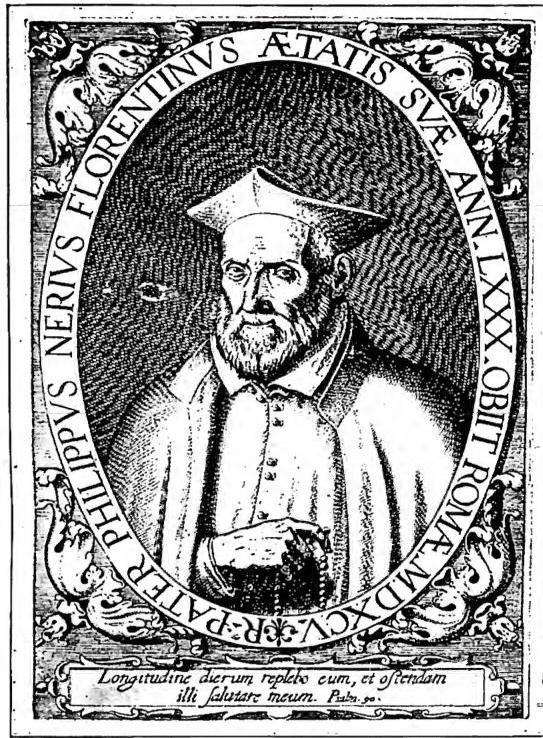
INCISIONE – St Philip Neri. Engraved portrait contained in the book by Cardinal Gabriele Paleotti, De bono senectatis (Rome, A. Zanetti, 1595), which was published a few months after the Saint’s death.
HISTORY OF WOODCUTTING. — Woodcutting preceded printing on metal: playing cards, printed fabrics, and above all religious images are found in abundance as early as the fourteenth century. Indeed, these latter were precisely the first wood engravings of any importance, although very little now remains of them, printed on loose sheets and intended, as objects of worship, to wear out rapidly. Among these figures with simple outlines, often hand-coloured, without hatching or chiaroscuro, mention may be made here of the Journey to Calvary (ca. 1400, Albertina, Vienna) and the Madonna and Four Saints (1418, Print Room of Brussels). Among the Italian engravings, likewise extremely rare and generally produced by Florentine or Venetian artists, one of the earliest woodcut books should be recalled: a book illustrating the Passion (Print Room of Berlin), in which both the text and the vignettes were printed using one woodblock for each page. This primitive system of printing was especially widespread in Germany, and it does not seem rash to suppose that the invention of movable type found precisely in this book production its opportunity and its origin. After the invention of printing, woodcutting became its chief aid in the decoration and illustration of volumes: the famous De re militari by F. Valturio (Verona, 1472) may be recalled, for whose illustrations Matteo dei Pasti has been named; as well as the Aesop of Verona (1479) and that of Naples (1485). The Florentine publications were also important, adorned with woodcuts reflecting the style of the finest local artists, as were those of Venice, very numerous; among the latter, at the very least, the Hypnerotomachia Poliphili (1499) by the Dominican Francesco Colonna should be mentioned, whose illustrations have also been attributed to Giambellino and Mantegna. At the beginning of the sixteenth century, the first wood engravings made with several blocks appeared; in Germany they were used, among others, by L. Cranach, and ARPI (v.) who was also for some time regarded as the inventor of the new process. Followers of Ugo da Carpi were A. Fantuzzi, G. Nicolò
and A. Andreani. Among the other engravers active in this period, the Venetians Domenico delle Greche, N. Boldrini and G. Scolari should be recalled; they worked especially from Titianesque drawings. In the seventeenth century, the engravings of the Coriolani, da Tiarini and Guido Reni were noteworthy. In the eighteenth century this art began to decline, and was not to revive until the end of the nineteenth and the beginning of the twentieth century, especially through the work of the group that arose around the journal Leonardo, which included, among others, A. Spadini and A. De Carolis. Numerous were the woodcut artists deriving from De Carolis, and the work of many contemporary artists is also noteworthy.
HISTORY OF INTAGLIO ENGRAVING. — Once Vasari’s thesis, which sought to link the origin of engraving to Maso Finiguerra and to impressions taken from his nielli, had been disproved (German prints dating several years before 1460 have in fact been discovered), the problem of the origins of engraving still had not been completely resolved. Nevertheless, Vasari’s account might offer an indication that the workshops of the Florentine goldsmiths were among the earliest foundries of this new technique of illustration. Impressions of nielli are today extremely rare, and among the most precious are the surviving proofs by A. Pollaiolo. Here too, as in the field of woodcut, the earliest engravings clearly reveal the influence of the most famous artists of the fifteenth century: noteworthy are those of the Master of the Great Passion, influenced by Andrea del Castagno (cf. the Penitent Jerome in the Uffizi). A. Pollaiolo is renowned for the print depicting the Combattimento dei 10 nudi, and worthy of remembrance is the great Assumption of the Virgin, inspired by Botticelli, which was, indeed, for a long time attributed to Botticelli himself. Among the interpreters of Botticelli’s drawings, the name of Baccio Baldini has been handed down; he is credited with the illustrations for the volume il Monte Santo di Dio (Florence 1487) and those for the Divina Commedia (there 1481). Among the other engravers, C. Robetta should be mentioned, who engraved from drawings by Filippino, Pollaiolo, and Ghirlandaio, also showing the influence of Dürerian compositions. In northern Italy many of the best-known artists, foremost among them A. Mantegna, devoted themselves to engraving: among these were Nicoletto da Modena, Benedetto Montagna, Jacopo de’ Barbari, Gerolamo Mocetto, and Giulio Campagnola, who
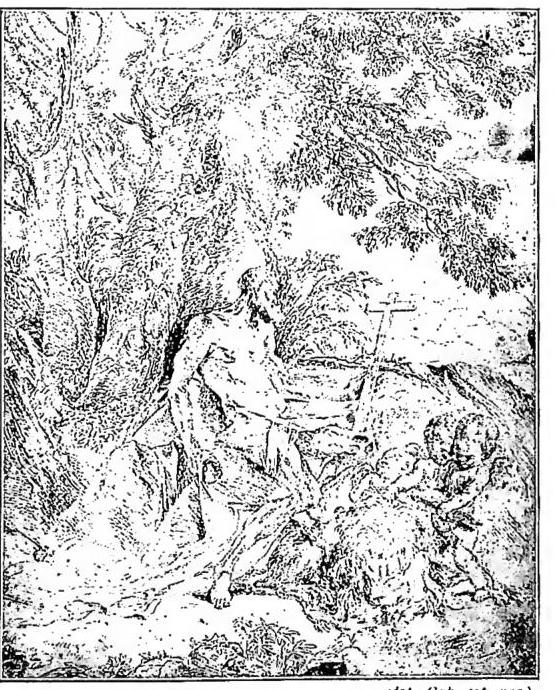
while another Mantuan, Giorgio Ghisi, devoted himself chiefly to reproducing Michelangelo’s work in the Sistine Chapel. Among the other most famous engravers of the sixteenth century are the Parmigianino, important above all as a precursor of a faster and more spontaneous manner of engraving, which would undergo extensive development in the following century; his follower A. Meldolla, called lo Schiavone, who was among the first to use drypoint; and, toward the end of the century, the Carracci. In the seventeenth century, noteworthy engravings were produced by O. Borgianni, il Baroccio (his Annunciation, employing several techniques, is particularly remembered), and the Florentine A. Tempesta, who exerted a particular influence on Callot and Stefano della Bella. Among the Emilian painters, engravings were made by il Guercino, G. Reni, and his finest follower S. Cantarini da Pesaro; among the Neapolitans, by Ribera and S. Rosa; among the Genoese, by il Grechetto; while among the other schools at least the Veronese G. Carpioni, the Pisan G. B. Vanni, and the Lucchese P. Testa must be remembered. It was in the eighteenth century, however, especially through the work of the Venetians, that Italian engraving was to reach its highest peaks. G. B. Tiepolo (v.) Piranesi (v.) gave rise to a flourishing school. Among the most celebrated Venetian engravers are also Carlevaris, Bellotto, Canaletto, Marco Pitteri (who engraved chiefly after drawings by Piazzetta), and F. Bartolozzi (engravings after M. Ricci and Zuccarelli). Toward the end of the eighteenth century and during the early nineteenth, engraving was reduced almost exclusively to the reproduction of pictorial works, and among the numerous engravers who devoted themselves to this practical activity, G. Volpato and R. Morghesi may be mentioned. The invention of photomechanical processes was decisive in restoring to engraving its primitive character as an autonomous creative activity, and in the second half of the nineteenth century the work of M. Fortuny, G. Fattori, T. Signorini, F. Faruffini, and A. Fontanesi was noteworthy in this respect. In our own day, engraving on metal, in its various techniques, is once again enjoying great favor as the principal activity of very many artists. - Vedi tavv. CV-CVI.
Forlì 1939; A. De Witt, I. italiana, Milan 1941. A. Petrucci, L'i. italiana, l'Ottocento, 2ª ed., Rome 1943; A. Pelliccioni, Dizionario degli artisti incisori italiani (dalle origini al XIX sec.), Carpi 1949; D. Betti, Tecnica dell'i., Florence 1950; L. Servolini, La xilografia. Tecnica e storia dell'i. in legno, Milan 1950.