
GIULIO ROMANO, GIULIO DI PIERO PIPPI DE' GIANNUZZI, Called. - Painter and architect, b. in Rome in 1499, d. at Mantua on 10 Nov. 1546. As a very young man he was at the school of Raphael, of whom he became the favorite and most active disciple, collaborating, before he was twenty, in the Vatican Stanze, in the Sala di Psiche at the Farnesina, and above all in the Logge.
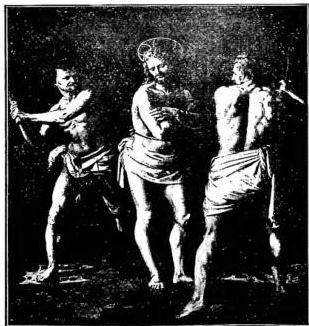
Already in these and in the other paintings completed in Rome (Flagellation in S. Prassede; altarpiece in S. Maria dell'Anima; Stoning of St. Stephen in S. Stefano at Genoa, etc.) he departs from Raphaelesque balance and rhythm, strengthening the plastic effect by loading the surfaces with smoky shadows, and already revealing that scenographic taste that later becomes more pronounced. After Raphael's death, he inherited together with Penni the completion of the works left unfinished (The Transfiguration), the commissions (altarpiece of Monteluce), and the direction of the decoration of the Sala di Costantino and of the Villa Madama on Monte Mario. Meanwhile his activity as an architect began (Villa Lante on the Janiculum; Palazzo Alberini; Palazzo Cicciaporci). In 1524 he went to Mantua, summoned by Federico Gonzaga, who first entrusted him with the construction of the Palazzo del Tè, then with the superintendence of all the buildings of the city. There he directed the works of the Palazzo Ducale, then the renovation of the nearby monastery of S. Benedetto di Polirone (1539) and that of the Cathedral (1544). As a painter in this period he worked above all in fresco in the vast decorations of the Palazzo del Tè, but the easel paintings are also numerous (Nativity for S. Andrea of Mantua, now in the Louvre, etc.). In 1543 at Bologna he provided a design for the facade of S. Petronio, where a work of sculpture is also attributed to him, with good reason, namely the terracotta group of the Madonna with the Child on the tomb of Ottaviano Castelli. He died at Mantua while preparing to return to Rome, summoned by Paul III to the direction of the Fabbrica of St. Peter's.
Even more than for his work as a painter, which nonetheless occupies a notable place at the beginning of the mannerist movement, G. R. is important as an architect. Better than in the Roman works, in which he still does not break away from Renaissance schemes, it is in the Palazzo del Tè that his genius as a sumptuous designer and his character as a classicizing scenographer are fully manifested, which would influence the Venetian architecture of the mainland.
Bibliography4 works
Emma Zocca