
ICON. — A Greek word meaning image, which has entered usage to designate portable paintings with sacred images from the early centuries, and generally those of Eastern type. The iconoclastic fanaticism which, between the 8th and 9th centuries, persecuted religious painting in Byzantine territory, destroyed portable paintings above all; this explains the extreme rarity of the i. from the early centuries and, consequently, in view of the scarcity of comparisons, the uncertainty of their dating. It should also be added that investigation is further impeded by the fact that these paintings, precisely because of the veneration in which they were held, often underwent repainting or alterations intended to keep them suitable for worship; at other times they were almost entirely concealed from view. The latter is the case of the famous i. of the Savior of the Sancta Sanctorum, called the Acheropita, whose existence is already documented by the Liber Pontificalis in the time of Stefano II (752–757): completely concealed at the end of the 12th century by a covering of gilded silver foil and by a painted veil that also concealed its original face, it could be examined only in 1907 by mons. Wilpert, who, despite the ruinous condition of the image, reached the
conclusion that it is a Roman work to be assigned to the 5th–6th century. In contrast, in the i. of the Madonna of S. Maria Nuova, a very recent restoration, removing the vulgar 19th-century repainting, revealed that the image of the 12th century concealed another, extraordinarily precious for its beauty and remote antiquity, which may perhaps date back to the 4th or 5th century. The study of these two i. also provides information about the technique with which they were executed: the i. of S. Maria Nuova is in wax (v. ENCAUSTO) on linen canvas, according to a technique that seems to have been widely used in the 4th–6th centuries; the Acheropita, on the other hand, is painted in tempera on hemp canvas glued to a walnut panel and prepared with a thin layer of lead white, and this is the technique commonly used thereafter.
Besides these, which are the oldest surviving in Rome, the i. with images of saints in the Museum of Kiev, brought from Sinai by Bishop Porfirio (perhaps from the 6th century, with features akin to the paintings of Fayoum), and those similar ones in the Museum of Cairo also predate the iconoclastic movement; whereas, among the many venerated in the monasteries of Mount Athos, only the Panagia Portaitissa of the monastery of Iviron would date, according to Kondakov, to the 9th century. Other famous i. in Rome are those of the Madonna della Clemenza in S. Maria in Trastevere and of the Madonna Salus Populi Romani in S. Maria Maggiore, both of extremely uncertain date: for the former, criticism has proposed various dates, between the 7th century and the end of the 13th; the latter, which seems to be a fragment of a full-length image, has variously been assigned to the 5th, 9th, and 13th centuries, in which last case it is considered, like the other, a copy of a very ancient original. Equally uncertain is the date of the entire group of i. of the Madonna which a late tradition attributes to s. Luca, in Rome (S. Maria d'Aracoeli, S. Maria in Via Lata, S. Maria della Pace, S. Agostino, S. Maria del Popolo, etc.) and in other places in Italy (Bologna, sanctuary of S. Luca; Bari, crypt of the Cathedral; S. Maria di Pulsano near Monte S. Angelo, etc.); of all of them, however, the oldest is that of Aracoeli, to be assigned to the 10th–11th century. Among the rare i. of the
10th century are also the greatly venerated Madonna Nicopeia in S. Marco in Venice, originating from Constantinople, and the portable mosaic with the Pantocrator in the Museo nazionale of Florence, composed of extremely minute tesserae set in wax, according to a technique fairly widespread in this period, examples of which, also of rather large dimensions, are preserved in the monasteries of Chilandari and Xenophon on Mount Athos; a well-known example of such i. in mosaic is that with the 12 feasts of the year, in the Museo dell’Opera del duomo of Florence, from the 12th century. I. attributable to this century are naturally more frequent (in addition to the most frequently cited ones in Rome, one may mention the Madonna called that of S. Guglielmo at Montevergine; the Madonna della
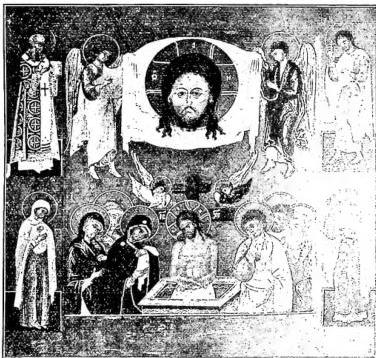
(from N. P. Kondakov, L'i. russe, Prague 1925, inv. 42)
ICONE — Holy Face and Descent from the Cross. Painting by Prokop Tchirin (first thirty years of the 17th century) — Leningrad, Russian Museum.
In these later i., the covering of silver foil became extremely common (already in use in the 12th century, as seen in the Acheropita of the Sancta Sanctorum); it sometimes covers the background, and at other times also part of the image, leaving visible only the face. The minor arts contributed to making the most venerated i. resplendent with such coverings and other ornaments. The silver foil covering the Acheropita, which was restored in various
periods up to the Baroque age, has, in its oldest parts, geometric ornaments hammered into moulds; in other parts it has repoussé figures, and is also enriched with enamels. The Nicopeia of Venice has a halo of enamels on gold foil and a frame adorned with other Byzantine enamels contemporary with the image. The technique most commonly used for ornamenting backgrounds, especially in the countries of the East, is filigree.
Among modern i., particular mention should be made of the one presented to His Holiness Pius X by the Russian Catholics on the occasion of his priestly jubilee (1908). — Vedi tavv. XCIII-XCIV.