
BARI, ARCHDIOCESE OF. In Apulia, in the province of the same name, it has about 464,000 inhabitants, 53 parishes, 245 secular priests and 120 regular priests, 2 seminaries (minor and regional). The see of Bari, which has as its suffragan dioceses Ruvo-Bitonto and Conversano, is united with the title of the ancient bishopric of Canosa (q.v.). The archbishop has the title of Primate of Apulia. Of particular importance is the chapter of the cathedral, whose canons have the privilege of pontifical insignia. The clergy proper, governed by a Grand Prior who is the first religious authority in the diocese after the archbishop, has the Palatine Basilica of St. Nicholas, exempt from the jurisdiction of the archbishop. Patrons: St. Nicholas, Bishop of Myra, and St. Sabinus, Bishop of Canosa; feast (of the translation of the relics of St. Nicholas), 9 May.
Bari arose near the necropolis of Caeliae (now Ceglie del Campo), which reached its zenith in the 5th century BC and was supplanted by Bari, which became one of the richest places in Magna Graecia, where the Italiote element of the Iapygi (from which the name Iapygia for the region between Cape Salento and Daunia, roughly the territory of the present-day provinces of Bari, Brindisi, Lecce and Taranto) and the Greek element fused. An autonomous city, on the model of the other Greek colonies of Magna Graecia, it became, after the Roman conquest of Apulia (317 BC), a municipium of some importance: perhaps in the Augustan age, when Horace, on his journey to Brindisi, speaks of it as a fortified city.
After the fall of the Western Empire, the Goths settled there. Later, towards the end of the 6th century, Lombard rule under Authari extended over all Apulia. Plundered by Constans II around the middle of the 7th century, Bari came under the sway of the Eastern Empire but only for a short time, for at the death of Constans II the city passed under the Lombard duchy of Benevento. Under Leo the Isaurian, the Eastern Empire reasserted itself on the Apulian coasts, but that subjection was poorly tolerated and Bari shook it off by giving itself an independent leader in the person of Duke Theodore. The later history of the city oscillated between high Byzantine rule and obedience to the Beneventan princes, who were all the closer. From 841 to 870 there was a Saracen interlude until Emperor Louis II managed to free the city after a long siege. But Bari’s return to Christendom once again benefited, anew, Byzantium. From then on, although contested by Saracens, Lombards and Germans, Bari was subject to Byzantine rule and for about two centuries was the bulwark of the South and the seat of the catapan of Italy. After some unsuccessful attempts at autonomy, the Normans intervened, exploiting local dissensions and in particular the hostility towards the Byzantines. In 1071 Bari fell into the possession of Robert Guiscard, who made the duchy of Apulia hereditary in his house. In the Norman age, Bari witnessed the translation of the relics of St. Nicholas, which a group of Bari merchants solemnly transferred from the Saint’s tomb in Myra of Lycia. On 9 May 1087, according to tradition, the relics were deposited in the palace of the catapan, ceded by its new owner, Archbishop Ursus II. Another version delays the translation to 1098 and attributes the merit to the Venetians. On the spot where the relics were deposited there quickly arose the famous basilica dedicated to St. Nicholas. The event consecrated what Norman rule made possible: the return of the Church of Bari to direct dependence on Rome, from which it had been detached during Byzantine rule.
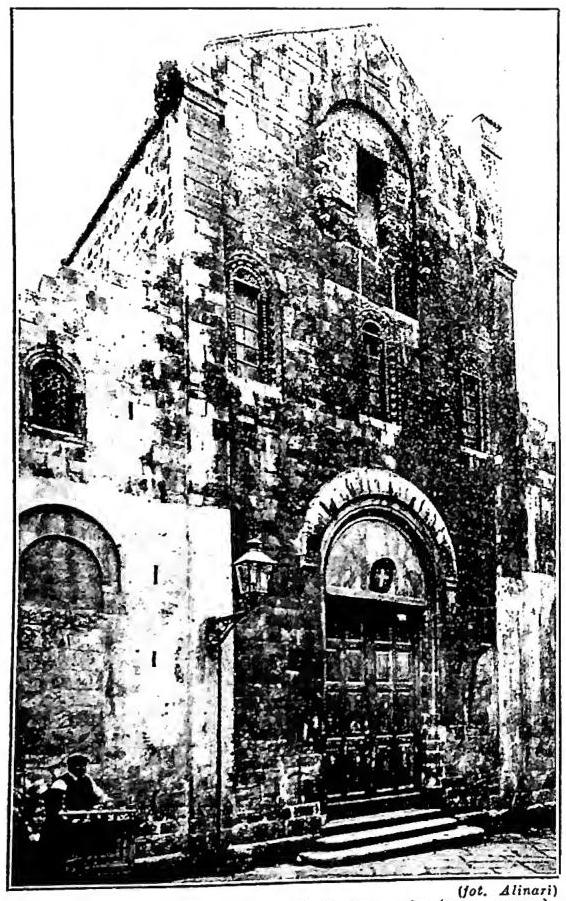
BARI - Façade of the church of S. Gregorio (11th–12th cent.).
of Bari as a metropolitan see, granting it jurisdiction over Canosa, Giovinazzo, Molfetta, Trani, Ruvo, Canne, Minervino, Montemilone, Lavello, Cisterna, Vitalba, Conversano, Polignano and Cattaro, on the opposite shore of the Adriatic.
In 1089 Urban II, upon presenting the pallium to Archbishop Elias, proclaimed him Primate of Apulia. Abbot of the ancient monastery of S. Benedetto, the cradle of religious sentiment in the city, Elias was entrusted with the custody of the relics of St Nicholas and the construction of the temple dedicated to the Saint, of which he was also the first rector. He governed the Church of Bari for three lustrums, until 1104. A council had been held at Bari in 1064; a second was held there in 1098 at the will and in the presence of Urban II, who years earlier, on the occasion of the Council of Melfi and the consecration of Elias, had come to venerate the relics of the Saint and to recognize their cult. Yet the attempt then made to renew religious unity between East and West did not bear fruit. Bari, already a port frequented by pilgrims from the Holy Land, became, toward the end of the 11th century, an important stop on the crusading enterprises. Peter the Venerable was a guest of Elias in the preparation of the Crusade; the bishop of Valence died there while awaiting embarkation. During the period of the Crusades, Bari, together with Brindisi, was the westernmost staging post before the voyage into the Levant for Norman, French and Provençal princes. The principality erected by Bohemond at Antioch and the ever more frequent establishment of Apulian and Barese merchants in the eastern Mediterranean, intensifying maritime relations, marked, for several centuries, an ever greater participation of the city in the renewed Latin unity of the sea that had once been Rome’s; from the most distant centuries of the Middle Ages, Bari has maintained its essential function as the gateway to the East.
The Norman domination, consolidated throughout southern Italy by Roger II, made Bari one of its chief centres. Around the year 1130 Archbishop Angelo, in harmony with Norman policy, became a supporter of Anacletus II against Innocent II. Subsequently, the city, which had become a centre of an autonomist attempt under Prince Grimoald Alferanite and was contested between Roger II, Lothair III and the elected Duke of Apulia Rainulf of Alife, was barbarously destroyed in 1156 by King William I. It passed through the series of dominations of the South: from the Normans to the Swabians, who favoured it, especially under Frederick II, also on account of the proximity of the Saracen military colony at Lucera and the fortress of Castel del Monte; from the Swabians to the Angevins, between whose two branches the city was disputed; from the Angevins to the Aragonese, who first enfeoffed it to the Del Balzo-Orsini, then to the Sforzas of Milan; from the Aragonese to the Spaniards, the Habsburgs and the Bourbons. Centuries of decline followed the Aragonese age: at the beginning of the 19th century the city had been reduced to little more than the ancient borough, and from the 50,000 inhabitants of its prosperous period to 18,860. Even during the years of the French Revolution and the Napoleonic epic, during the occupation by the troops of the Directory in 1798, the first brief restoration and the reign of Joseph Bonaparte, Joachim Murat laid, in 1813, the first stone of the new city at the edge of the old borough, marking for Bari the advent of new times.
Upon entering the new Italian State in the wake of the Expedition of the Thousand, it has received in recent years decisive impetus that has made it the principal commercial and maritime centre, after Naples, of southern Italy.
In more recent centuries, the ecclesiastical history of the diocese presents only a few moments of particular interest: one of its archbishops, though never having taken possession of his see, Bartolomeo Prignano, was elected pope (Urban VI); under him the Great Schism of the West arose, and the Church of Bari was also divided between the Urbanist and Clementine clergy. Other notable figures of archbishops succeeded one another during the 15th–17th centuries: in the time of Leo X, Gian Giacomo Castiglioni; before and after, Cardinals Latino Orsini, Stefano Gabriele Marini, who later became Patriarch of the Indies, Girolamo Grimaldi; the former nuncio to the court of Turin, Giulio Cesare Riccardi; Cardinal Bonvisi; Ascanio Gesualdo, formerly nuncio to Belgium and Germany and later Patriarch of Constantinople; Nunzio Gaeta, who then moved to the patriarchal see of Jerusalem. The diocese of Bari had already in ancient times been enlarged with the territory of Canosa; later it incorporated those of Acquaviva and, in the revision of the ecclesiastical constitution of the kingdom carried out in 1818, that of Bitetto.
Bari has produced several illustrious names: for holiness, such as the Blessed James of Bari, a Franciscan friar; for dignity, such as Cardinals James of Turre and Francis de Caris, of the 14th century, and Archbishops Paul the Teuton of Manfredonia (16th cent.) and Francis Nicolai (18th cent.); for political initiatives, such as the leaders of the Barese autonomist movement Argiro the Lombard, Agirizzo the Greek, Melo the Apulian; chroniclers and historians, such as the archdeacon John, author of the Translatio s. Nicolai and other writings (11th cent.); Lupus Protospatharius and the anonymous author of the Annales Barenses and perhaps also William the Puglian, the singer of Robert Guiscard; the 17th-century historian of the city, Fr. Antonio Bestillo, SJ, and the 18th-century describer of the cult of St Nicholas, Nicola Putignani, canon of the cathedral; and among modern scholars who worked on the publication of the Codice diplomatico barese, one must at least recall Francesco Carabellese and Monsignor Francesco Nitti.
Not far from the city, a pilgrimage destination on the last Sunday in August, is the sanctuary of the Pozzo di Capurso, dedicated to the Virgin. In the city are the houses of the Dominicans, formerly the convent of S. Francis of Paola, which they reoccupied after their return in 1820; of the Capuchin Friars Minor, of the Jesuits, in the building attached to the church of the Gesù, of the Salesians, of the Benedictine Nuns of S. Scholastica, who have repeatedly moved from building to building. At Palo del Colle is the only Olivetan monastery remaining in Italy.
Pier Fausto Palumbo
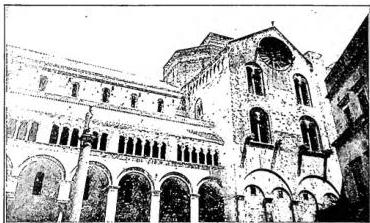
ARTE. - Within the perimeter of its ancient walls, the "old city," raised on the promontory that juts into the sea between the two harbors, preserves the most significant monuments of Bari: the Cathedral, St. Nicholas, the church of St. Gregory, and the Castle. The Cathedral was founded by Archbishop Bisanzio; construction began in 1034 and was completed in about thirty years, but the destruction suffered by the city in the time of William I the Norman (1156) prompted a general reconstruction that took place between 1170 and 1178. The new cathedral arose with its clear Egyptian-cross plan and the two apsidal bell towers, of which the one on the right collapsed in an earthquake during the 17th century. Many restorations have altered the beautiful structure; however, the work begun in 1920 has restored to the church some of its ancient values both externally and internally.
Externally, noteworthy besides the high façade is the apsidal window rich in sculpture and the ends of the transept, especially the right one with an extremely ornate rose window. The dome, which rises at the intersection of the transept with the central nave, has a low cupola that barely emerges from the octagonal drum decorated with reliefs of distinctly Arab character. Internally, the three naves are divided by sixteen monolithic columns. Here the distribution of space is characteristic, for the naves narrow toward the apse so as to give a sense of greater depth to the structure. The level of the transept and the presbytery is raised by seven steps, and for this reason too this part of the building assumes a character of greater grandeur. The central apse preserves remains of frescoes from the 13th century, while in the transept there are paintings by Tintoretto, Paolo Veronese, and Paris Bordone. Adjoining the cathedral is the "trulla," a 17th-century cylindrical building externally and dodecagonal internally; originally a baptistery, it is now a sacristy, and from here one descends into the 12th-century crypt of the cathedral. In the archives of the Bari cathedral are preserved ancient parchments, particularly famous an Exultet, a work of Beneventan calligraphers of the 11th century, adorned with miniatures of Byzantine taste but certainly by Italian artists.
The basilica of St. Nicholas, begun in 1087 under the direction of the Benedictine Elias, is without doubt the most important among the Romanesque monuments of Apulia. Its crypt was consecrated by Pope Urban II on 1 October 1089. The building was completed in 1108 but was consecrated much later, in 1197, by the bishop of Hildesheim by mandate of Celestino III, it is said in the presence of Emperor Henry VI. The beautiful façade preserves its original character and reflects in its divisions the forms of the interior, especially in those two pilasters that run the entire length, marking the limits of the main nave and accentuating the upward sense of its lines. Two large towers, only partially built, flank the front slightly in projection.
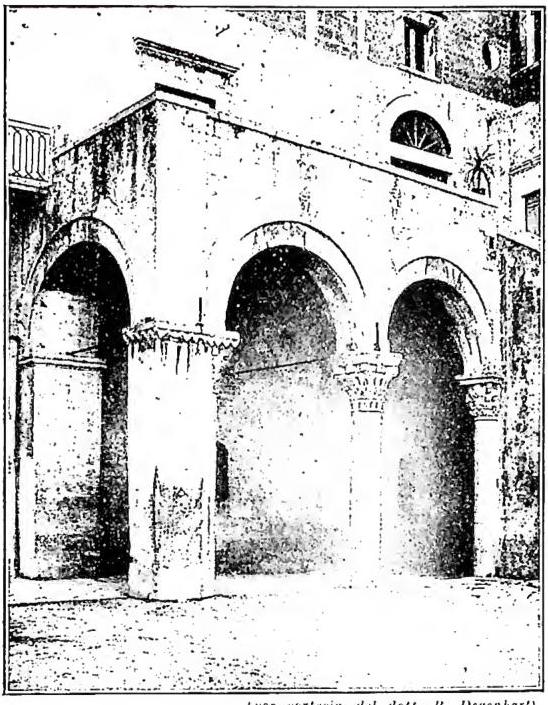
The church of S. Gregorio has a Romanesque façade dating to the late 11th or early 12th century, adorned with three beautiful portals. The castle is one of the most beautiful in Apulia. It has a central nucleus built by Frederick II between 1233 and 1240 on the remains of a previous Norman construction, probably founded where the ancient acropolis of the Greek city once stood, and a 16th-century addition. In the new city, the church of S. Ferdinando is notable for its Neoclassical façade by Fausto Niccolin