
BANDELLO, MATTEO. – Novelist, born at Castelnuovo sulla Scrivia around 1485. At a very young age, perhaps in Rome, he entered the Dominican Order, whose master general at that very time (1501–1506) was his uncle, Vincenzo Bandello. He moved to the Milanese convent of the Grazie, where he did not remain long, being constantly on the road to Genoa, Florence, Naples, and Calabria. He subsequently broadened still further the circle of his travels and acquaintances, having in 1506 won the favor of the Bentivoglio, exiles in Milan from their Bologna; on several occasions the young Dominican then crossed the Alps on diplomatic missions. After the Battle of Marignano (1515), he moved to Mantua, to the court of Isabella Gonzaga; six years later, when Francesco II Sforza assumed the duchy of Milan, he returned there for a few years, until the Morone conspiracy (1526) aroused suspicion against him and he had to seek a change of air, returning to his Gonzaga patrons, this time as secretary to Luigi, captain of the Holy League. After leaving Gonzaga, in 1528 we find B. with Cesare Fregoso, captain first for Venice and then for France, and thereafter with Fregoso’s widow, Costanza Rangoni, a guest of Francis I of France, when Fregoso fell at the hands of Charles V’s assassins (1541). In the peaceful retreat of Barens, the adventurous friar devoted himself to the learned conversations of the circle that gathered around Rangoni and to composing his novellas and verses. On 1 September 1550 he was appointed bishop of Agen by the king of France, reserving half the revenues of the see for Ettore Fregoso, a cleric from Verona; but the appointment was purely provisional, since B. resigned at the beginning of 1555, when Giano Fregoso was appointed to that see; he was then granted the castle of Bazen, situated in the diocese. He died in France in 1561.
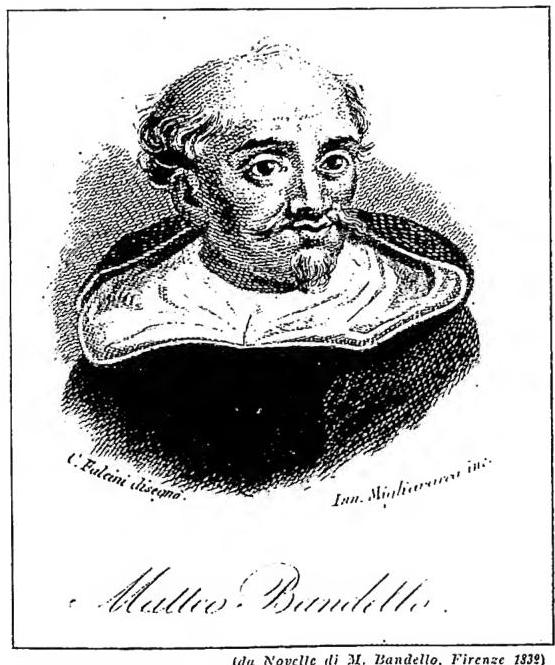
In B., the describer prevails over the artist and, consequently, the historical document acquires greater interest than the narrative itself. Historical figures and distant events come to life in his closely packed pages; but even more so do the people and events of real life, which the practiced eye of the contemporary scrutinizes and displays without veils.
Moving away from the framework of the Decamerone, although it was so widespread in the sixteenth century, B. leaves his two hundred and fourteen novelle independent of one another, but precedes them with dedicatory letters in which, among other things, he explains how and where the novella had previously been narrated, thereby recreating around the work the color of the period. From the religious point of view, his work attempts to undermine the very foundations of morality: licentiousness, ecclesiastical in this case, passes from speech to a complete lack of respect for sacred things—from Boccaccian laughter to the most extreme immorality.
Works: Tutte le opere di M. B., edited by F. Flora, Milan 1934–35.