
GONZAGA, FAMIGLIA. – The asserted Germanic descent of the G. and their supposed kinship with the Ottonians are entirely legendary. As regards their origin, it is still debated whether they were milites of Countess Matilda of Canossa or, from very ancient times, minor vassals of the monastery of S. Benedetto in Polirone (the feudal bond with this monastery still existed toward the end of the fourteenth century). In the second half of the twelfth century the G. settled in the city of Mantua and increasingly expanded their possessions around it and toward Reggio Emilia. In the thirteenth century they were banished from Reggio and their estates in the Mantuan territory were confiscated, but the protection of the Bona-
(fot. Geb. fot. naz.)
In 1328 Luigi G. overthrew the lordship of the Bonacolsi and was proclaimed captain general of Mantua, with the right to designate his successor. From Ludovico the Bavarian he received the title of imperial vicar. He took part in the league against Giovanni of Bohemia, and later in that against the Scaligeri; but in 1358 he was forced to recognize the high sovereignty of the Visconti. He died in
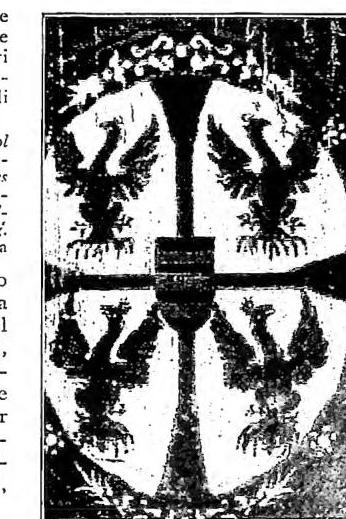
1360. He was succeeded in the office of captain general by GUIDO (1360–69), LUDOVICO (1369–82), and FRANCESCO (1382–1407). Francesco sought to escape Visconti domination by relying on Venice. The feudal bond linking the G. to the monastery of S. Benedetto was annulled by Boniface IX, who made Mantua a fief directly dependent on the Holy See, exempting the G. from any tribute, even merely formal. Francesco reformed the Bonacolsi statutes and, concentrating power in his own hands, laid the foundations of the principality. In 1403 the emperor Wenceslaus gave him the title of marquis, but Francesco did not use II. His successor GIANFRANCESCO (1407–1444) refused the same title in 1413, but later bought it in 1433 from Sigismund, when he judged that the latter had consolidated his position on the imperial throne: he thereby acquired the right to add four eagles with outspread wings to his coat of arms. Gianfrancesco found himself in difficult circumstances, caught between the Duchy of Milan and the Republic of Venice, which were at war with each other. In 1438 he abandoned the Venetian alliance in favor of the Milanese one, and the Peace of Cremona compelled him to cede considerable territories to Venice. During his government, Vittorino da Feltre’s school flourished in Mantua. At his death Gianfrancesco divided the state among his four sons, but the death of two of them and the rebellion of a third, CARLO, enabled the other son, LUDOVICO (1444–1478), to remain sole lord. In 1450 Ludovico allied himself with Francesco Sforza, whom he strongly assisted in the conquest of the Duchy of Milan; but the Peace of Lodi confirmed Mantua’s loss of the territories previously ceded to Venice. During his government Ludovico greatly increased the prestige of the marquisate, especially through his activity in public works. He donated reclaimed lands to cultivators, devoted particular attention to water management, had two churches built to designs by Leon Battista Alberti, and commissioned the celebrated tower with its clock regulated by Bartolomeo Manfredi. A passionate reader of the classics, he lavished subsidies on writers and artists. Ludovico likewise arranged that after his death the state should be divided among various heirs, thereby causing a dispersal of power and wealth. Of his sons, FRANCESCO was the first to wear the cardinal’s purple (in 1461): for him Poliziano wrote the Orfeo; LUDOVICO received the bishopric of Mantua; GIANFRANCESCO was assigned the lordship of Sabbioneta, Bozzolo, etc.; and RODOLFO, who died in the battle of Fornovo, that of Castiglione delle Stiviere, Solferino, etc.
From Gianfrancesco’s branch, SCIPIONE, son of Carlo, deserves mention. Born in 1542, he studied at Padua and in 1565 went to the court of Maximilian, obtaining for himself and his family the title of prince of the Empire. In 1585 Sixtus V made him patriarch of Jerusalem, and in 1588 appointed him cardinal; in 1590 he received from Vincenzo I the government of Monferrato, and he died in 1593. In 1564 Scipione founded the Accademia degli Eterei, which counted Tasso among its members, and he was one of the revisers chosen by the poet for the Gerusalemme. The same branch also included GIULIA, daughter of Ludovico, born in 1513 and married to Vespasiano Colonna. Through her personal charm she attracted scholars and poets around her; she was celebrated by Ariosto and other writers and portrayed by Sebastiano del Piombo and Titian. Giulia took part in the movement of the «reform» and corresponded with Carnesecchi. She died in 1566. From the Castiglione delle Stiviere branch, s. LUIGI (v.), great-grandson of Rodolfo, and LUIGI (1745–1819), scholar and adventurer, should be noted. In France he presented himself as a Jacobin; later, in Austria, he ceded to Maria Theresa every right of sovereignty in exchange for a life annuity.
On the throne of Mantua, Ludovico was succeeded by FEDERICO (1478–84), who for some time commanded Sforza’s troops in the war between Florence and Sixtus IV. Under FRANCESCO (fourth marquis of Mantua, 1484–1519), the marquisate became involved in the great political and military struggles of the age. While his wife, Isabella d’Este, made Mantua a major cultural center, Francesco, placed at the head of the Italian League in 1495, pursued an ambiguous policy; consequently, when French rule was restored in Milan in 1500, he only narrowly avoided having his territories divided between France and Venice. His successor FEDERICO (1519–40), although from 1521 he held the office of captain general of the Church, sought the favor of Charles V and, during the War of the League of Cognac, opened the way to the landsknechts in agreement with Alfonso d’Este. From that moment he remained faithful to imperial policy, but his hope of recovering the lands ceded to Venice and his aspiration to the Duchy of Milan were disappointed. The sole compensations for his activity as an imperial agent were the elevation of Mantua to a duchy (1530) and the gift of Monferrato, which was to cause so many misfortunes for the G. At Federico’s death, the regency for his young nephew FRANCESCO was assumed by ERCOLE (born in 1505, died in 1563), who abandoned it during Francesco’s brief government and later resumed it until 1550. Ercole was appointed bishop in 1521, then went to the University of Bologna, and in 1526 received the cardinal’s purple. During his regency Ercole restored the state’s finances by restraining court luxury, appointed Giulio Romano prefect of waters and buildings, renovated the Cathedral, calling upon Veronese to decorate it, and commissioned paintings from Titian. In 1561 he was one of the five papal legates to the Council of Trent, whose presidency was entrusted to him and which he held until his death.
Ercole’s brother was FERRANTE (1507–57), who took part in the 1527 campaign in Rome with the imperial forces and, in 1530, after Orange’s death, commanded the army at the siege of Florence; he subsequently participated in the expedition to Tunis and in the War of Provence. In 1539 he purchased Guastalla. In 1546 he was appointed governor of Milan. But after the conspiracy against Pier Luigi Farnese and the unfortunate outcome of the War of Parma of 1551–53, he was recalled to Brussels, and Milan was given to the duke of Alba. At Ferrante’s death, the lordship of Guastalla passed to his firstborn son, CESARE. A nephew of Ercole, the third-born son of Federico, LUDOVICO, was taken as a boy to France in 1549, where he inherited the estate of his maternal grandmother, Anna d’Alençon. He became an influential figure at the court of Henry II, was a trusted adviser of Caterina de’ Medici, and a support of the Catholic party. By marrying Enrichetta di Clèves, he acquired the titles and possessions of Rethel and Nevers. Another G., CURZIO (1536–99), was sent by Cardinal Ercole to Charles V as delegate for the peace of Cateau-Cambrésis. He then moved to Rome, where he was admitted to the Accademia delle notti vaticane founded by Cardinal Borromeo; he wrote Rime and a chivalric poem.
The power of the G. reached its height with another nephew of Ercole, GUGLIELMO (1550–87),
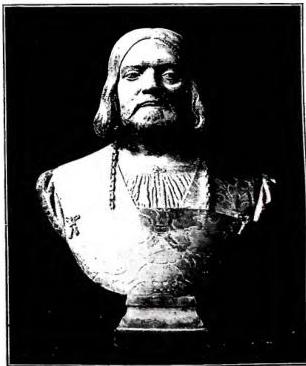
GONZAGA, Famiglia – Bust of Francesco G. Terracotta by G. C. Romano (15th century) – Florence, Museo Bardini.
In 1637 Carlo I’s nephew, CARLO II (1637–55), ascended the throne of Mantua, under the regency of his mother MARIA until 1647. Maria devoted all her energies to rebuilding the country, and her activity seemed to produce good results; but the government of the ineffectual Carlo II, and subsequently that of FERDINANDO CARLO (1655–1708), brought new wars, new Franco-Spanish and imperial invasions, and new devastation upon Mantua. On 30 June 1708 Ferdinando Carlo was declared guilty of felony, and the Diet of Regensburg annexed the Duchy of Mantua to the direct authority of the Empire. Two years later Guastalla too became part of the hereditary states of the House of Austria. Mantua nevertheless retained its ducal title until 1815, when its territory was annexed to the Kingdom of Lombardy–Venetia. – Vedi tav. LXIV.