
BOEMIA. –
I. GEOGRAPHY
Region of central Europe corresponding to the upper basin of the Elbe (Labe, in Czech), that is, to a quadrilateral enclosed on every side by uplands (the Erzgebirge, or Krušné Hory, to the NW; the Giant Mountains, or Krkonoše, and the Sudeten Mountains to the NE; the Moravian-Bohemian hills to the S.; and the Bohemian Forest, or Šumava, to the W.), which thus isolate it from the adjoining areas of Bavaria, Saxony, Prussia, Moravia, and Austria. Despite its modest extent (52,062 sq km, approximately three times that of Lazio), Bohemia is a land of highly varied appearance, resources, and aptitudes. Of the peripheral mountainous sectors, only the western one has well preserved its original woodland cover, on the exploitation of which the local economy essentially depends; both the Krušné Hory and the Sudeten Mountains, on the other hand, have for some time been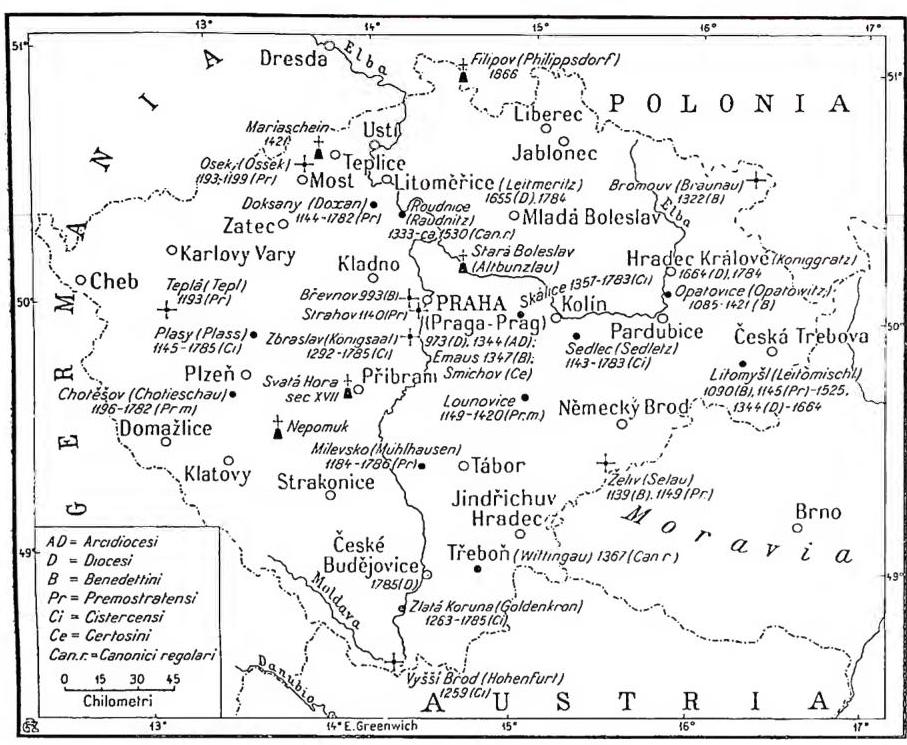
The climate, distinctly continental, with cold winters (-3°) and hot summers (20°) in the lowland areas, has abundant rainfall, but well distributed for agriculture. The marginal regions, damper and colder, remain within the domain of the forest (from 40 to 60% of the territory). The population, which had not reached one million inhabitants in the middle of the seventeenth century, numbered 6,300,000 at the beginning of the present century and 6,800,000 in 1910, falling to 6,700,000 in 1921 (as a consequence of the First World War and the strong emigration movement). The 1930 census recorded 7,109,376 inhabitants (137 per sq. km.; approximately the rate of Liguria), of whom one third were Germans. After Germany’s defeat and the reconstruction of the Czechoslovak state, the latter were transferred, in their overwhelming majority, to the American and Soviet occupation zones in Germany, and the population of B. fell in 1947 to 5,626,566 inhabitants (108 per sq. km.).
In the depopulated marginal areas, Bohemian groups from the interior of Czechoslovakia and from abroad will be settled. It is not yet possible to foresee what repercussions these events will have on the economic structure of B. Before the last world conflict, more than two fifths of its population was engaged in industry and less than one third in agriculture and forestry; both activities were possible and developed thanks to active internal trade (Moravia, Slovakia, Subcarpathian Ruthenia, the latter having passed to the U.S.S.R.) and international trade.
Among the inhabited centres, Prague, the country’s traditional capital, is today approaching one million inhabitants (921,000 in 1947); another, Plzeň, exceeds 100,000 (118,000 on the same date), and about ten others exceed 20,000 (Ústí nad Labem, Liberec, Hradec Králové, Kladno, České Budějovice, Karlovy Vary, etc.).
Giuseppe Caraci
II. HISTORY
This country, which remained to the east of the regions occupied by the Romans and was inhabited by the Quadi and the Marcomanni, is mentioned by Tacitus, Strabo, and Velleius Paterculus. The primitive populations were overwhelmed in the 6th century by Slavic tribes that arrived from beyond the Carpathians and established there their first state institutions. Thrown into crisis by Avar and Frankish invasions, they found in the Slavic prince Samo a valiant leader who succeeded in establishing a kingdom in the 7th century; at his death, however, it disintegrated. With the predominance of the Franks in Germany and Italy, the Bohemians, or Czechs, as they were also called, came under their influence, not only politically but also religiously; but the decline of the Empire after Charlemagne favored the emergence, during the 9th century, of the kingdom of Great Moravia, which also included B., under Prince Mojmír. His successor Rostislav thus found himself between the nascent kingdom of Germany and the Empire of Constantinople, in a region subject to a dual influence; without breaking relations with Rome, he welcomed into Moravia the two apostles Cyril and Methodius, who came from the East, and supported Methodius, whom Pope Adrian II appointed archbishop of Pannonia.
Svatopluk (871–94), Rostislav’s successor, continued his predecessor’s policy. The great Hungarian invasion at the beginning of the 10th century, penetrating the Danube valley, separated the Byzantine East from the West, breaking up that kingdom, which remained isolated, and forcing B. into more direct contact with Germany and the West.
Pier Fausto Palumbo
During the 10th century, the duchy of B. gradually consolidated under the Přemyslid dynasty, whose capital was Prague, a city then in the first stages of its development. Prince Wenceslas (v. : 920–29) regulated relations with Henry I, king of Germany, by treaty, thereby decisively directing the destiny of B. toward the West; at the same time, he fostered the development of Latin Christianity in the country. He fell victim to the reaction led by his brother Boleslaus and was venerated as the nation’s patron saint; the impulse he had given was never again halted.
Under Boleslaus II, the bishopric of Prague was established (973), its territory being detached from the bishopric of Regensburg and subjected to the metropolitan see of Mainz: the first bishop was a Saxon, soon followed by the Czech St Adalbert, who founded at Břevnov near Prague the first monastery, with Benedictine monks brought from Rome. B. united its destiny with that of neighboring Germany in political and religious affairs, while attempting to enlarge its borders. The Přemyslid Ottokar I (d. 1230) obtained from Philip of Swabia, king of Germany, the hereditary royal crown (1190) as a fief of the Empire; this dependence was only formal, but it entailed the right to participate with the other princes in the election of the emperor. Ottokar II (d. 1278) aspired to succeed the extinct Babenbergs in the duchies of Austria and Carinthia, in Styria, and in Carinthia, but he faced the king of Hungary and King Rudolf of Habsburg, by whom he was defeated. His son Wenceslas IV also obtained the kingdom of B. in 1300 (cf. Dante, Purg., VII, 97 ff.), but with him the dynasty came to an end in 1305, being succeeded by that of Luxembourg. Under the latter, together with the expansion of German colonization and without impairing national independence, a new current of civilization developed in B., corresponding to that which encompassed all Western Europe. It was especially under Charles I (later Emperor Charles IV) that this current attained its greatest splendor in the arts, literature, and sciences; the University of Prague was founded; monumental buildings were constructed; and the diocese of Prague was elevated to an archbishopric.
At the same time, however, a reforming movement and an anti-German tendency began to intensify. These erupted violently under Wenceslas IV, king and emperor, through the work of John Hus and his disciples, and later assumed a distinctly national and political character through the work of John Žižka. The wars became more bitter under the reign of Sigismund, Wenceslas’s brother, king of Hungary as well as emperor, and kept not only B., which was left devastated by them, but also the neighboring countries in a state of agitation.
In 1526 B. came under the rule of Ferdinand of Habsburg, later emperor, and followed the fortunes of this dynasty, undergoing a constant process of Germanization which in the 18th century threatened to absorb completely whatever still remained of Czech nationality. It was only with 1848 that a stronger patriotic spirit began to make itself felt, together with the desire for independence and the emergence of a national literature and language, while, drawing upon the tradition of Hus and Žižka in opposition to the Habsburgs, anti-Roman religious prejudices also took root. The struggles in the Vienna Parliament on this subject were bitter and ceased only when, at the end of the world war, in 1918, B. began to form part of the independent Czechoslovak republic.
For further ecclesiastical information, literature, art, and the school system, V. CECOSLOVACCHIA.