
LAZIO. -
I. GEOGRAPHY
This name, which originally applied to a small territory S. of Rome, today designates the southernmost region of central Italy, comprising, in addition to L., as it existed until a little more than twenty years ago, 1) Sabina, a hilly and mountainous region centered on Rieti, formerly attached to Umbria, separated from it in 1923 and constituted as a province; 2) a strip of the Abruzzo aquilano (the former district of Cittaducale), transferred to the same province; 3) the northern part of Campania on the right bank of the Garigliano, which, together with part of the former province of Rome, formed the new (1934) province of Littoria, later named Latina.L. has thus come to unite districts differing greatly in their natural and human characteristics: the bare and arid Apennine mountains of the Simbruini, Ernici, and Mets; the volcanic anti-Apennine complex (Volsini, Cimini, Sabatini, Albani) and the limestone complex (Lepini, Ausoni, and Aurunci) nearer the sea; the Roman countryside and the Roman agro.
The area N. of the lower Tiber, between the anti-Apennines and the sea, is known by the name of Roman Tuscia and extends as far as the Fiora River. The latter area, covered mostly with scrub and woodland, gives way inland to the pleasant landscape of the volcanic lakes (Bolsena, Vico, and Bracciano), surrounded by chestnut groves and vineyards and continuing, beyond the Tiber and Rome, into the Alban Hills. The valleys of the Aniene (Tivolese) and the Sacco (Ciociaria) are likewise fertile in vines and olives, whereas cereal cultivation predominates in the Rieti basin, crossed by the Velino. The coast is generally low, straight, and without harbors, and the only natural roadstead (developed for military purposes) is that of Gaeta. The coastal plain, partly below sea level and covered with marshes because of inadequate drainage, has been reclaimed in recent decades and thereby made available for large-scale agricultural colonization.
On the whole, L. has a predominantly agricultural-forestry-pastoral economy (41.7% of the population engaged in these activities). Among cereals (including maize), wheat predominates; among tree crops, vines (generally specialized cultivation), followed by olives and fruit trees. Potato, sugar-beet, and artichoke harvests are considerable (the latter accounting for 1/4 of national production). Sheep are prominent in livestock raising, being particularly numerous in the hilly areas. The development of industry appears late and slow, but has been considerable in recent years, especially because of the requirements of Rome’s large urban nucleus.
Apart from the capital, no inhabited center reaches 50,000 inhabitants. The only seaport with heavy traffic is Civitavecchia, the terminus of communications with Sardinia.
| Provinces and provincial capitals (population 1949, 1000 inhab.) | Number of municipalities | Area sq. km. | Population | ||
|---|---|---|---|---|---|
| 1936 Census | Estimate 1 Jan. 1949, absolute, in 1000 inhab. | density per sq. km. | |||
| Frosinone (21) | 89 | 3239 | 445.607 | 473 | 146 |
| Latina (29) | 33 | 2249 | 237.333 | 276 | 125 |
| Rieti (33) | 71 | 2752 | 174.961 | 177 | 64 |
| Roma (1628) | 112 | 5337 | 1.562.843 | 2067 | 393 |
| Viterbo (41) | 59 | 3602 | 234.180 | 249 | 69 |
| Lazio | 364 | 17.179 | 2.654.924 | 3242 | 189 |
Giuseppe Caraci
II. CIVIL HISTORY. — Ancient L., which initially extended over more than 2,000 sq. km, gradually expanded, especially in the Volscian territory, through the gradual establishment of Latin colonies, whose development became intertwined with that of the Roman colonies. After the Latin War, the change represented by the coexistence of Latin and Roman colonies was soon to be followed by the predominance of the latter.
(prop. Esc. Catt.)
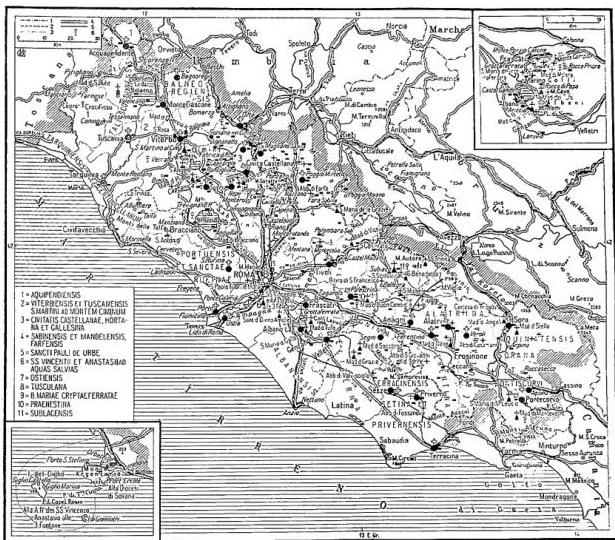
LAZIO - Lazial conciliar region: 1. region boundary; 2. provincial boundary; 3. ecclesiastical district boundary; 4. roads; 5. railways; 6. oratory.
Rectors appointed by the bishop of Rome were placed in charge of these possessions, and he thus began effectively to contest the exercise of authority over those lands with the Emperor of the East, especially in the eighth century, when the donations of Liutprand (728–42) recognized in the Roman pontificate that political character which was strengthened by the journey of Stefano II to France and by the donation of Pipin.
The political character mentioned above led—from the end of the eighth century—to ever new clashes between the local autonomous elements and the will to centralize papal power, which—especially through the actions of Zaccaria and Adriano I—relied upon the numerous domus cultae, against which a noble revolt broke out in the time of Leone III. The domus cultae consisted of numerous rural estates with scattered dwellings and were placed under ecclesiastical administration: the colonists had a certain military organization and possessed a special currency, more or less authorized or recognized by the pontiff.
After the foundation of the Sacrum Imperium, the Emperor and the Pope came into conflict, because both wished to send their own representatives to the Patrimony; the dispute was resolved favorably for the bishop of Rome, who, in the ninth century, continued to appoint his own officials charged with administering justice. As time passed, during the first half of the tenth century, the Comites Campaniae appeared: governors appointed, perhaps for life, by the pontiff, who extended his influence over the cities through judges chosen by the Comites.
Alongside, and in correlation with, the spread and differentiation of the ruling class, there emerged—in the second half of the tenth century and even more in subsequent times—a movement toward the expansion of agriculture and the intensification of building activity. At the same time, the families that became owners, sometimes in consortium, of mills or extensive areas of land arose from the lesser feudal society, from lay administrators of ecclesiastical institutions, from officials of the papal government in the individual centers, and perhaps also from free laborers. Serving these propertied families was a numerous multitude of peasants, bound to them and to the land they cultivated by ties that were more or less strict and burdensome; it is evident, however, that even in the Patrimony of S. Pietro—from the tenth century onward—the ancient serfs gradually gained their freedom, obtaining more favorable forms of contract and thus rising toward small property, without, however, giving rise to those corporations that were already flourishing in the cities and often exercising considerable influence over the government.
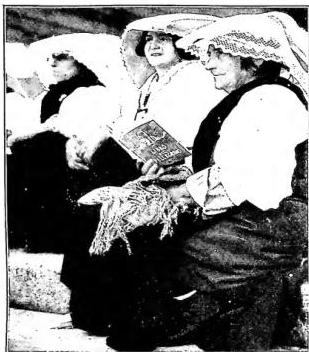
LAZIO - Peasant Women of Minturno - Rome, Holy Year 1950.
This raises the question of how this regime arose. It is immediately evident that—when the pontiffs were unable to assert their authority amid the raging factions—the small cities found themselves contested by several officials aspiring to govern them, or were even abandoned to their own devices. To the dangerous isolation were added the attacks of imperial, Roman, and Norman armies: hence the thousand necessities of attack and defense that induced the citizens to unite for their common salvation, consequently intervening in the government and preparing themselves for autonomy, later supported, in the strengthening of this evolutionary movement, also by the papacy, which desired to lay firm foundations for temporal dominion beyond the walls of Rome. Meanwhile, the figure of the Comes Campaniae—to which reference has already been made—underwent considerable change, since this office was assumed by the most powerful lords of the Campagna, who were beginning to predominate in the Patrimony and sometimes even in Rome: such were the counts of Tusculum in the eleventh century. Later, comites and duces are sometimes found appointed by the pontiff.
At the end of the century, and even more so in the twelfth, the popes (Callistus II, Honorius II, Eugenius III, and others) energetically set about reorganizing their dominion: having defined the boundaries of certain cities, including Velletri, they decreed that these should, at the Church’s request, provide soldiers and send representatives to the Parliaments. Innocent III also brought the Senate of Rome, to which various cities were attached, including Viterbo, under his influence. In 1207, the Pontiff reorganized the provinces of the Patrimony; he exacted oaths of fidelity from the counts, barons, and representatives of the Communes; and finally proclaimed a general peace, dissolving all leagues. Innocent III also convened a general Parliament at Viterbo in order to increase the authority of the rectors; and since these were thereby led to place themselves under the Pontiff’s protection, his influence over the Patrimony was greatly increased, all the more because he was the sole judge in conflicts between rectors and provincial parliamentarians.
In 1231, the papacy intervened to resolve the questions of taxation and military service that divided the two classes of milites and pedites in the Communes of the area surrounding Rome, through an arbitration decidedly favorable to the milites, over whom the pontiff thus assumed a high patronage, securing their devotion. Gregory IX was even able to count on the support of Viterbo, Corneto, Tivoli, Velletri, Terracina, and Anagni against the urban autonomist forces in Rome. In the fourth decade of the thirteenth century, pontifical authority in L. was strengthened by the failure of imperial action in Tuscia and Sabina, while, in 1268, the battle of Tagliacozzo crowned the work of Urban IV, who was intent on reorganizing the Patrimony. Boniface VIII (1294–1303) devoted himself to this work more than anyone else. This Pontiff relied especially on the Communes because—after striking at the great families of the contado—he could seek support only from the people against a possible baronial resurgence, offering in exchange to the nascent urban organizations the support of papal authority.
Later—during the Avignonese pontificate—the rectors of the Patrimony were forced to live in the continual search for a balance amid the persistent divisions between the factions, which it was by then felt necessary to overcome. After the Western Schism, and after the incursions of Ladislaus, in the time of Innocent VII (1404–1406) and Gregory XII (1407–17), the lands of the province submitted to Alexander V (1409–10), who occupied Viterbo, Montefiascone, and Corneto. The work of reorganizing and subjugating the Patrimony continued under Nicholas V (1447–1455) and Pius II (1458–64). The latter was able to subdue Sabina, occupy Palombara, and eliminate the threat posed by Piccinino’s ambitions. The work of Pius II was completed by Paul II (1464–71), who was able to extend his authority over the whole Patrimony.
From the end of the fifteenth century onward, the history of L. cannot be treated separately, but must be framed within the history of the Papal States and then—even—of united Italy.
It remains only to recall what was done in the way of reclaiming unhealthy areas, since this is now the sole regional element.
III. ECCLESIASTICAL HISTORY
L. is a privileged region, because Rome, the primatial see, is situated there, where the successor of S. Peter resides. From the 5th cent. the Latium vetus and the Latium adiectum were distinguished, while the northwestern part of Rome belonged to Tuscia.No detailed information is available concerning the spread of Christianity in L., but it may certainly be affirmed that the center of propaganda and organization must have been Rome, as it was for most of the Churches of Italy; and the affairs of those of L. are bound up with the history of the Roman Church. Until approximately the middle of the 2nd cent., no names of established dioceses are known; groups of Christians, more or less numerous, probably existed, dependent upon and directed by Rome. By the end of the same century the organization must have made considerable progress: indeed, around 190 Pope Vittore convened a synod of Italian bishops to decide the Paschal controversy; undoubtedly several of them must have been from L., but nothing more precise can be said. In the first half of the 3rd cent., during the long period of peace preceding the persecution of Decius, the organization must have become more clearly defined and several Churches must have been established. After the death of Fabiano, the Roman clergy informed S. Cipriano that they had decided, together with the «episcopi vicinis», to defer the question of the «lapsi» (Ep. 30); shortly afterward, in 251, Pope Cornelio convened a synod of 60 bishops, most of them certainly from L. (Eusebio, Hist. eccl., VI, 43). Unfortunately, no document has transmitted more precise information, but from hagiographical and archaeological sources, such as cemeteries, inscriptions, and churches, the existence of the Churches of Ostia, Porto, Albano, Palestrina, Terracina, Labico, and Formia may be admitted with near certainty. To these Churches belonged the martyrs attested by reliable documents: Asterio, Ciriaco, and Aurea for Ostia; Aristone, Nonno, Ercolano, Taurino, Eutropio, Bonosa, and Zosima for Porto; Secondo, Carpoforo, Vittorino, and Severiano for Albano; Agapito for Palestrina; Alessandro, Magno, Erasmo, and others elsewhere.
After the Constantinian peace the Churches multiplied increasingly, and at the Synods held under Popes Giulio (340), Damaso (372), and Siricio (386), there were many bishops from L.; the Churches of Tivoli, Anzio, Velletri, Segni, Bolsena, Tarquinia, etc., in fact date from this period.
In the 5th and 6th cents. the Churches of L. underwent the unhappy vicissitudes of the barbarian invasions, by which Rome was victimized, with destruction, plundering, devastation, and changes; but at the beginning of the 7th cent. L. had approximately 30 established dioceses.
With the opening of the Middle Ages, religious life also flourished in L. in its most characteristic manifestations.
Famous monasteries populated the region: Subiaco, Farfa, S. Silvestro al monte Soratte—where Carlomanno withdrew in the 8th cent.—Casamari, and Fossanova, to mention only the most celebrated outside Rome and its immediate surroundings. Colonies of Greek monks also moved into L. (Grottaferrata, Valvisciolo), increasing in number and exercising broad influence during the outbreak of the Byzantine struggles in the periods of iconoclasm and schism.
To the monasteries must be added the shrines which, as early as the late Middle Ages, began to attract pilgrims, such as the Madonna del Buon Consiglio at Genazzano, the Cristo di Sutri, the S.ma Trinità al Monte Autore, S. Maria della Quercia, and S. Maria Capodacqua. A characteristic group is formed by the Franciscan shrines of the Rieti valley (Greccio, Fontecolombo, Poggiobustone, La Foresta), which are connected with s. Francesco, who, after Umbria, left the richest traces of his passage in L.
Leading figures are the saints who during this period adorned the region: Bonaventura di Bagnoregio, Tommaso d'Aquino, and Rosa da Viterbo. Later came s. Giacinta Marescotti and, in more recent centuries, bb. Carlo da Sezze and Tommaso da Cori, s. Giuseppe da Leonessa, s. Felice da Cantalice, s. Paolo della Croce, etc.
During the frequent struggles and revolts of the Roman population in the 12th–14th cents., various cities of L. received the pontiffs, who embellished and fortified them, such as Anagni, Viterbo, etc. Until, with the subjugation of the entire region, its fortunes became mingled with those of the Papal States, of which L. formed two legations.
It is the region that possessed and still possesses more episcopal sees than the other regions; continuous relations with the center of the Empire favored this numerous development. Many of these sees have now disappeared. In the Latium vetus there were the sees of Subaugusta; Labicum; Gabii; Treba Augusta; Nomentum; Ficulca. In the Latium adiectum: Antium; Tres Tabernae; Fundi; Formiae; Mentum; Casinum; Frusino; Atina. In Etruria: Loricum; Caere; Aquaviva; Falerii; Vulsinii; Ferentum; Forum Clodii.
(phot. Alinari)
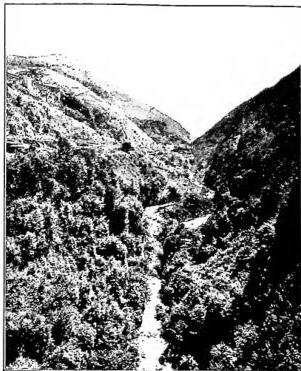
LAZIO - The Aniene near the Abbey of S. Scolastica - Subiaco.
chesne, Le sedi episcopali dell'antico ducato di Roma, in Arch. Soc. rom. di storia patria, 13 (1892), pp. 475-503. A. Harnack, Missione e propagazione del cristianesimo, Italian ed., Milan 1945, p. 371 ff. For the Middle Ages, V. Italy. For particular monographs on sanctuaries, monasteries, etc., V. the specific bibliography which, in a special section devoted to L., has been published by the Rivista di Storia della Chiesa in Italia from 1947 onward. Giuseppe Damizia
IV. ART
Rome (v.), a highly active centre of artistic culture, the region is in itself of considerable importance for the number and quality of the monuments it still preserves. Its artistic production does not, however, at least until the Baroque period, possess a unified character; this is due first and foremost to the Roman traditionalism of the Middle Ages, which on the one hand prevented the unification of regional forms and on the other lacked sufficient power of expansion; then to the immigration of foreign artists, especially during the late Middle Ages and the early Renaissance; and finally to the differing cultural conditions of the areas north and south of the city.Only scant remains survive from the early Christian period: the colonnades of the Constantinian Basilica in the cathedral of Albano, a trichora of uncertain date beneath the church of Carità at Tivoli, the remains of the basilica of S. Sinfarosa on the Via Tiburtina and of the basilica of Pammachius at Porto. The contributions of the architectural culture of the Comacine Masters are represented in the region, on the other hand, by the oldest section of S. Pietro at Tuscania.
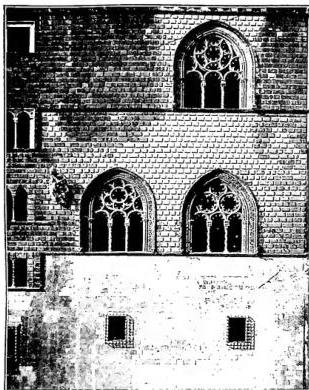
LAZIO - Tarquinia, Palazzo Vitelleschi (1436–30).
The characteristic features of Romanesque architecture sometimes appear in highly interesting forms as early as the 11th century in S. Flaviano at Montefiascone, and with distinctly Lombard accents in S. Maria di Castello at Tarquinia. They then spread through the region quite rapidly, but were adopted more for their ornamental than for their structural characteristics. At Viterbo, under the combined influence of Lombard and Roman styles, a vigorous and original local architecture developed (Duomo, S. Sisto, S. Maria Nuova, S. Giovanni in Zoccoli), which also spread to the neighboring centers (Tarquinia, Tuscania, Vetralla). Tarquinia also adopted Arab-Sicilian forms (S. Giacomo), while Tuscania combined Tuscan, Umbrian, and Roman elements in the façades of its principal churches (S. Pietro, S. Maria Maggiore); the Umbrian taste for horizontal cornices spread more or less everywhere in upper L.; Narnese forms recur in a group of churches in the Sabina (Montebuono, Tarano, Fianello); elements of southern, and especially Campanian, taste mingle in southern L. with Lombard forms (Anagni) and Roman ones (Terracina). Benedictine architecture left its finest work in S. Maria la Libera at Aquino, while Arabizing elements lend an original character to the architecture of Gacta. Cosmati (v.) display a classicism that is at once vigorous and picturesque, as in the portico of Civita Castellana and the cloister of S. Scolastica at Subiaco.
Gothic reached southern L. between the end of the 12th and the beginning of the 13th century, in a form at once restrained and pure, with the abbeys of Fossanova and Casamari. Various buildings then arose that were more or less stylistically dependent on those prototypes: S. Maria in Flumine at Ceccano, the abbey of Valvisciolo, S. Francesco and S. Maria Maggiore at Ferentino, the church of Amaseno, the cathedral of Priverno, the transept of the cathedral of Anagni, etc. The new style reached the outskirts of Rome with S. Nicola on the Via Appia. Somewhat later, the abbey of S. Martino al Cimino exerted a similar influence on northern L. (Viterbo, cloister of S. Maria in Gradi, S. Francesco; Montefiascone, extension of S. Flaviano; Tarquinia, S. Giovanni, etc.). At Rieti, the portico of the Cathedral and the churches of S. Pietro, S. Domenico, and S. Agostino have Gothicizing forms and also adopt the Aquilan type of façade with a straight crowning. These forms persisted throughout the 14th century and into the following century at Amatrice (S. Francesco, S. Agostino), at Cittaducale (S. Maria del Popolo), and at Leonessa, where the latest examples of Gothic are in fact found. The phenomenon recurs in less pronounced form in lower L., where, at Fondi, in a group of churches, the fifteenth-century phase is closely joined to that of two centuries earlier. Interesting complexes of medieval civil architecture are preserved at Viterbo, Tarquinia, Tuscania, Tivoli, Segni, Anagni, Ferentino, etc.; among the public palaces, those of Anagni, Priverno, and Viterbo should be mentioned; Genazzano, on the other hand, offers a homogeneous group of civil buildings in a southern Gothic style dating from the early 15th century. Romanesque sculpture is generally limited to decorative works; the Cosmatesque style spread more or less everywhere, eventually merging in southern L. with related Campanian forms, distinguished by their taste for color and their manner of ornamentation. In the late 13th century, the theme of the tomb was extensively treated in the Viterbo area; the most interesting example is that of Adriano V (Viterbo, S. Francesco), on which Arnolfo may perhaps have collaborated. Wood sculpture boasts highly coherent examples such as the Madonna of Acuto, from the 13th century and now in the Museo di Palazzo Venezia in Rome, or works of refined execution such as the group of the Deposizione in the cathedral of Tivoli.
Roman painting of the 11th century spread through the region in extensive cycles, such as those at S. Anastasio at Castel S. Elia, where linear schematicism takes on a particular power of suggestion, or those at S. Pietro di Tuscania, which are closest to Roman models in their refined elegance. The frescoes of S. Silvestro at Tivoli, by contrast, have greater breadth of form. Between the 12th and 13th centuries, the production of panel paintings representing the Savior (Tivoli, Sutri, Trevignano, Viterbo, etc.) or the Madonna (Viterbo, Vetralla, etc.) was likewise extensive. The most important cycle of Benedictine school painting in the region is preserved at Ausonia (S. Maria del Piano). The mosaics of the abbey of Grottaferrata belong to a more Byzantine manner, with a Venetian tone. Byzantine in character as well, but more vigorous and free, are the frescoes in the chapel of S. Gregorio at the S. Speco of Subiaco, related to those in the crypt of the cathedral of Anagni, which constitute the most important medieval cycle in the entire region and to which artists of various tendencies also contributed. Reflections of the masters active in Rome at the end of the 13th century are combined with a lively narrative quality of popular inspiration in Consolo’s works at the S. Speco of Subiaco, while the painter of S. Maria in Vescovo repeated Cavallinian formulas in the early years of the 14th century, with heightened linear accents; the oldest frescoes of S. Flaviano at Montefiascone are connected with Roman and Assisian forms.
Because of the historical conditions of L. in the 15th century, Renaissance styles entered the region with some delay; significant buildings from this period include the church of the Quercia near Viterbo, the tempietto della Peste, also at Viterbo, the church of S. Maria del Soccorso at Corchiano, that of S. Aurea at Ostia antica, and S. Oliva at Cori with its adjoining cloister, etc. A reflection of Bramantesque forms appears in the tempietto del Sangue at Velletri; Sammicheli then began the cathedral of Montefiascone, Antonio da Sangallo the Younger built the churches of Cellere and S. Maria in Moncoloro near Montefiascone, as well as the chapel known as La Rocchina on Isola Bisentina; and Vignola built those at Mazzano Romano and S. Oreste, and S. Maria del Piano near Capranica. His manner spread throughout upper L., imparting a distinctive character to several towns in the Viterbo area. The style of Giacomo Della Porta is reflected in the Gesù at Tivoli. Civil production was considerably more extensive in this period. The works of military architecture were grandiose (Genazzano, Bracciano), often carried out by artists active in Rome, such as B. Pontelli (Ostia), Giuliano da Sangallo (Grottaferrata), Antonio da Sangallo the Elder (Nettuno, Civita Castellana), Antonio da Sangallo the Younger (Civitavecchia, Montefiascone), and Peruzzi (Roccasinibalda). The magnificent palace at Caprarola, rising from fortification works, is by Vignola, who was also responsible for the Villa of Bagnaia; Ponzio worked at Mondragone, and Della Porta at the Villa Aldobrandini in Frascati.
The great cultural disparity that was developing between Rome and L. also accounts for the limited value of its works of sculpture and painting. Nevertheless, while Giovanni Dalmata completed the decoration of the tempietto of S. Giacomo at Vicovaro, Bregno sculpted the tabernacle of S. Maria della Quercia, and Andrea Della Robbia executed the maiolica lunettes there. Around 1540, Michelangelo sculpted, probably for Vittoria Colonna, his Pietà of Palestrina, now in Florence, in the Museo dell’Accademia.
Thus, while Masolinian forms had early penetrated the region through the cycles of the Annunziata at Riofreddo and Cori, the region’s figurative culture around the middle of the century is represented by the mediocre Pietro Coleberti (Priverno, Sermoneta) and Iacopo da Roccantica (Montebuono). A work of great beauty and stylistic coherence, on the other hand, is the Mazzatosta chapel in the church of S. Maria della Verità at Viterbo, due to Lorenzo da Viterbo, a vigorous individual painter within the circle of Piero della Francesca. Various works by Antonizzo Romano are scattered throughout the L., alongside those of modest masters of average attainments such as Piermatteo d'Amelia and Antonio da Viterbo. An enclave of Veronese mannerism is formed by the works of Cristoforo Scacco at Fondi and Montesambiago; toward the Ascolano area worked the belated and eclectic Cola dell'Amatrice.
The great painters of the 16th century left no work in the L.; their followers, however, are widely represented through the Mannerist period. Viterbo possesses Sebastiano del Piombo’s admirable Pietà; the Villa of Caprarola and the Villa d'Este at Tivoli offer examples of important Mannerist complexes, while other painters such as the Siciolante, Pulzone, Muziano, etc., are represented in various ways in the churches of the region; the Veronese Torresani were particularly active at Rieti.
From Rome, the Baroque spread throughout the L. Maderno worked on the papal Villa at Castel Gandolfo and on the church of S. Maria del Trivio at Velletri; Bernini built the churches of Castel Gandolfo and Ariccia and the façade of the sanctuary of Gallaro; Antonio del Grande built the Collegiata of Marino; Mattia De' Rossi that of Valmontone; Girolamo Rainaldi the S. Teresa of Caprarola, and his son Carlo the two parish churches of Montecompatri and Monte Porzio; Carlo Fontana worked for a long time at Formello; Girolamo Fontana erected the façade of the cathedral at Frascati; and later Salvi renovated the church of S. Maria in Gradi at Viterbo. Many works that variously reflect the manner of the major masters still await precise stylistic identification, but very many others are merely modernization projects or convey the nobility of their models in clumsy, provincial forms.
Among the sculptures of the Baroque age, particular mention should be made of Puget’s Immacolata in Tivoli cathedral, the Berninesque statues in Rieti cathedral, and the monuments in the baronial chapel at Palestrina. Among the pictorial cycles, those by Domenichino at the Badia of Grottaferrata and by padre Pozzo in the church of the Gesù at Frascati are especially noteworthy; works by various masters are found in different churches of the region, but for the most part they are of little significance.
Neoclassical architecture is particularly well represented at Civitavecchia and Rieti; a fine collection of works by Camuccini is housed in the eponymous palace at Cantalupo.
Examples of entirely modern centers, with often noteworthy buildings, are provided by Latina, Pomezia, Aprilia, and especially Sabaudia, new towns in the recently reclaimed area of the Agro Pontino. - Vedi tavv. LXI-LXII.