Machine translation of the 1948–1954 Italian original. The original text is authoritative.
FRASCATI, diocese of. — The suburbicarian diocese of F. in the province of Rome comprises the northwestern area of the Alban Hills and, over an area of 150 sq km, has 50,000 inhabitants, of whom 49,950 are Catholics; 17 parishes, 28 secular priests, and 75 religious; a minor seminary (1948); its patrons are the holy apostles Filippo and Giacomo; the feast is celebrated on 1 May.
F. is the heir of nearby Tusculum, which was the seat of a principality of the Prisci-Latini and, having become a municipium, remained a faithful ally of Rome. In the early Middle Ages Tusculum was famous as the ancestral fief of the counts of Tusculum, who, between the 10th and 12th centuries, dominated Rome and gave the Church many popes. In 1191 Tusculum was completely razed to the ground by the Romans, and a large part of the population, including the bishop, went to swell that already existing around the two churches of S. Maria and S. Sebastiano « in Frascata ». Nevertheless, F. remained a locality of modest importance, which in 1410 was granted by Giovanni XXIII to Giovanni and Nicola Colonna. In 1500 it became a dominion of the Holy See.
The bishop of F. is one of the cardinals of the Order of Bishops, which in the earliest period had its see at Labicum, whence, in 1111, Bishop Bovo transferred to Tusculum. With the destruction of that city, the episcopal see was transferred to F., whose first cardinal-bishop was Nicola de Romania (1205). Among the prelates should be recalled: Egidio, sent by Giovanni XII to Poland in 964; Giacomo de Vitry (1228), a learned opponent of the Albigensians; Pietro Giuliani (1273), archdeacon of Gregorio IX and later Pope Giovanni XXI; Berengario di Fredol (1309), a collaborator of Bonifacio VIII in the Liber sextus decretalium; Baldassare Cossa (1419), formerly Giovanni XXIII, after his submission to Martino V; Bessarione (1449); Alessandro Farnese (1519), later Paolo III; Giov. Pietro Carafa (1550), later Paolo IV; Lorenzo Corsini (1725), later Clemente XII; Enrico Benedetto, Duke of York (1761–1807), who donated a rare collection of books to the Seminary library; Bartolomeo Pacca (1818); Francesco Saverio Castiglione (1821), later Pio VIII.
FIG. Anderson
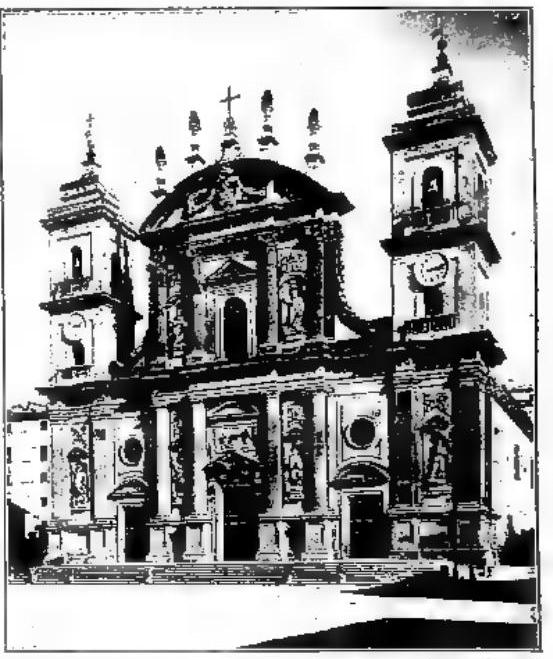
FRASCATI, diocese of. — Facade of the Cathedral, by Girolamo Fontana (1697–1700).
MONUMENTS. – At Tusculum there remain, in addition to the polygonal walls, the ruins of a theatre, an amphitheatre, a cistern, and a portico. The Cathedral was designed by C. Rainaldi and P. De Rossi (17th century), with a façade (1697–1700) by G. Fontana and frescoes by A. Pozzo, as in the vault of the Gesù, built by Pietro da Cortona. Also noteworthy are the church of S. Maria, already in existence in the 9th century; the episcopal palace, begun under Pio II; and the church of the Capuchins (16th century). The great attraction of F. consists in its celebrated villas, of which the best known is the Villa Aldobrandini. – Vedi tav. CXIII.
BIBL.: G. Stefanucci, Series chronologica Tusculanorum Antistitum, in the appendix to Synodi Tusculanae, Rome 1764; Cappellotti, pp. 625–51; G. B. De Rossi, Il Tuscolo, le ville tusculane e le loro memorie cristiane, in Bull. d’arch. crist., 2nd series, 3 (1872), pp. 86 ff. and 1873, p. 83 ff.; B. Gama, Series episcop., pp. xix–xxi, Suppl. I; D. Seghetti, Memorie storiche di Tuscolo antico e moderno, Rome 1891; P. Kehr, Italia Pontif., II, Berlin 1907, pp. 36–47; G. Grossi-Gondi, Il Tusculano nell’età classica, Rome 1908; G. Tomassetti and G. Bissotti, Tusculana, there 1912; G. and Fr. Tomassetti, Campagna romana, IV, there 1926, pp. 346–450; S. Kambo, Il Tuscolo e F., 2nd ed., Bergamo 1930; Cortineau, I, col. 1212; G. Battelli, Ratiores detimarum Italiae, Latium (Studi e testi, 128), Vatican City 1946, p. 19. Alberto Galetti
Cite this article
“FRASCATI, DIOCESI DI.” Enciclopedia Cattolica, vol. V (1950), p. 1011. Azione Romana digital edition, https://azioneromana.com/article/frascati-diocesi-di.