Machine translation of the 1948–1954 Italian original. The original text is authoritative.
FARNESE, FAMILY. — Its origins are not well known. It seems to have taken its name, between the 11th and 12th centuries, from its fief of Castrum Farneti. Until the fifteenth century, the F. were minor feudal lords in the service of various cities, particularly Viterbo and Orvieto.
The oldest document concerning them records that in 1754 PRUDENZIO F., as representative of Orvieto, received Pope Adrian IV. PIETRO defended that city against Henry VI; another PIETRO went to the aid of Florence when it was threatened by Artigo VII. Guido was bishop of Orvieto in 1302, and in 1309 consecrated its cathedral. During the schism the F. remained faithful to the legitimate popes; but although favored by them, they retained their status as nobles of the contado, whose possessions lay in the area of Lake Bolsena. With RANUCCIO the Elder (d. around 1460), the F. moved to Rome. Ranuccio was made senator in 1417, and from Martin V and Eugene IV received benefices and vicariates (Montalto, Latera, Canino). With Ranuccio’s sons, the F. entered the Roman aristocracy: GABRIELLE married Isabella Orsini, and PIER LUIGI Giovannella Caetani of Sermoneta. A son of Gabriele, RANUCCIO, died in the battle of Fornovo; from Pier Luigi were born BARTOLOMMEO, who originated the branch of the F. of Latera (which became extinct in 1668); GIULIA, married to Orsino Orsini, famous for her beauty and for the rumor of her love affair with Alessandro VI (her daughter LAURA married Niccolò della Rovere, nephew of Julius II); and ALESSANDRO, who became Pope PAUL III (v.). Before marrying the Orsini, he had had several illegitimate children, whose legitimation he obtained from Julius II and Leo X: PAOLO and RANUCCIO, who died young, COSTANZA and PIER LUIGI. PIER LUIGI (d. in 1547), after serving in the imperial army, with which he took part in the Sack of Rome, was appointed by Paul III,
(phot. Alisari)
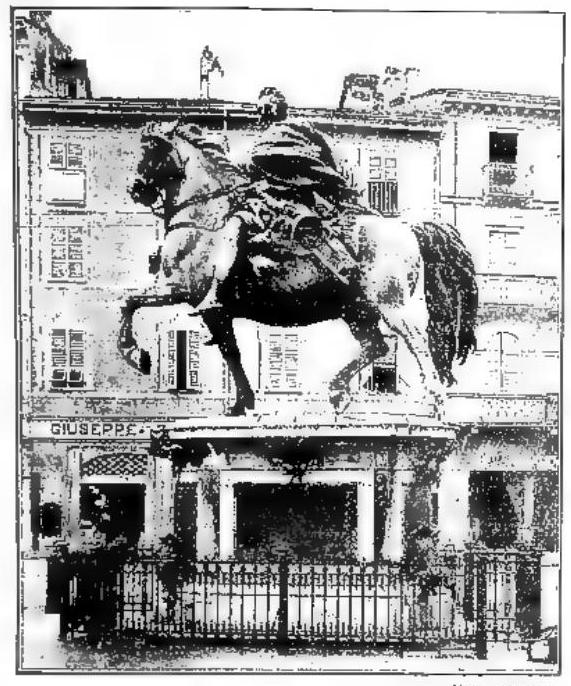
FARNESE, FAMIGLIA - Equestrian monument to Alessandro F. Bronze by Francesco Mochi (1626) - Piacenza.
in 1557, appointed gonfalonier of the Church; from him he received Castro at Ronciglione, and in 1545 the lordship of Parma and Piacenza, raised to the status of a duchy. Since this concession had been made without the consent of Charles V, who was then at odds with the Pope over the issues surrounding the council, a conspiracy plotted by the nobles of Piacenza against the new duke found the viceroy of Milan complicit. Pier Luigi was killed, Piacenza occupied in the Emperor’s name, and Parma handed over to a representative of the Pope.
From Pier Luigi were born: VITTORIA, who married Guidobaldo della Rovere, duke of Urbino; ALESSANDRO (d. 1589), archbishop of Parma and cardinal, who built the Gesù, the Farnesina, and the villa on the Palatine in Rome; RANUCCIO (d. 1565), archbishop of Naples and cardinal, celebrated for his extensive learning and unimpeachable morals; ORAZIO (d. 1553), duke of Castro and prefect of Rome, who married Diana, the natural daughter of Henry II, fought for France against Charles V, and died defending Hesdin; OTTAVIO (d. 1584), who succeeded his father in the ducal title. Having been reconciled with Charles V, Julius III had Parma returned to Ottavio in 1550; but the following year, when the Pope showed himself inclined to consent to the Spanish occupation of Parma and Piacenza, Ottavio allied himself with France. Spain and the Pope went to war against the duke, but in 1552 a truce was concluded, and after the peace the duke’s possession of Parma was recognized. Later (in 1557) Ottavio also recovered Piacenza from Philip II. Ottavio’s son, ALESSANDRO (b. 1545, d. 1592), served the king of Spain. He fought at San Quintino and Lepanto. Appointed governor of Flanders, he succeeded through his skill in breaking up the “Union of Ghent”: since the southern provinces, Catholic in faith, had risen only in defence of their autonomies, which Philip II had sought to abolish, Alessandro restored the privileges they had enjoyed under
Charles V; thus Spain, although it lost the northern provinces, definitively secured its dominion over the southern ones. Alessandro crowned his work with the reconquest of Antwerp (on Alessandro F. the fundamental work is: L. Van Der Essen, Alexandre Farnise prince de Parme gouverneur général des Pays-Bas, 4 vols., Brussels 1933–35).
By Maria of Burgundy, granddaughter of the king of Portugal, he had: EDOARDO (d. 1626), bishop of Tusculum and cardinal; MARGHERITA, who married Vincenzo I Gonzaga and, having been repudiated, became a nun; RANUCCIO I (d. 1622), who succeeded him in the duchy. From Ranuccio and Margherita Aldobrandini, niece of Clement VIII, were born: MARIA, who was the wife of Francesco I of Modena; VITTORIA, who, upon her sister’s death, married her brother-in-law; FRANCESCO (d. 1647), cardinal; and EDOARDO (d. 1646), who succeeded his father on the throne. In the seventeenth century the F. no longer had more than secondary importance in Italian politics. Nevertheless, Edoardo entertained ambitious plans for expansion. In the war of the Mantuan succession he sided with Spain; he fought against the Barberini and Urban VIII in the war known as the War of Castro, in which he lost that fortress, although it was later returned to him. By Margherita, daughter of Cosimo II de’ Medici, Edoardo had: ALESSANDRO (d. 1687), who served Venice under Francesco Morosini, and RANUCCIO II (d. 1694), his successor in the duchy. Ranuccio renewed the struggle against the Barberini, protected by Innocent X: in 1648 Castro was taken by the papal troops and destroyed. Ranuccio married Margherita of Savoy, then Isabella d’Este, and finally Maria, Isabella’s sister. By Margherita he had: EDOARDO (d. 1693); FRANCESCO (d. 1727), who married Dorotea of Neuburg, Edoardo’s widow; ANTONIO (d. 1731). Edoardo’s daughter, ELISABETTA (v.), was given in marriage to Philip V, king of Spain. Since neither Francesco nor Antonio had children, Cardinal Alberoni, who had arranged that marriage, although he did not succeed in his attempt to restore Spanish rule in Italy, nevertheless obtained the assignment, by the Quadruple Alliance through the Treaty of The Hague, of the duchy of Parma and Piacenza to don Carlos, son of Philip V and of
(photo Alisari)
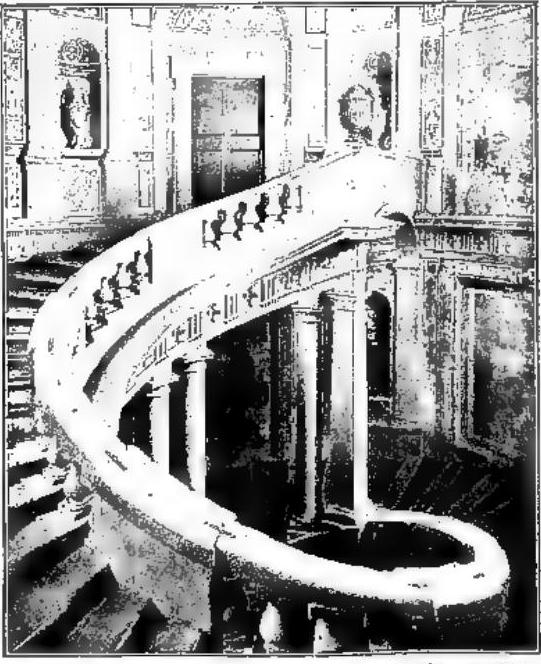
FARNESE, FAMIGLIA — F. Palace. Royal staircase by Jacopo Barozzi, known as il Vignola (1557) — Caprarola.
Elisabetta F. After the War of the Polish Succession, the duchy was given to Austria, but by the Treaty of Aix-la-Chapelle it passed to Elisabetta’s other son, Filippo. — Vedi av. LXXI.
BIBL.: F. M. Annibali, Notizie storiche della casa F., 2 vols., Montefiascone 1817–18; Odorici, in Litta, Famille celebrit 1817; F. de Navanno, Rome, le Palais Franche et les F., Patri 1914; A. Valente, I F. ed il possesso di Parma dalla morte di Pierluigi all'elezione di papa Giulio III, in Archivio storico per la province napoleone, 28 (1942), pp. 157–75; id., Papa Giulio III, I F. e la guerra di Parma, in Nuovo rivista storica, 26 (1942), pp. 304–19; F. Braudel, La Méditerranée et la monde méditerranéen à l'époque de Philippe II, Patri 1949, passim. Roberto Palmarocchi
Cite this article
“FARNESE, FAMIGLIA.” Enciclopedia Cattolica, vol. V (1950), p. 637. Azione Romana digital edition, https://azioneromana.com/article/farnese-famiglia.