
CAETANI (GAETANI). — According to a family tradition, the C. traced their origins to the consuls (hypati) and dukes of Gaeta; but their reliable genealogy begins in the 12th century; and already at that time they are found
divided into three principal branches: that of Naples, which found support at the Angevin court but had no historical importance and disappeared in the 15th century; that of Pisa, from which came ALDOBRANDINO, cardinal from 1216 to 11 January 1223, as well as other prelates, and which played a part in the affairs of that republic; from it descended the banker Giacomo Sciarra (d. 1342), who was on familiar terms with Bonifacio VIII; and that of Anagni, related to the barons of the Campagna, whose founder was LOFFREDO I, father of
BONIFACIO VIII and of LOFFREDO II, senator of Rome in 1290–92, appointed count of Caserta by Carlo II d’Angiò. This appointment was confirmed to PIETRO (d. 1308), whom his papal uncle appointed rector of the Patrimony and marquis of the March of Ancona, and who succeeded in establishing a vast and powerful barony comprising Sermoneta, Ninfa, an immense latifundium extending from the slopes of the Volsci to the coast through the Pontine Marshes, S. Felice Circeo, Carpineto, Sgurgola
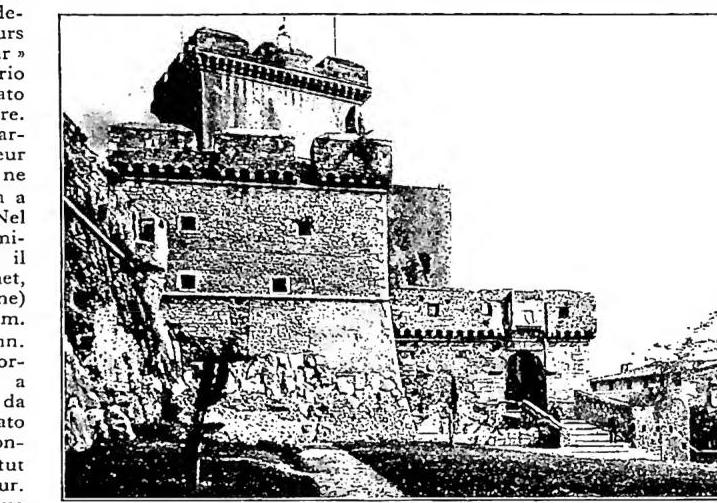
Pietro’s brother was FRANCESCO, created a cardinal by his uncle on 17 December 1295, who died at Avignon on 16 May 1317 and worked tirelessly to safeguard the memory of Boniface VIII on the occasion of the celebrated trial under Clement V. On 14 March and 19 July 1302 he bought from the Gabelluzzi the estate of Cecilia Metella on the Appian Way and built the corresponding castle; but he held it for only a few years. Among Boniface’s relatives in those years were BENEDETTO C., iunior, created a cardinal in the first half of 1295 and who died on 14 December 1296, STEFANESCHI (v.), created a cardinal together with Francesco.
LOFFREDO III, Pietro’s son, enlarged the family domains with the extensive and wealthy lordship of Fondi and Traetto.
The fortunes of Boniface VIII’s nephews and great-nephews unfolded in continual contact with those of the Campagna and Marittima of the Papal States and of Rome itself, as well as with those of the Kingdom of Naples. NICCOLÒ, a captain of remarkable ability, played an important role in them, and especially his son ONORATO I (b. ca. 1336), by Giacoma Orsini, count of Fondi, whom we find at the court of Naples in 1352. In 1358, together with his brother GIACOMO, he received the lordship of Anagni from its citizens; in 1367, in alliance with other lords, he seized Ferentino, but was driven out shortly afterward and was also excommunicated by Urban V. Gregory XI appointed him rector of the Campagna and Marittima in 1377. After Gregory XI’s death, he refused to recognize the election of Urban VI and joined the rebellious cardinals. After defeating the Romans at Ponte Salario on 16 July 1378, he withdrew to Fondi, where, under his protection, on 20 September, in the Cathedral, Robert of Geneva (v.) was elected and crowned pope by the schismatics under the name of Clement VII.
From the antipope he received the government of the Campagna and Marittima, which Urban VI had taken from him, but was consequently struck by the excommunication imposed on him by the latter. He found support for his policy in Joanna, queen of Naples, until Charles III of Durazzo came to the throne and sided with the true Pope. He fought for a long time both against Charles III and, with greater violence, against Ladislaus, who succeeded his father in 1386. He was forced into a truce in 1390, which he also renewed with the new pope, Boniface IX, but broke in 1397. Finally defeated by the combined forces of the Pope and the king, he was forced to sue for peace. He died on 20 April 1400, leaving as heir his only daughter Jacobella to whatever remained to him after his unfortunate reverses.
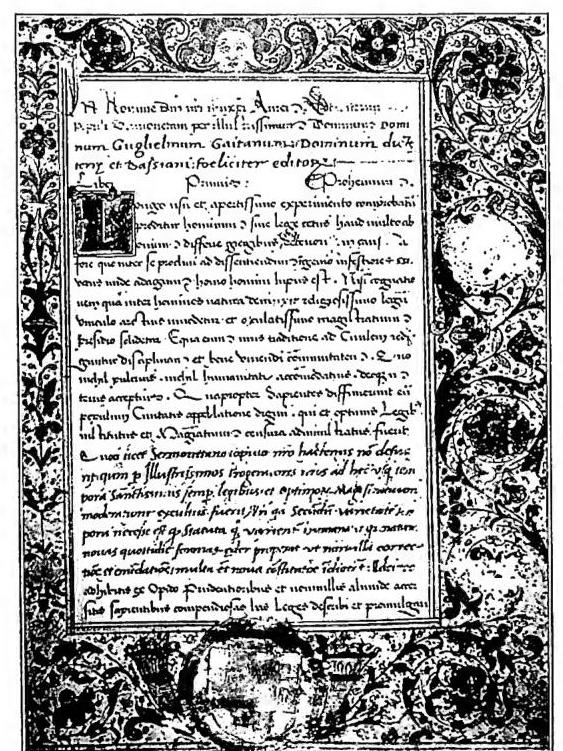
(from G. Caetani, Domus Caietana, Sancasciano 1917–33) CAETANI - Borgia statutes of Sermoneta (late 15th century).
GIACOMO II (d. in 1423) did not take part in the disturbances stirred up by his brother Onorato, and inherited from his niece Jacobella what remained to her of her paternal inheritance. By Sveva Sanseverino he had GIACOMO III, to whom he assigned the possessions situated within the Papal States; to CRISTOFORO, who was a valiant captain, he assigned the properties located in the Kingdom; and indeed the latter later played a major role in its affairs and originated the branch of the C. of Aragon, who continued their father’s tradition in the service of the Aragonese kings. A third brother was ANTONIO, who entered the ecclesiastical career. Born around 1360, he was archdeacon of Bologna in 1387, and in 1390 is found as prior of S. Giacomo sopr'Arno in Florence. In 1395 he aspired to the archdiocese of Patras; instead, in February 1395, he received the patriarchate of Aquileia, at a difficult moment owing to the country’s internal dissensions. With the help of his brother Cristoforo, he was able to enter Friuli and Istria, of which, besides being metropolitan, he was also feudal lord, and he governed the country with great skill. He left Friuli at the beginning of 1401 to go to the Kingdom, and on 27 February 1402 Boniface IX created him cardinal of S. Cecilia, following his renunciation of the Patriarchate.
He was the only great and illustrious prelate of his house between the group of the 13th–14th centuries and that of the 16th and 17th centuries. As for the schism in which he became involved, he was constantly concerned to bring about its end at the Conclaves in which he took part. He held in commendam the monastery of SS. Alessio and Bonifacio (1404); he was major penitentiary, archpriest of the Lateran Basilica, bishop of Palestrina (1405), and abbot of Farfa (1407). In 1408 he withdrew from obedience to Gregory XII and promoted the Council of Pisa in the hope of ending the schism. He then took part in the election of Alexander V and adhered to that of John XXIII. He died on 11 January 1412 in Rome and was buried in the church of the Minerva.
Pio Paschini
During the 15th century, the C. of Sermoneta maintained active relations with the great Roman families in connection especially with the policy of Eugene IV and that of Sixtus IV.
A critical moment for them came when Alexander VI, taking occasion from their continual conflicts with the people of Sezze, intervened against them with a bull on 22 September 1499 and assigned their patrimony to the Camera.
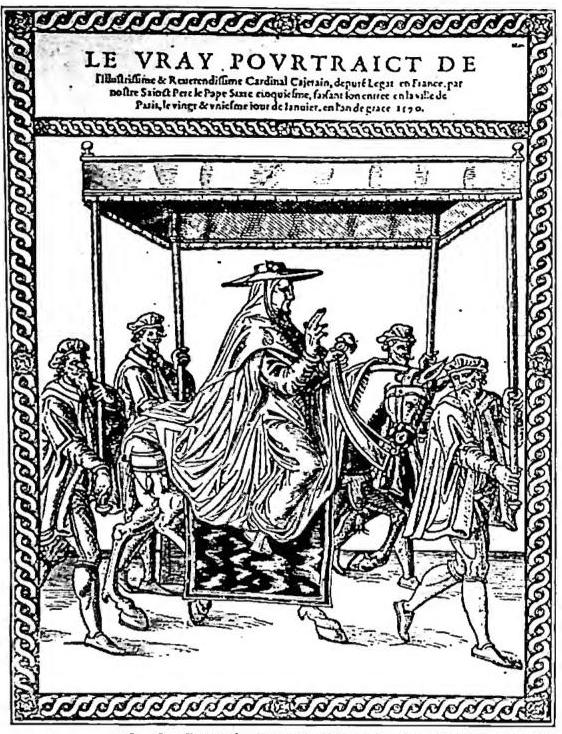
(from G. Caetani, Domus Caietana, Sancasciano 1867–33)
CAETANI - Entry of Cardinal legate Enrico C. into Paris, on 25 January 1590. Wood engraving - Paris, National Library, Estampes.
was nuncio to the emperor, then, in October 1592, ordinary nuncio in Spain.
A member of the Sacred College was also ANTONIO C. (b. 1566), of the dukes of Sermoneta. He studied law at Bologna and Perugia and accompanied his uncle Enrico on his legations. On 31 August 1605 he succeeded Cardinal Bellarmino in the see of Capua, and in 1606 was sent as nuncio to Germany to the emperor. Returning to Rome in 1611, he was immediately sent as nuncio to Spain. Created cardinal of S. Pudenziana on 19 July 1621, he died in the Curia on 17 March 1624 and was buried at S. Pudenziana.
The last of this group of prelates is LUIGI C., born at Piedimonte in July 1565, also of the Sermoneta branch; patriarch of Antioch on 14 March 1622, he was created cardinal on 19 January 1626. He was coadjutor at Capua to Cardinal Antonio and succeeded him in that see; he died in the Curia on 15 April 1642 and was buried at S. Pudenziana.
As the seventeenth century waned, so too did the fortunes of the C. of Sermoneta, until MICHELANGELO C. arose to lend them new lustre. Duke of Sermoneta and prince of Teano, son of Enrico and Teresa de Rossi, he was born in Rome on 20 March 1804 and died there on 12 July 1882. A keen spirit, of singular intelligence and broad culture, he devoted himself especially to Dante studies and, under the guidance of Tenerani and Minardi, to sculpture and painting. In the ancestral palace, “the hermitage of the Botteghe Oscure,” he generously welcomed into his home eminent men from every country, from Stendhal to Taine, from Balzac to the Prince of Wales, from d'Azeglio to Gregorovius. A moderate liberal, he distrusted overly facile enthusiasms (“The Italians’ ignorance of political matters,” he lamented in 1848, “is beyond all belief. Everyone contributes to the obstruction of all legality”) and called for carefully considered and gradual reforms. Pleased by the election and the first acts of Pius IX, he supported his policy as president of the Roman Circle (December 1847) and as minister of police in the Bofondi ministry (12 February 1848). After the fall of the Roman Republic, he devoted himself more than ever to his favoured studies and to political and cultural relations with the cream of European intellectuals, even after blindness struck him in 1865. On the day after the plebiscite of October 1870, as president of the Provisional Government Junta, he officially presented its results to Vittorio Emanuele II.
Michelangelo’s son was ONORATO, born on 18 January 1842; a deputy for several legislatures, he was also mayor of Rome, president of the Royal Geographical Society (1879–1887), promoted African explorations, and left writings on geographical subjects. Minister of Foreign Affairs from March to July 1896, he died on 25 September 1917. His son was LEONE C.: he attempted a political career, but gained renown for his specialized competence in Islamic studies, particularly for the Annali dell'Islam, which he published in 10 volumes from 1904 to 1906, and for an Onomasticon arabicum, of which only one volume was published in Rome (n. d.), compiled in collaboration with G. Gabrielli.
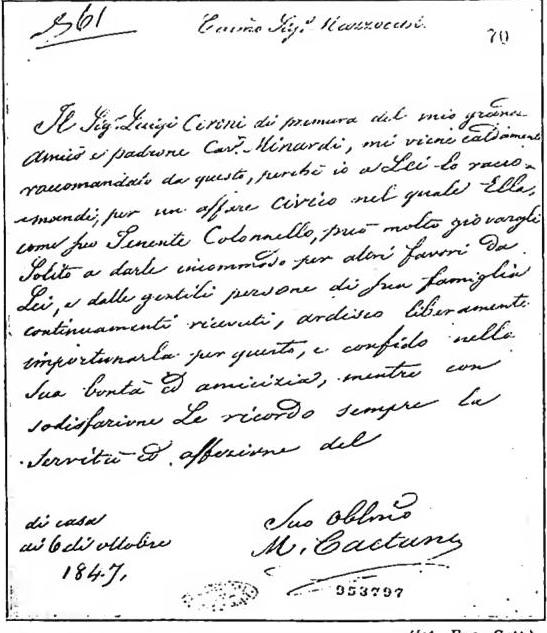
(Int. Enc. Catt.) CAETANI – Autograph letter from Michelangelo C. to Mr. Mazzocchi (6 Oct. 1847) – Rome, archive of the Institute for the History of the Risorgimento.