
ANAGNI, DIOCESI di. — A small city in southern Latium, in the province of Frosinone, 50 km from Rome, A. is the seat of a bishopric directly dependent on the Holy See; it currently has 45,500 inhabitants, 27 parishes, 37 diocesan priests, and 45 religious priests. Owing to its natural position, dominating the
Sacco valley, it was of great importance in antiquity and the Middle Ages. Capital of the confederation of the Hernici, in 311 B.C. it was subjugated to Rome by the consul Tremulus and reduced first to a prefecture and then to a municipium. Christianity seems to have been introduced there toward the end of the second century, while one of its first preachers is said to have been the Dalmatian Giuliano, martyred under Marcus Aurelius at Sora.
It was once thought that s. Magno, bishop of Fondi, was bishop of A., described in his Passio as bishop of Trani and killed under Decius together with the virgin Secondina, venerated in A. since the eleventh century. But the evidence is lacking, and the origins of the diocese therefore remain unknown. The first bishop of whom we have record is Felice, who in 487 attended the Roman Council under Felice III, followed by Fortunato, present at three other Roman synods (499–511). From this point the episcopal list has a gap of a century, until Pelagio (5 July 595), with whom the succession becomes more regular. The bishops (many of whom were of Lombard stock) were often present at Roman synods, and their history is linked to that of the Popes. In times of conflict, the latter took refuge in A.; thus, for example: Leone IV, who died there in 855; Giovanni XII, driven out by Otto I in 963; and Alessandro II, during the struggle of 1062 with the imperial forces and the antipope Cadalo. On this occasion the Pope had Pietro, of the princes of Salerno, elected bishop of A. as successor to Bernardo (the same man whom Niccolò II appointed administrator of the diocese of Trevi and vice-chancellor of the Church of Rome). Pietro was sent as apocrisiarius to Constantinople in 1071 and began construction of the Cathedral in 1074. In 1088, on the occasion of the hospitality extended to Urbano II, his diocese was enlarged through the incorporation of that of Trevi (23 August 1088), and, after taking part in the First Crusade, he completed
At A., Alexander III forged the league against Barbarossa (1159) and discussed there the preliminary terms of peace after Legnano (Pactum Anagninum, 1176). In 1181, the same pope consecrated the Cathedral, when Asael was bishop, having succeeded Nauclero (d. in 1177). At A., Innocent III, a native of the city, like Gregory IX, Alexander IV, and Boniface VIII, granted it municipal statutes; in that cathedral Gregory IX excommunicated Frederick II (1227) and Innocent IV excommunicated Manfredi (1254); in the nearby palace, in 1303, Boniface VIII suffered the outrage inflicted by Guglielmo Nogaret and Sciarra Colonna, emissaries of Filippo il Bello (an episode branded in fire by Dante, Purgatorio, XX, vv. 85-89).
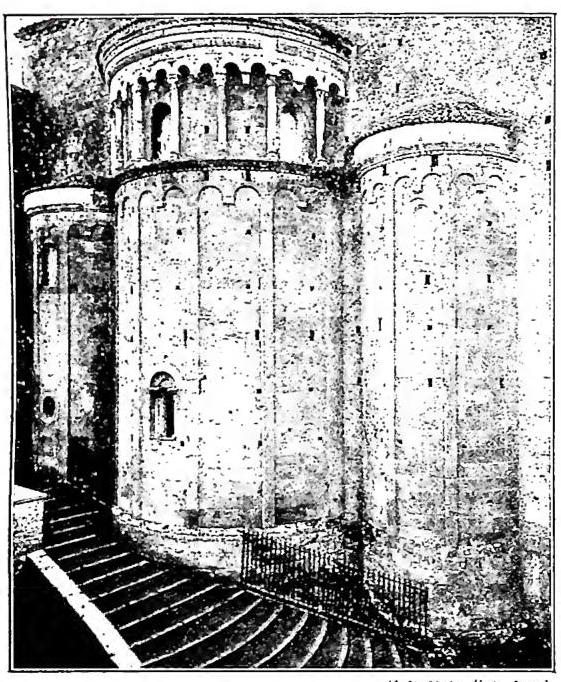
ANAGNI - Abside del Duomo (inizio sec. XII).
Nel sec. XIX, in seguito al giuramento del vescovo Tosi a Napoleone, la diocesi rimase senza titolare e dal 1815 al 1837 fu retta da amministratori apostolici. Oltre ad un seminario di teologia e filosofia interdiocesano per tutta la parte meridionale della provincia di Roma, affidato ai Gesuiti, la diocesi di A. conta numerose case religiose.
In passato furono celebri le abbazie di Gloria
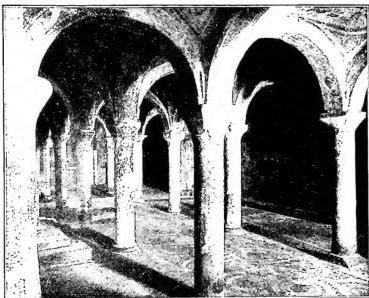
(cistercense dal 1123), S. Teodoro di Trevi, S. Pietro di Villamagna e S. Giorgio (Benedettini) e S. Reparata (Benedettine), fondate ai tempi di s. Benedetto. Tra i monumenti medievali della città il principale è la Cattedrale, dedicata all'Annunziata (1071-1105), con la gigantesca statua di Bonifacio VIII sulla facciata. All'interno il pavimento in musaico, opera di maestro Cosma, fatto eseguire dal vescovo Alberto (m. nel 1238). Sotto la chiesa è la cripta, con pitture dei secc. XII-XIII, illustranti la storia dei ss. Magno, Secondina e Pietro vescovo di A. (m. nel 1105). Alla cattedrale è annesso il tesoro con i suoi paramenti medievali, tra i quali un piviale, una pianeta e due dalmatiche, regalo di Bonifacio VIII. - Vedi Tav. XCIII.
THE COUNCIL OF A. — On Holy Thursday, 24 March 1160, Pope Alexander III, assisted by the cardinals and bishops in his retinue, solemnly excommunicated the Emperor Frederick Barbarossa and declared released from their oath all those who had sworn allegiance to him. “This Frederick,” said the Pope in the bull of excommunication, “who no longer fulfills the office of emperor, but that of tyrant; the schismatic Octavian and all their principal supporters, we have publicly excommunicated on the day of the Lord’s Supper, with the candles lit, amid the priests, nobles, and people gathered in the church.”
Is this truly a council? In Hefele-Leclercq this name does not appear. Mansi speaks of the Council of A. held on 7 Apr. 1161, at which Alexander deposed and excommunicated Ugo, abbot of Cluny, who had not recognized him as Pope. It must, however, have been merely an assembly of bishops, presided over by the Pope.