
TRANI, ARCIDIOCESI of — City and archdiocese in the province of Bari. Over an area of approximately 670 sq km, it contains a population of 223,175 inhabitants, almost all Catholics, distributed among 36 parishes served by 135 diocesan and 40 regular priests; it has a seminary, 9 male and 32 female religious communities (Ann. Pont. 1953, p. 428). Barletta (v.), the archiepiscopal title of Nazareth, and the perpetual administration of Bisceglie united to II. Residence in T.
The legend of the ss. Redento and Magno, concerning the origins of the Church, does not permit any certain conclusions to be drawn on the matter (Lanzoni, I, p. 301). It would not be surprising if, following a method that was very widespread, the title of bishop were attributed to that Magno who is mentioned in a deed of donation from June 834, by which the gastald Radeprando offered Bishop Auderis « ecclesia S. Magni Tranensis episcopi, quam ibse (sic!) pater meus, de licencia domni Leopardus, episcopus predecessoris tuis, a novo fundamine construxit » (A. Prologo, Le carte che si conservano nell'Archivio del Capitolo metropolitano di T., Trani 1887, p. 23, n. 1). The first bishop whose existence is certain is a Eutichio who, according to the Vita et translatio s. Sabini of Canosa, from the first half of the 9th century (BHL, 1443), was present at the supposed consecration of the church of S. Andrea at Barletta by Gelasius I (492–96), and certainly in 501 and the following years took part in the Roman Councils of Pope Symmachus. After him are known: Sutinio, who took part in the Synod of Paul I (761); Leone, at the Council of Nicaea in 787 (Ughelli, VIII, col. 891); and the aforementioned Leopardo and Auderis, of the 9th century. According to Prologo (v. BIBLICA), however, Eutichio, Sutinio, and Leone would be fictitious.
Although little is known of the life of T. under the Byzantines and the Lombards, the few surviving documents testify during this period to such rapid political and commercial development that the city soon succeeded in separating itself from the giudicaria of Canosa and in acquiring its own gastald and sculdascio, like Bari, Monopoli, Conversano, etc. T., already a castrum and a center of trade with the East, became one of the principal maritime cities of the Duchy of Benevento and, together with Bari, remained the last stronghold of the Latin rite, while politically not disdaining agreement and the protection of the Emperor of the East. After the fall of the Lombards and the outbreak of the struggle among Byzantines, Franks, and Lombards, the city experienced the alternating fortunes of the conflict. During this period, the names appear of Rodostano, as bishop of T. and defender of the Latin rite around the year 1000; of a Giovanni I (1010); and then of another Giovanni to whom Leone, ACCIDIA (v.) among the Bulgarians, addressed a celebrated letter (PG 120, 836) concerning the union of the Greek and Latin Churches, which was then at issue because of Michele Cerulario (v.). This Giovanni II (1053–1059) was deposed by Niccolò II for collusion with the patriarch of Constantinople; Delio, elected in the same year, was present at the consecration of S. Angelo in vulta.
The elevation of the see to an archbishopric took place in the final years of Byzantine rule, which, in order to preserve the city at any cost, distributed titles and honors. The first archbishop of Trani, Bisanzio, was a leading figure at the end of the Greek occupation and during the early period of the Norman conquest (1073). Under him, the territory of the diocese became extremely extensive. With the decline of Canosa, the ecclesiastical possessions of what had been the oldest and richest bishopric in Apulia were divided between Bari and T., which thus extended its boundaries from those of the Sipontine diocese
(fot. Alinari)
The reorganization of the diocese by Pius VII (1818) greatly benefited T. The Churches of Nazareth and Canne, whose bishop had also governed the Church of Barletta, were united with that of Trani together with Andria and Minervino, while the archbishop of the time, L. Pirelli (1818–20), became perpetual administrator of the diocese of Bisceglie. In this way T. has now largely regained the territorial extent it possessed in the Middle Ages. Patron saint of the archdiocese: s. Nicola Pellegrino (feast on 26 May).
(fot. dimari)
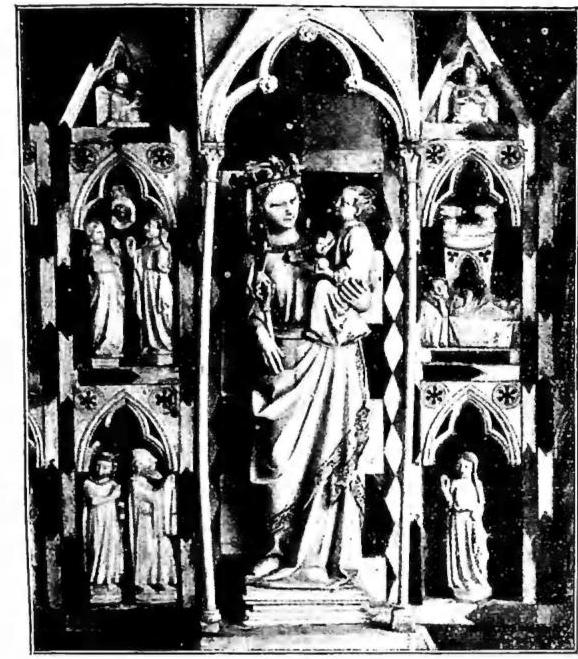
TRANI, ARCHIOCESI of — Madonna and Child, with scenes from the life of Mary Most Holy at the sides. Detail of a panel in ivory (French school of the 13th century) — Trani, Cathedral.
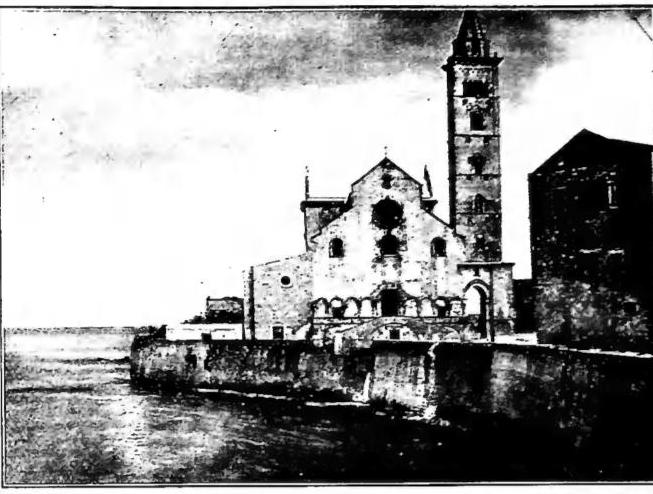
mare e dedicato a s. Nicola Pellegrino, il greco errante morto a T. proprio nell'anno dell'inizio dei lavori, e canonizzato quattro anni dopo sotto Urbano II. Per l'esistenza in situ della chiesa antica, cui si aggiunse la cripta nuova sotto il presbiterio attuale, il pavimento della Cattedrale si eleva di 5 metri sul piano stradale e vi si sale da due rampe di accesso. La chiesa romanica, nella forma e nella struttura, è una delle più tipiche cattedrali pugliesi: facciata alta e snella volta ad occidente con duplici spioventi laterali; disposizione crociata dei vuoti nella massa compatta di pietra rosata (rosone e monofore centinate); linea semplice e armonica nella pianta a T con altissima nave trasversa e tre absidi con finestre ornate. La facciata inoltre viene come mossa da quel sensibile gioco di curve ch'è sulla zona inferiore e sull'ala esterna della navatella destra: gli otto archi della facciata, avanzi di un portico distrutto o in fieri come a Bitonto, Ruvo, ecc., coronano il portale maggiore riccamente ornato nell'archivolto e negli stipiti e i battenti bronzei fusi da Barisano da T., l'autore delle porte di Monreale e Ravello, nella seconda metà del sec. XII, con arte in cui si avvertono influssi bizantini ed arabi, oltre che romanici (vedere, più che le formelle con figure simboliche ed ornati geometrici, quelle con le scene della Deposizione e di Barisano ai piedi del s. patrono). L'interno, a tre navate, ha restauri e deturpazioni, come lo scempio dei capitelli, scalpellati, stuccati e decorati ad olio e vernice nel 1837. Integri i matronei, ornati di 14 trifore come nel S. Nicola di Bari e nel duomo di Bitonto; ancora a posto nel presbiterio gli avanzi dell'antico pavimento con le scene di Salomone al tempio e David con la cetra. Di grande interesse la cripta di S. Nicola e l'episcopio che serba le reliquie di s. Leucio vescovo di Brindisi, traslate nella seconda metà del VII sec. in un loculo scavato apposta; il sepolcro gotico di Passapepe Lambertini e un buon fresco raffigurante la Madonna col Battista e s. Antonio.
L'archivio conserva 734 pergamene, tra i più vetusti documenti medievali della vita pugliese. A destra della facciata è il campanile, la più imponente forse di tutte le torri pugliesi, alta 65 m., poggiato da un lato sulla
chiesa e per il resto su una robusta base alleggerita da due archi ogivi. La sua costruzione si deve a più artisti: i due primi piani con bifore romaniche appartengono a « Nicolaus sacerdos et protomagister » (metà del sec. XIII); il terzo e il quarto con trifore e quadrifore sono di un secolo dopo; il quinto con pentafore, archetti e cuspide terminale del 1353-65. Recentemente si temette per la sua stabilità.
Oltre al Duomo, T. ha altre chiese notevoli. Quella di S. Andrea, tra le più antiche chiese a cupola della regione, è a croce greca triabidata con forti pilastri centrali che sorreggono la cupola emisferica. Allo stesso tipo, ma con tre cupole all'interno emisferiche e piramidali all'esterno, la maggiore su alto tamburo ornato di archetti, appartiene la chiesa di S. Francesco, fondata nel 1176 dall'abate Benincasa e dedicata alla SS.ma Trinità. Caratteristica la facciata monocuspidata e ornata di archetti, l'archivolto del portale su due colonnine pensili e i pilastri superstiti di un portico forse mai compiuto. Altro edificio romanico è la chiesetta di Ognissanti (sec. XII), eretta nel cortile dell'ospedale dei Templari e fino al 1312 proprietà di quest'Ordine. Ha doppio portico anteriore con capitelli su agili polistili e tre portali finemente ornati di sculture (il mediano serba due formelle con una Annunciazione), interno a tre navate con archi a doppia ghiera, in cui si conservano una Madonna veneto-orientale e una Vergine con santi di scuola veneziana del '500, e tre absidi grazioso tutte in pietra locale come il resto della fabbrica.
Anche le città comprese nella diocesi, tra le più popolose della provincia, serbano notevoli monumenti. Dell'antica cattedrale di Corato (sec. XIII) non resta che il portale ogivale con il bassorilievo della lunetta raffigurante Gesù tra la Vergine e il Battista, e il campanile trecentesco mozzato da un fulmine. Molto più interessante è la gotica chiesetta di S. Domenico con crociera sorretta da costoloni sagomati e snelle colonne angolari.