
DEPOSITION FROM THE CROSS. — This designation refers to the scene depicting the removal of the dead Jesus from the Cross before his burial. The Gospels recount that on the evening of Friday of the “parasceve,” after Jesus had expired, the noble Joseph of Arimathea went to the Roman procurator Pilate and asked him for Jesus’ body in order to bury him. Pilate, astonished at such a rapid death on the cross, granted Joseph the corpse. The Arimathean “took him down” (Mc. and Lc.) or “removed him” (Io.) from the Cross, with the help of Nicodemus, who had come with approximately 100 pounds of myrrh and aloes; he embalmed Jesus, wrapped him in the shroud he had purchased, and placed him in the tomb hewn from the rock (Mc. 15, 42-46; Lc. 23, 50-54 have almost the same text; Mt. 27, 57-60; Io. 19, 38-42 is the only one to mention Nicodemus). It may be supposed that Joseph removed Jesus from the Cross with his own hands and carried the corpse to the tomb.
ART. - The scene of the d. of C. from the Cross appears in Christian art associated with the representation of the Crucifixion (v.), around the beginning of the 5th century (the cup of Perm, the Gospel of Rabbùlà). It is necessary, however, to reach the 9th century before artists, stimulated by a desire for historical truth, represent the scene of the d. in its realism and include it in the entire figurative cycle of the Passion. By
d., however, one must understand, in the strictest iconographic sense, the moment in which the body of Jesus is lowered from the Cross to be wrapped in the shroud and enclosed in the tomb. Artists did not always adhere to this precise moment, in fact, and often extended the episode to the immediately subsequent one of the lamentation of the Virgin, Magdalene, John, and the pious women over Christ, already taken down from the Cross. From this representation there later developed the other, even more concise, representation of the Pietà (v.).
In the history of art, this distinction was not always taken into account, and the various iconographic motifs of the final moments of the Passion were often all designated by the generic name of d.
In the East, it appears in the frescoes of the rock-hewn churches of Cappadocia (Tokale-Göreme), and the scene is reduced to essentials: Christ is lowered from the Cross and his body is supported by Nicodemus (Io. 19, 38 ff.); the Virgin, s. John, and the pious women witness the scene, petrified in their gestures of grief and without directly participating in the action.
The Virgin is often depicted in the act of kissing one of Jesus’ hands, hanging along the side of the Cross, while John, on the other side, repeats Mary’s gesture (katholikon of Mount Athos). Sometimes, however, the Virgin also participates in the action and supports the Son’s body in her arms, assisted by Nicodemus and Joseph of Arimathea, while John and the pious women remain sorrowful and mute in their hieratic immobility (peribleptos of Mistra).
In the West, the iconographic theme initially connects with the motifs of Byzantine art, and knowledge of it, determined above all by the importation of Eastern codices, expanded increasingly from the 7th century onward and lasted throughout the Romanesque period. In Rome, the scene of the d. is of-
fered by the frescoes in S. Urbano alla Caffarella (11th century) and in S. Giovanni ante portam Latinam (late 12th century); there the d. is carried out by s. John and Joseph of Arimathea, a motif repeated in a miniature of cod. lat. 123 of the Biblioteca Angelica. In the mosaic cycle of Monreale in Sicily (12th century), the three Marys appear carrying two vessels of balsam. Also noteworthy is the d. on the ivory, now in Paris, from the 13th century (A. Venturi, II, p. 614 and fig. 442). Thus, when Antelami depicts the d. in the bas-relief of Modena Cathedral, which is in fact his first securely datable work (1178), the Byzantine scheme is expanded by the inclusion of the Church and the Synagogue, personified at the foot of the Cross, while the pious women, enclosed in their grief, are joined on the opposite side by the scene of the soldiers casting lots for the Redeemer’s garment. The Virgin, standing apart, is bowed in her grief.
In the d. of Volterra Cathedral, by an artist perhaps from Lombardy and a follower of Antelami, and in that of Tivoli Cathedral, likewise descended from the same stylistic sphere, the motif of the katholikon of Mount Athos returns. Jesus’ body is supported by Joseph of Arimathea, while the Virgin and John stand on either side of the Cross. At Volterra they hold Jesus’ hanging hands; at Tivoli, with greater hieratic solemnity and with
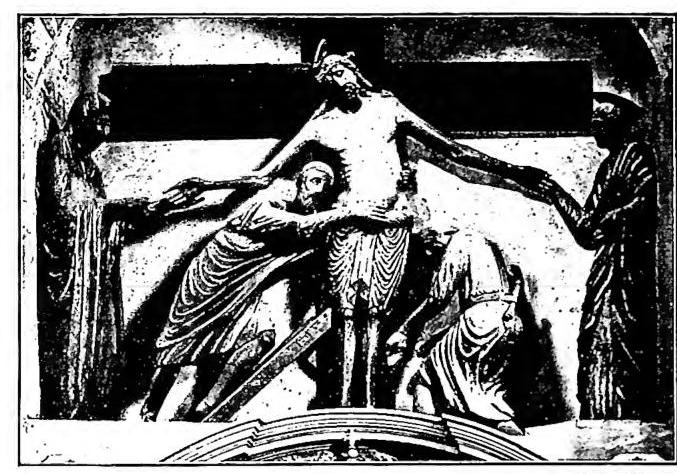
The scene of the d. represented on the pulpit of the former S. Piero Scheraggio, now in S. Leonardo d’Arcteri, a fragmentary work by anonymous Tuscan sculptors of the second half of the 12th century, likewise follows Byzantine canons. Greater dramatic intensity of gesture is found in the fresco of the end of the century in the crypt of the cathedral of Aquileia, where the Virgin supports the fallen body of Jesus, while the pious women gather, slender, in a restrained and sorrowful gesture, and John raises the garment of the Redeemer to his lips. At Venice, in the church of the SS. Apostoli, a mosaic from the beginning of the 13th century instead shows affinities with motifs widespread in the painting and sculpture of central and southern Italy (the Porta di Barisano at the cathedral of Trani, Corale, XI, L. 5 of the Estense Library of Modena, and later the d. by Nicola Pisano and assistants in the lunette on the façade of the cathedral of Lucca, etc.).
In the 14th century, with Giotto (Padua, Scrovegni Chapel), the scene changes: the desolate nature of Golgotha is represented only by a bare tree atop a rock which, following a diagonal, leads the eye to the center of the drama, shifted toward the lower left. The body of Jesus has fallen, supported by Mary’s loving embrace; the pious women, in their immobile forms, bend over him, and John, his arms open in a gesture of supreme plasticity, conveys the dramatic climax of sorrow. The changed accents within the changed compositional scheme humanize the scene, and Giotto’s iconographic motif, which is that of the lamentation over the dead Christ cited above, remains one of the highest manifestations of art, one that would enjoy extensive continuation throughout all succeeding centuries (v. also PIETÀ).
Simone Martini, in the lost panel of an altarpiece at the museum of Antwerp, and Pietro Lorenzetti, in the fresco of the lower church at Assisi, instead take up the preceding motif of Jesus’ body not yet completely detached from the Cross and folded onto the arms of those taking part. Giotto di Stefano, called Giottino (d. of the Uffizi), returns to the Giottesque scheme, but replaces the spare and plastic landscape with the gold background against which the Cross stands out naked.
Throughout the 14th and 15th centuries, the various iconographic motifs of the d. alternate. In the 16th century, the two principal themes are taken up again: that of the lamentation over Christ and the other, which adds the Virgin’s fainting to Jesus’ descent from the Cross, both scenes grouping several figures. While the first scheme derives from the medieval tradition, the other is connected with Byzantine painting itself, in an increasingly synthetic and unified vision.
Marvelous examples of the first motif are the d. by Signorelli in the cathedral of Cortona, by Correggio in the picture gallery of Parma, by Tintoretto in the Accademia Gallery in Venice, by Carracci in the National Museum of Naples, and, ultimately, the many d. by Van Dyck. The second motif is first represented by the composition begun by Filippino Lippi in 1505 for the painting in the church of the S.ma Annunziata in Florence, now in the Uffizi, and completed by Andrea d’Assisi, followed by the other of 1515–16 that Signorelli left at Umbertide. From these two, and from the other by Sodoma, painted after 1508 for the church of S. Francesco in Siena and now in that picture gallery, with the fusion of the two moments, derives the celebrated d. that Daniele da Volterra frescoed in Rome at Trinità dei Monti. The triangular scheme of Lippi and Signorelli of Cortona is transformed, and the composition, structured on diagonal lines, acquires plastic force in the massive human architectures and creates a work of the highest dramatic value. Barocci appears to follow the scheme of the Volterrano in his d. in the cathedral of Perugia, completed in 1569.
In the 17th century, among others, one should remember, for its monumental construction, the canvas by Massimo Stanzioni in the Certosa di S. Martino in Naples, one of the last works in which the theme of the d. is expressed in the full power of its lofty religious significance. – Vedi tav. XCI.