GIOTTO di BONDONE. — Painter and architect, b. at Colle di Vespignano in Mugello, in all probability in 1267, d. at Florence in 1337.
An artist among the greatest of all time, generally regarded as the founder of the Italian figurative language, in the same sense in which Dante is acknowledged to possess “the glory of the language.”
A disciple, according to an ancient tradition that, despite the doubts of certain modern scholars, remains valid, of Cimabue, from whom he learned to exalt the harsh power of chiaroscuro and, to contain its imposing volumes, the biting efficacy of the contour line, he also looked to late-thirteenth-century Roman painting (to the great Isaac Master rather than to Cavallini, whom he instead influenced), to late-thirteenth-century Pisan sculpture and especially to Arnolfo, and beyond it to Romanesque sculpture and perhaps also to ancient art.
Close in date to these frescoes are the documented Crucifix of S. Maria Novella and the Madonna of S. Giorgio alla Costa in Florence.
Probably in the years between 1296 and 1300, G., with extensive assistance from helpers, painted the 28 frescoes of the Legend of s. Francis in the same upper basilica at Assisi.
The arguments advanced by an entire series of German scholars to deny G. authorship of the cycle do not withstand criticism. In contrast with the now traditional Franciscan iconography of the thirteenth-century panels, G. gives the legend a formulation profoundly new in the spirit of simplification and order that dominates II. Far from indulging in the episode, the artist seeks for each event the most direct and essential pictorial formulation, and finds it in a synthesis of plastic order, concretized in the absolute and coherent reduction of every phenomenal appearance to an architecture of volumes. Space itself proves to be intimately co-natural with the plastic substance of things, in a vision very different from that based on the harmonious relationship between container and contained proper to the Isaac Master and the Roman school, and which instead finds a counterpart in Arnolfo’s spatiality. Even in the more complex compositions (Nativity at Greccio,
(Alinari photograph)
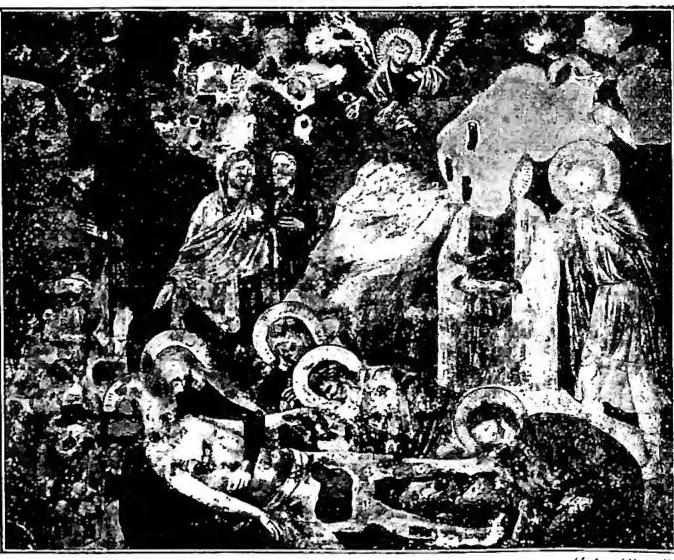
GIOTTO di Bondone — Lamentation over the Dead Christ, fresco in the upper basilica of S. Francesco — Assisi.
[Non-Text]
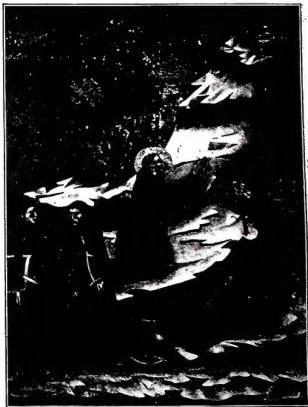
Preaching before Honorius III, Appearance before the Chapter of Arles, Confirmation of the Rule, where the use of elementary means of perspective is more exposed, and in those with landscape backgrounds (Preaching to the Birds, Miracle of the Spring, Gift of the Mantle), space arises primarily from a scaling of volumes, from an interconnected relationship of masses. The poetic rationale of these compositions lies precisely in the conscious reduction of visible things to the pure, elementary fact of plastic form, and therefore in the isolation, on every narrative occasion, of the dominant note of dramatic emotion. This is all the more so because a biting line contains the volumes and springs and tightens precisely at the focal point of dramatic tension, precisely where the decisive gesture is born (Renunciation of Possessions, Knight of Celano, Lamentation of the Poor Clares). Thus the volumes, initially seen in their elementary absoluteness, emerge from their isolation and enter into a vital reciprocal relationship: from this arises the Giottesque compositional dynamic whereby volumes draw together in a tightly linked chain through the mediation of the plane. And the various types of composition could be enumerated like the tonalities of a scale, from the simplicity of an ancient bas-relief in scenes composed of few figures on a single plane, in a gentle rhythm, to those that gather a large number of silent and solemn onlookers in transverse or semicircular groups, possessing an impenetrable calm saturated with dramatic content, and to those that shift the fulcrum of the action to the convergence of several compositional lines, now with the grave movement of a ceremony, now in the agitation of a hurried rhythm.
Color as well, vivid and intense, underscores through contrast the somewhat discontinuous plastic and compositional articulations, and everything, in short, suggests the feeling of a world undergoing its first and unexpected revelation. The astonished contemplation of creation and the wonder of the miracle are thus the nucleus of the lyricism of the Legend of s. Francis. And one may, with due restraint, discern in it a consonance with the candid yet also robust poetry of the Fioretti: but everything is recreated in a more solemn and choral tone, in which there is already the presentiment—destined to become law at Padua—of a supreme necessity governing events.
In the Jubilee Year of 1300 G. executed in mosaic the Nauicella in the atrium of the old S. Pietro; it was later entirely remade (two angels’ heads remain, one at Boville Ernica, the ancient Bauco, the other in the Museo Petriano).
On 25 March 1305 (or, according to others, 1306), G. completed the pictorial decoration of the Arena Chapel, built at the behest of Enrico Scrovegni on the site of the Roman amphitheatre at Padua. Despite the differing opinion of certain critics, it must have begun with the Stories of the Virgin in the highest band, characterized by an extreme spatial rarefaction and by an abstract, almost metaphysical setting. More fused chiaroscuro, a new harmony of the colors, and the tendency of the volumes to spread across the plane as far as the boundary of a thickened contour, synthesizing plastic and spatial suggestions, generate a richness of texture, in the musical sense of the term, that distinguishes the plasticity of Padua from that of Assisi. The result is a poetry limpid yet, more than any other—except Dante’s—laden with moral meaning. A slow play of tensions and relaxations, almost a pulsation of forms, gives the stories, unfolding in an atmosphere of hermit-like solitude and ancient solemnity tempered only by a human breath of suffering, a tone of profound and detached life. These are compositions conceived in the manner of a plastic frieze, in which the volumes are placed in a tenacious relationship with a continuous background plane, whether this assumes, as in the scenes of the Exile of Joachim, the solid presence of a rocky ridge, or whether instead (Nativity of the Virgin, Annunciation to s. Anne) it is elliptically indicated by the continuous void of a space behind the plane of the figures. The first Stories of Christ, up to the Flight into Egypt, continue the relief-like composition with a tighter concatenation. But already in the Massacre of the Innocents and the Baptism, new transverse compositional lines begin to emerge, even within the predominance of the horizontal rhythm. The swelling of the dramatic wave corresponds to this more animated mode of composition. Yet one does not find that unexpected opposition of masses, that…
broken rhythm, those sudden angles that at Assisi revealed the impetuous temperament of an artist still young. Here a calmer spirit prevails, finding its pictorial measure in a more unified plastic continuity. In the Resurrection of Lazarus, the convergence upon Christ of the rocky ridges and the long sheer descent of the rock shifts the focal point toward one of the margins, generating an extraordinarily enduring and unresolved tension. This more dramatic strand of G.’s inspiration reaches its culmination, after other scenes in which a pregnant sense of the action’s prescient gravity is entrusted to the absolute plastic continuity by which the slow rotation of the volumes identifies itself with space, in the fresco of the Lamentation, the commanding summit of his art. The compositional conception of several converging axes mysteriously joins with the vision of rotating volumes to create the most absolute identity of plasticism and space. And the breathless concentration of all the lines, summed up by the interminable duration of that descent of rock, is as though arrested by the reduction of all appearances in the sensible world to the square forms of the most elementary and absolute plasticity: the loftiest expression of pain petrified in an absolute cosmic fraternity.
The decoration of the Chapel is completed by the Judgment on the entrance wall (largely by pupils), the Virtues and Vices in grisaille on the dado, and a Crucifix on panel.
Some years later should be dated the Polyptych of Badia in the Museum of S. Croce, only partly autograph and much deteriorated, and the Madonna of Ognissanti in the Uffizi, a composition of supreme, yet tense and tightly controlled, balance.
The frescoes of the Peruzzi Chapel (Stories of s. John the Evangelist) and the Bardi Chapel (Stories of s. Francis) in S. Croce in Florence, extensively repainted in the last century, differ from the cycle at Padua through a less tightly controlled composition, a more relaxed rhythm, and a broader “time.” In the Peruzzi Chapel, which probably precedes the other, there is nevertheless a heroic tone that passes into the loftiest calm in the Bardi Chapel (after 1317), where G. attains his own culmination of classicism.
(phot. Gab. fot. ...)
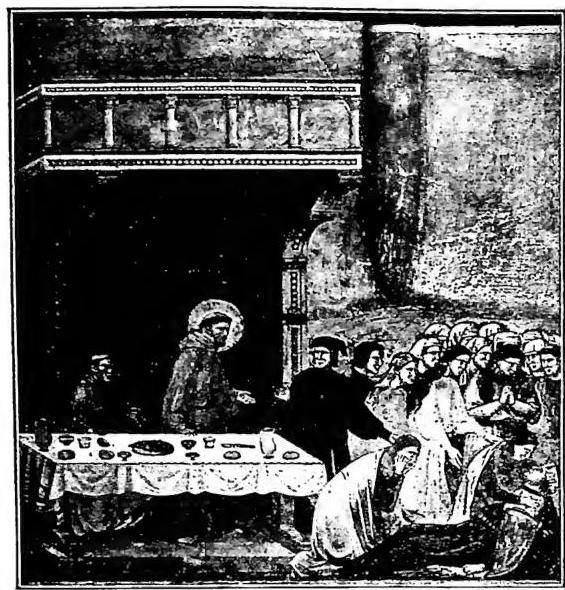
GIOTTO di BONDONE - The miracle of the thirsty man, fresco in the upper basilica of S. Francesco - Assisi.
(phot. Gab. fot. naz.)