
GIOVANE ITALIA. – The foundation of the G. I., carried out by Mazzini in July 1831 at Marseille, was determined on the one hand by distrust of the Carbonari movements, which were rather local in character and generally lacking in sufficiently ideal preparation, and on the other by the desire to assert the need for the unity of Italy, no longer a simple geographical expression but a programmatic objective to be achieved in the form of a republican government. The Istruzione generale per gli affratellati alla G. I. rejected any compromise with the monarchical status and with the state fragmentation existing in the peninsula. By affirming that the G. I. was «the brotherhood of Italians believing in a law of Progress and Duty, who, convinced that Italy is called to be a nation, consecrate, united in association, thought and action to the great aim of restoring Italy as a nation of free and equal men, One, Independent, Sovereign», Mazzini, explicitly condemning the policy of the Restoration based on the preservation of territorial particularism, constituted through his political, ideal and practical action a powerful incentive for the implementation of the Risorgimento of Italy.
Since this association founded by Mazzini pursued aims that were evidently subversive of the existing state of affairs, its action could only be illegal from the standpoint of positive law. In the Istruzione Mazzini himself affirms this apertis verbis: the G. I. is «an association aimed above all at an insurrectional purpose, but essentially educational until that day and after that day (on which it will achieve the unity, independence and sovereignty of the people in the peninsula)»; and in the circular of 8 December 1831 he states that the republican programme could be implemented only against the sovereigns. The assertion of the unity of Italy, from the Alps to the Ionian Sea, from the mouths of the Var to the west to Trieste in the east, was not merely the dream of an idealist, but also drew upon the concept of European equilibrium, the firmest foundation of the political action of the European cabinets, especially from the eighteenth century onward. The attempt to insert Italian unity and nationality positively into the process of European history directly and immediately failed, above all because of the revolutionary and insurrectional efforts, but the Risorgimento of Italy benefited greatly from it, because these failed attempts provided a stimulus and an incentive toward a more national and less narrowly particularistic policy—a policy that ultimately led Piedmont to become the bulwark against foreign domination and gave the Italian national and independence movement a monarchical and unitary solution. In short, the action of the G. I. and of Mazzini, from the expedition to Savoy to the sacrifice of the Bandiera brothers and the Milanese uprisings of 1853, conditioned not only the policy pursued by Carlo Alberto in favor of independence, but also, in a certain sense, lay at the basis of all Cavour’s diplomatic activity, from Plombières to the Expedition of the Thousand and the proclamation of the Kingdom. The G. I. as such did not last so long: it was especially active from 1830 to 1840, when its founder, in 1834, also established Young Europe, which envisaged a republican continent with a Young Switzerland, a Young Poland, a Young France and a Young Germany, with a periodical in French and German (La jeune Suisse) and one in Italian (La G. I., of which six issues appeared from March 1832 to 1834); the G. I. was dissolved by Mazzini himself in 1848.
As a secret society permeated by clearly-

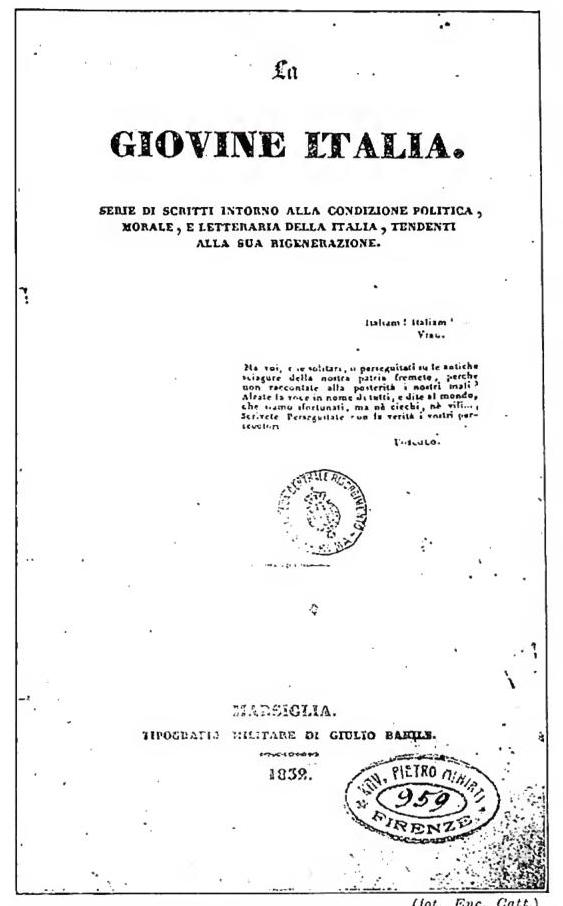
(phot. Enc. Catt.) GIOVANE ITALIA - Frontispiece of the first issue, Marseille 1832 - Rome, copy of the Library of Modern and Contemporary History.