
GIOACHINO MURAT, king of NAPLES. — Born on 25 March 1767 at La Bastide Fortunière, died on 13 October 1815 at Pizzo in Calabria. His parents intended him for the ecclesiastical state, and he entered the Lazarist Seminary of Toulouse; but the priestly mission was not for him, and in 1788 he left the Seminary and enlisted in the mounted chasseurs.
Enthusiastic about the Revolution and a friend of Bonaparte, he served as the latter’s aide-de-camp during the Italian campaign of 1796. Made divisional general in 1799 in reward for his conduct during the Egyptian campaign, he contributed decisively to the success of the coup d’état of 18 Brumaire.
G. M.’s military gifts as a cavalry commander were truly outstanding, and he took part in virtually
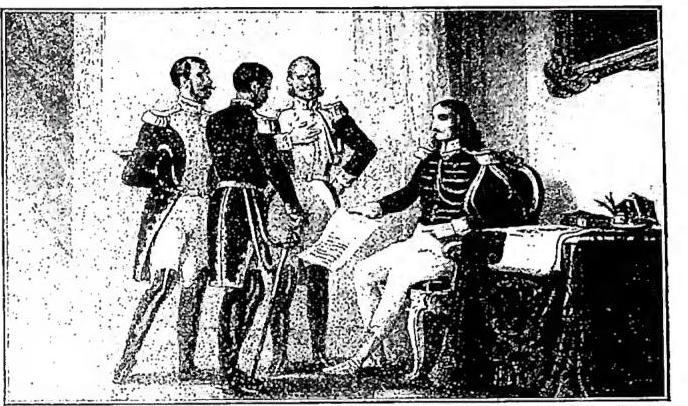
all the Napoleonic campaigns at the head of his cavalry: during the Russian campaign he commanded the cavalry of the Grand Army. Marshal of the Empire, he became Grand Duke of Berg and Clèves in 1806. In November 1807 he was given command of the troops that invaded Spain, and he suppressed the Madrid uprising of 2 May 1808 with ferocious energy. In July of the same year he succeeded Giuseppe Bonaparte to the throne of Naples. In the Kingdom of Naples he improved the population’s social, economic, and spiritual conditions through appropriate reforms. With a prudent financial policy he consolidated the public debt, promoted laws in favor of agriculture, industry, and commerce, and greatly increased the construction of public works. During his reign, the French codes were adopted, suitably revised and modified according to local needs; but the Civil Code, which entered into force on 1 January 1809, also contained articles relating to divorce. In his relations with the Catholic religion, G. asserted in all his measures the supremacy of the State over the Church. The clergy as a whole was regarded as a state organ, duly salaried and therefore obliged faithfully to carry out the orders and instructions transmitted to it by the government. In order to preserve the throne, G. M. abandoned Napoleon after the Battle of Leipzig and allied himself with Austria; but upon hearing of the Emperor’s return from Elba, he conceived, with the Proclamation of Rimini of 30 March 1815, the idea of rising up all Italy and constituting it as an independent kingdom. Defeated, he withdrew to Cannes and Ajaccio, from where he set sail to reconquer his Kingdom; but, having landed at Pizzo, he was taken prisoner and sentenced to death.