
AUSTRIA. – A state of Central Europe, comprising almost the entire northern versant of the Eastern Alps, from the Swiss border (Vorarlberg) to Burgenland with the Salzach basin (Salzburg), the Mur basin (Styria), the upper Drava (Carinthia), and the Danube valley from Passau to Bratislava (Upper and Lower Austria).
SUMMARY:
I. Geography
II. History of Christianity
III. Literature
IV. School systems
V. Art.I. GEOGRAPHY.
The territory of Austria, within the 1922 frontiers, measures 84,000 sq. km., on which live 7 million inhabitants (density: 84 per sq. km., higher than France’s, lower than Switzerland’s). The population, entirely German (97%), is overwhelmingly Catholic (90.4%), with few Protestants (4.3%) and a Jewish nucleus (2.8%).
A mountainous and relatively poor Alpine state, it benefits from its transit position (where routes intersect between Slavic and Balkan Europe and between Germanic and Latin Europe), despite the difficulties of communications (it nonetheless has over 25,000 km of roads and 6,800 km of railways; the Danube is fully navigable within Austrian territory).
Alongside agriculture (one-fifth of the population) and industry (one-third), commerce (one-seventh) is therefore one of the primary sources of activity. Cereal production (especially rye) is insufficient for consumption; livestock farming is flourishing (2.2 million head of cattle), though far less so than in Switzerland; forestry products are abundant, and the subsoil yields not inconsiderable resources (lignite, iron, lead, zinc, copper, magnesite, etc.), which together feed a varied and lively industry (furniture-making, paper mills, iron and steel, etc.).
A federal republic since 1918, it returned to this status in 1945, after the end of the Anschluss with Germany (13 March 1938). For four centuries (until the First World War), Austria was one of Europe’s principal powers, but it did not form a national unity, only a dynastic one. On the eve of the First World War, the Austrian monarchy, together with the Hungarian Crown (personal union), ruled over more than 676,000 sq. km. and 55 million inhabitants (300,000 sq. km. and 30 million in proper Austria), from the Sudetenland to the lower Adriatic and from the upper Danube to Galicia.
At the end of the Second World War, Austria was entirely occupied by Allied troops (May 1945). Reconstituted (4 July 1945) within the 1937 frontiers, it was divided into four occupation zones: the Soviet or north-eastern zone (comprising Lower Austria, Burgenland, and Upper Austria on the left bank of the Danube), the American or north-western zone (comprising Salzburg and Upper Austria on the right bank of the Danube), the French or western zone (comprising Tyrol and Vorarlberg), and the British or southern zone (comprising Carinthia, Styria, and eastern Tyrol). The last two zones border on Italy. Vienna, like Berlin, is also subdivided into four zones and is the seat of the Allied command in Austria.
With 1.5 million inhabitants (2 million in 1939), Vienna, once the capital of a great monarchy, remains one of the most important cities of Central Europe. Graz (Styria), Linz (Upper Austria), and Salzburg also exceed 100,000 inhabitants.
| Districts | Area in sq. km. | Population (1946) | Density | Capital (Population in thousands) |
|---|---|---|---|---|
| Vienna | 278 | 1,431,837 | — | Vienna (1,548) |
| Lower Austria | 19,296 | 1,492,846 | 79 | Vienna |
| Upper Austria | 11,994 | 1,197,252 | 100 | Linz (173) |
| Salzburg | 7,153 | 362,353 | 51 | Salzburg (106) |
| Tyrol | 12,647 | 401,899 | 32 | Innsbruck (95) |
| Vorarlberg | 2,602 | 187,414 | 72 | Bregenz (18) |
| Carinthia | 9,535 | 542,368 | 57 | Klagenfurt (63) |
| Styria | 16,385 | 1,112,672 | 68 | Graz (220) |
| Burgenland | 3,977 | 271,362 | 70 | Eisenstadt (5) |
| TOTAL | 83,867 | 7,000,003 | 84 |
Giuseppe Caraci
II. HISTORY OF CHRISTIANITY.
Today the word Austria refers to that predominantly mountainous region, which, bordered by Germanic and Czechoslovak territories to the north and Italian and Yugoslav territories to the south, extends between the upper and lower Danube and the Inn, between the Enns and the Leitha (its right-bank tributaries), and the Mur and Drava to the west. The March of Austria with the city of Vienna was the heart of present-day Austria. In antiquity, this region roughly corresponded to Noricum and Upper Pannonia.
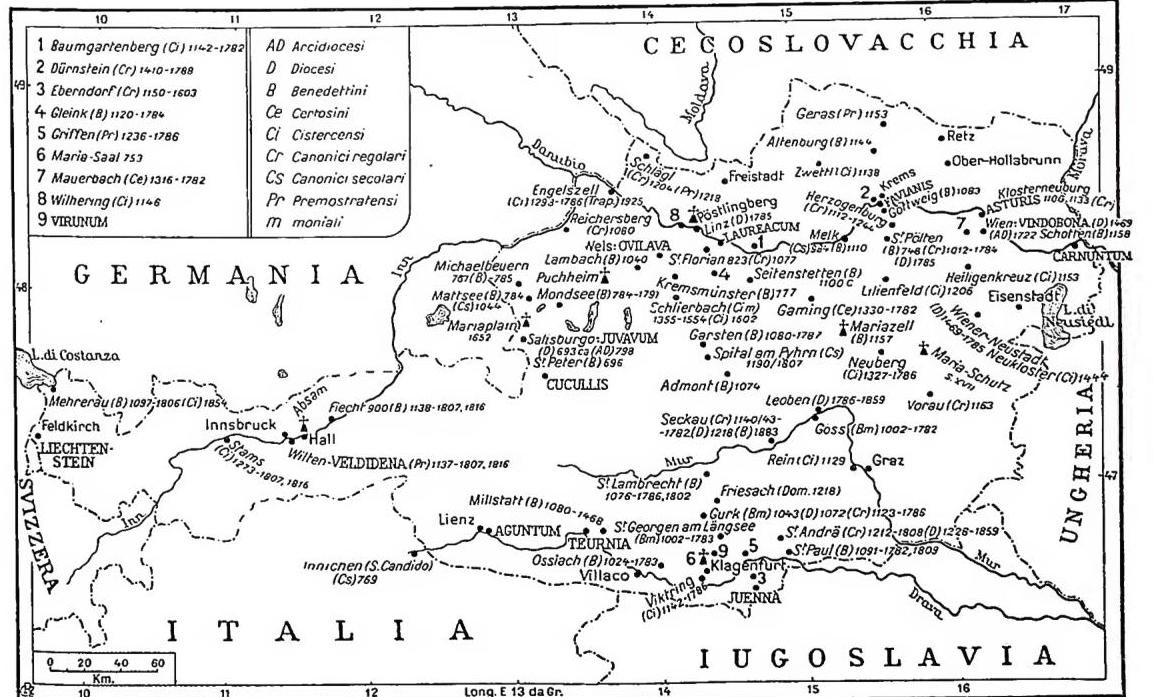
The centres of diffusion for Christianity, as for other Eastern religions, were Mediolanum, Sirmium, and, for the southern regions, Aquileia. We know that Syrian and Italian legions were stationed in these provinces for a very long time, and traces of the cult of Mithras, Cybele, etc., are found everywhere today. It is likely that Christianity penetrated sporadically through soldiers, settlers, and merchants. We do not know, therefore, when the hierarchical organization was established; Aquileia must certainly have been the first centre for the spread of Christianity, a fact confirmed by local legends that attribute the introduction of the Christian religion into these parts to Hermagoras and Fortunatus of Aquileia, or to Mark or other disciples of Peter.
The few martyrs known from the time of Diocletian date to this period: among them Maximilian of Laureacum, Florian and 40 companions in the same place, and Victorinus, bishop of Petovio (Pettau).
Austria is a state of Central Europe, which comprises almost the entire northern versant
AUSTRIA – Historical ecclesiastical map.
(from G. Ischau, Handbuch der deutschen Kunstdenkmäler. Österreich, II, Vienna 1933, p. 427)
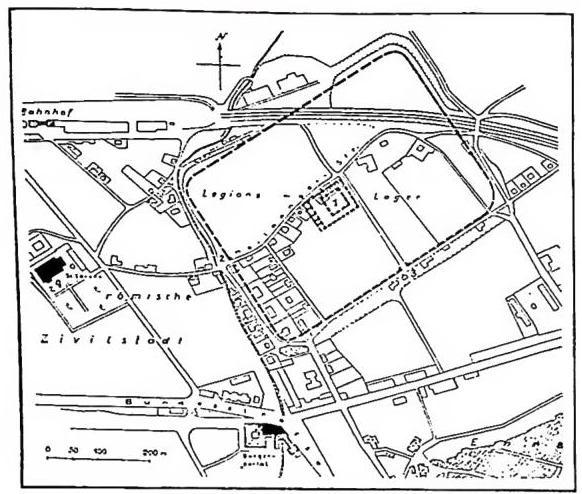
AUSTRIA — Plan of the Roman fort (A.D. 190) of Laureacum, today Lorch, near Enns (Upper Austria); 1. praetorium; 2. decuman gate; 3. main gate; 4. forum and capitolium of the civil town, where the episcopal basilica dedicated to St Lawrence arose (4th century), now the cemetery church.
It was in the 4th and 5th centuries that the episcopal sees of Celeia (Cilli) and Petovio (Pettau)—whose bishop Apollinaris subscribed to the Council of Sardica (344)—came into being; likewise Laureacum, capital of Noricum Ripense (the basilica lies beneath the present church of St Lawrence); Carnuntum (where a church arose among the arcades of the amphitheatre); and Tiburnia (with Bishop Paulinus at the time of Severinus, its basilica lying beneath the parish church of St Peter, while the cemetery basilica today constitutes one of the most interesting monuments of Romano-Christian Austria). For the other cities we do not know whether they were episcopal sees or not: only future excavations may confirm this.
2. Medieval period. — a) Early period. — After Odoacer, the Austrian regions were traversed by Theoderic on his way to Italy, while from the west the Alemanni and Bavarians spread through the Alpine valleys. Around 510 the Lombards halted for about half a century in the eastern part. They were followed by the hordes of the Avars (c. 585), together with the Slav peoples subdued by them—the Serbs, Croats, Slovenes and the so-called “Alpine Slavs”, i.e. Slavs of the Alps: the latter penetrated in isolated groups as far as Tyrol. Roman, or rather Celtic-Roman, nuclei certainly remained scattered everywhere. At this time, with a first temporary Merovingian domination (from 550), we have knowledge of the survival of the three sees of Tiburnia, Celeia and Petovio (letter of the bishops of Venice to Emperor Maurice, 591; cf. MGH, Epistulae, I, 17). For the rest, the scanty sources are completely silent about the religious state of these regions in the 6th and 7th centuries.
Only with the Bavarian state organisation do we have news about the ecclesiastical situation. While the east was slowly transformed into the so-called “Avar desert”, a certain Bavarian penetration spread towards the present-day regions of Tyrol, Carinthia and Styria. With the mission of St Rupert and the establishment, at Iuvavum (later Salzburg), of a monastery with an episcopal see (St Peter’s) under Duke Theodo of Bavaria, we have, around 700, at last a fixed point for the subsequent systematic spread of Christianity in the eastern Alps, where the immigrant Slav populations were still pagan; the remaining Roman nuclei, instead, had been absorbed.
Yet the Christian mission assumed secure forms and effective methods only after the definitive hierarchical organisation
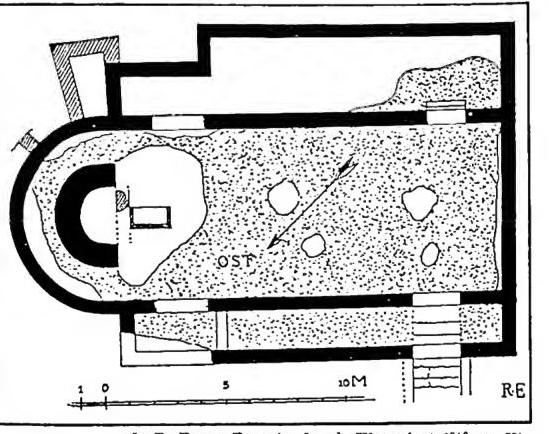
AUSTRIA — Plan of the Christian basilica at Duel, near Feistritz, Carinthia, built at the beginning of the 5th century in the centre of a Roman refuge.
The mission was predetermined in the famous Synod of Regensburg (799). To facilitate the government of regions so distant from the sees themselves, the office of chorepiscopus was instituted, Salzburg’s in Carinthia, Passau’s in the Eastern March, an institution which lasted beyond the year 900. In 823 the important monastery of St Florian was founded; then villages and small centres, colonies of cities, monasteries and German bishoprics arose on territories donated by the German kings. Everything, however, was upset and devastated during the invasion lasting more than 50 years of the Magyars (900-55). These pagan hordes, like the Huns and the Avars, systematically devastated all the neighbouring countries (Italy throughout the Po valley, France as far as the Seine, and almost all Germany), but above all the Eastern Alpine regions. Only the great victory of Otto I (955) on the Lechfeld put an end to Magyar barbarism and opened a new period, the period of the third and definitive Christianization and of the complete Germanization of the Eastern Alps, with the exception of the most distant region towards the Adriatic, where the Slovenes remained.
The only ecclesiastical building still intact and still in use from that second period is the parish church of Karnburg, in Carinthia, which is the chapel of an imperial palace (Pfalz) mentioned in 888.
b) Second period: political organization, colonization and definitive ecclesiastical organization: 9th–13th centuries. — As a consequence of the Magyar invasion, along the Danubian regions it was necessary to begin almost everything anew; in the interior of the Alpine system, and in the southern parts, the depopulation and devastations were less serious. Since religious life is closely bound up with political and cultural developments, we here touch on the political history of Austria.
Ido K. Ginkart, Die Kunst und die Körner VI, 1. Klagenfurt 1930, p. 697
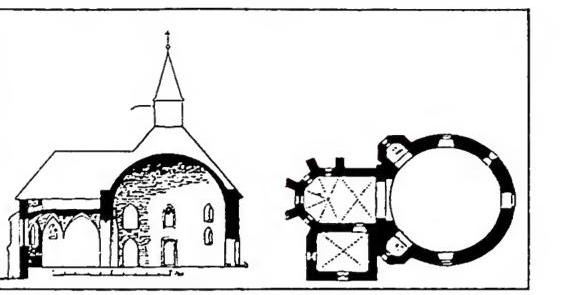
AUSTRIA – Plan of the parish church of Flattnitz, 1390 m., Carinthia, consecrated in 1173, with Romanesque dome, Gothic choir and bell tower from the 14th century.
We now turn to the other territories that later joined proper AUSTRIA. STYRIA, developed under the Traungauers (at STIRIASBURG), was originally a march, later elevated to a duchy and, in 1192, passed by inheritance to the Babenbergs. CARINTHIA, a duchy in its own right since 1000 (previously under Bavaria), had dukes from various houses and passed by inheritance to AUSTRIA in 1335. The history of TYROL is more complex. The progressive union of various counties, originally enfeoffed to Trent and Brixen, led to the formation of a fairly large and homogeneous territory that took the general name of TYROL and became an immediate fief (“curiosumittelbar”) of the Empire. Through various vicissitudes and hereditary lines, TYROL too was united to AUSTRIA in 1363. VORARLBERG likewise arose from many small counties and lordships; especially under the counts of Montfort (1188–1400) it became a uniform territory, acquired by the Habsburgs in 1390. It should be noted finally that the name “Österreich, AUSTRIA” dates from 996, while VIENNA first appears under its new name “Wenia, Wien” in 881.
As for the colonization of these lands, the southern parts—namely Carinthia and much of Styria—suffered fewer losses of men and devastation than the northern districts. The flat, open region toward Hungary had remained almost a desert. It must also be noted that many areas, especially the vast forests north of the Danube toward Bohemia and many inner Alpine regions less accessible, had hitherto been virtually uninhabited. One of the most urgent tasks therefore was to repopulate the whole region. This was ordinarily accomplished by enfeoffing more or less extensive territories to German lords, to cities, but more often to bishoprics and monasteries. These, in turn, set about making the lands granted them productive through ever more intensive colonization. This process can be said to have ended, broadly speaking, during the 11th century.
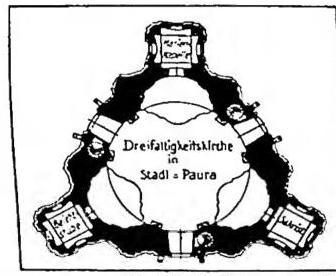
AUSTRIA – Painting of the sanctuary of the Most Holy Trinity at Stadl-Paura (Upper Austria), by Johann Michael Prunner, built in 1714–17.
Slowly a new and quite distinctive spirit emerged, so that the “Austrian” man, in his mentality, culture, and historical antecedents—though never repudiating his Germanic origins—came to form a type of his own, clearly distinct from the other variations of the German people proper.
Since the native and immigrant population was now Catholic, the organic developments of settlement brought with them the developments of ecclesiastical organization and religious life. For centuries the two centres of ecclesiastical organization remained the sees of Passau and Salzburg. While Passau, after its vain attempt to rise to metropolitan status (recall the famous Lorch forgeries), contented itself with governing the distant Austrian parts through an “officialate” seated in Vienna, Salzburg pursued a more flexible policy. By reviving the defunct system of chorepiscopi, episcopal sees were established at first as mere vicariates of the metropolitan, but soon became true dioceses, albeit rather small ones, while the bishops remained vicars (archdeacons) of the metropolitan for the regions far from Salzburg. Hence the curious fact that the archbishop of Salzburg had the right to appoint his own suffragans. These supplementary bishoprics were: Gurk in Carinthia (1072); Seckau in Styria (1218); Lavant in Carinthia (1226). In the mid-15th century, at the initiative of Emperor Frederick III, the bishopric of Ljubljana arose in Carniola.
Yet the true, enduring glory of this era lies in the cultural achievements of the great Bavarian—and especially Austrian—monasteries, feudal lords of vast territories, opened through patient labour to every development of civil and religious culture. At this point one might list the Benedictine, Augustinian Canons, Cistercian, and Premonstratensian monasteries.
If today the great Austrian monasteries often present a large—and often very large—number of parishes completely incorporated into them, this is because those were once the territories raised by the monastery itself to the highest level of Christian civilization.
The constantly lively relations of the Austrian lands with Italy and the Near East resulted in a continuous exchange of reciprocal cultural, literary, artistic, and commercial influences that spurred rapid general development in that peripheral part of Germany. Austria then became, as we have already noted, the true centre of German culture, and the court of the Babenbergs in Vienna was the most splendid (Walter von der Vogelweide; early German literature, origins of great German epics such as the Nibelungenlied, etc.). Here lie the roots of that marked sense for every kind of high culture which remained forever the proudest boast of Austria.
In a sense, the history of Christianity in Austria ends at this point, an era that has written some of the most splendid pages, as witnessed by the grand ecclesiastical art of the time (see bibliography). For the centuries that followed down to our own day, Austrian Catholicism broadly followed the main spiritual and cultural movements of Europe, sometimes with specific aspects and distinctive traits. Brief sketches will therefore suffice to outline the history of Austrian Christianity up to the present.
3. Modern Age
The beginning of this period is marked above all by the century-long wars against the Turks. The danger began earlier, but from 1470 to around 1500 almost every year saw violent Turkish incursions deep into the Austrian provinces. In 1520 the first siege of Vienna occurred, which stunned all Europe. The 16th century marks the height of Turkish predominance; Austria assumed full responsibility for defending Europe against the Turks, though often hindered by the burgeoning Protestantism, which exploited its political strength to extort from Austrian rulers ever new religious and political concessions in exchange for meagre support; and by France, which never ceased to ally itself, openly or secretly, with the Ottomans. Only in the 17th century, after the second siege of Vienna (1683), did Austria finally expel the Turks from Hungary (a singular merit belonging to Marco d’Aviano, an Italian Capuchin) and push them back toward the Balkans. The finest victories that saved Europe from the Ottoman nightmare are linked to the name of Prince Eugene of Savoy, the Austrian general. The long and arduous war against the Turk, which also had a religious character, led—especially after the Catholic restoration—to a grand revival of all religious and cultural forces, so that the years from the 17th century to the mid-18th mark, with the Baroque culture, a second golden age for Austria.A second characteristic element at the start of this period is the violent surge of Protestantism in Austria and the work of the Catholic Reformation. The rapid spread of Lutheranism in Austria was determined, as indeed were the vehement developments of heresy throughout Europe, by a complex of religious, political, economic, and cultural causes that, toward the end of the 16th century, had created—with the valuable contribution of humanism—a state of general tension. This tension gave rise to continuous wars (especially between Germany and France), to internal revolutions, namely the various peasant uprisings provoked by radically changed economic conditions after the great discoveries and, above all, by the general religious revolution of Luther, Calvin, Zwingli, Henry VIII, etc. Austria also suffered greatly from the peasant uprisings of the first half of the 16th century, but especially from the extremely rapid expansion of Protestant heresy. Nobles—often for political reasons and to pressure the government—more than oppressed peasants and the urban middle classes, turned to the new faith. Unfortunately, the clergy of the period left much to be desired. The Catholic Church finally rediscovered itself and, through the Council of Trent, renewed the spirit of faith and inner holiness, the powers of resistance and renewal in all Christian life, first among the clergy and then among the people. This arduous work proved a fertile leaven that, after a few decades of incubation, by the late 17th century produced in Austria a swift Catholic revival of universal significance. The credit for the Catholic Reformation belongs above all to the Styrian line of the Habsburgs (Charles of Styria and Ferdinand), who in the second half of the 16th century, chiefly through the Jesuits, began a systematic campaign of reconquest from Graz (University of Graz, colleges, seminaries, etc.), thus making Austria the vanguard of the Catholic Reformation itself. Sometimes violence was used to achieve this goal, but generally the force of persuasion alone sufficed (Martin Brenner, bishop of Seckau, the “hammer of heretics”!). In the Tyrol, never so invaded
But even from the mid-18th century, the philosophical and political currents that then pervaded all European states began to be felt more and more in Austria: growing rationalism (in Germany under the form of Enlightenment), secret societies (Freemasonry), the omnipotence of the State (brought to its height by Louis XIV), police regimes, and monarchical absolutism with all its train of caesaropapism. Thus in France there was Gallicanism and Jansenism, as in Germany there was Febronianism, and in Austria Josephinism. The origins and tendencies were identical; there were, however, variations according to individual countries and their specific historical, political, and social conditions. In the Austrian government, after so many wars (against the Turks, against France, against Prussia), a bare economic utilitarianism began to be introduced, in connection with the beginnings of liberalism and mercantilism in England; the need was felt to strengthen the power of the State, following the example of France, Prussia, etc.; thus perfect monarchical absolutism was reached, and consequently the unification of the state structure, fragmented by so many provinces of different nationality, culture, and confession: a rigorous centralism, therefore. All this complex of new forces and directives could not fail to influence ever more strongly the relations between State and Church. The entire Austrian-flavoured caesaropapist system entered history under the name of “Josephinism” (q.v.), from Joseph II (1780–90). The Austrian Church was almost completely severed from Rome; a formation (general seminaries) was imposed on it according to current ideologies; everything deemed useless to the public aims of the State was forthwith suppressed; many forms of popular piety—pilgrimages, festivals, confraternities, and above all the “useless” monasteries, i.e., those that did not run schools or public welfare works, were abolished. Religious tolerance was introduced, marriage was incorporated into civil legislation, and (indeed a great boast of Josephinism) a system of education was created, from elementary school to the university, all rational and compulsory, etc. Although Josephinism was disastrous for the Church, for the clergy, and for popular piety, it cannot be denied that it had certain merits, such as, for example, the new and more homogeneous diocesan and parochial circumscriptions, a more rational distribution of charity, and others besides, even though these were often put into effect despite canonical procedures.
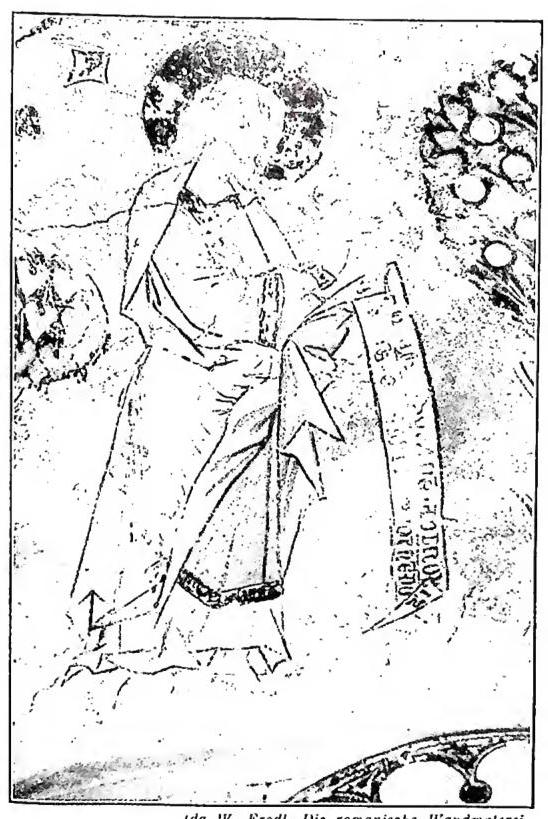
AUSTRIA - God creates man. Detail of the fresco by Master Enrico of Gurk (c. 1220) - Gurk, Cathedral, episcopal oratory.
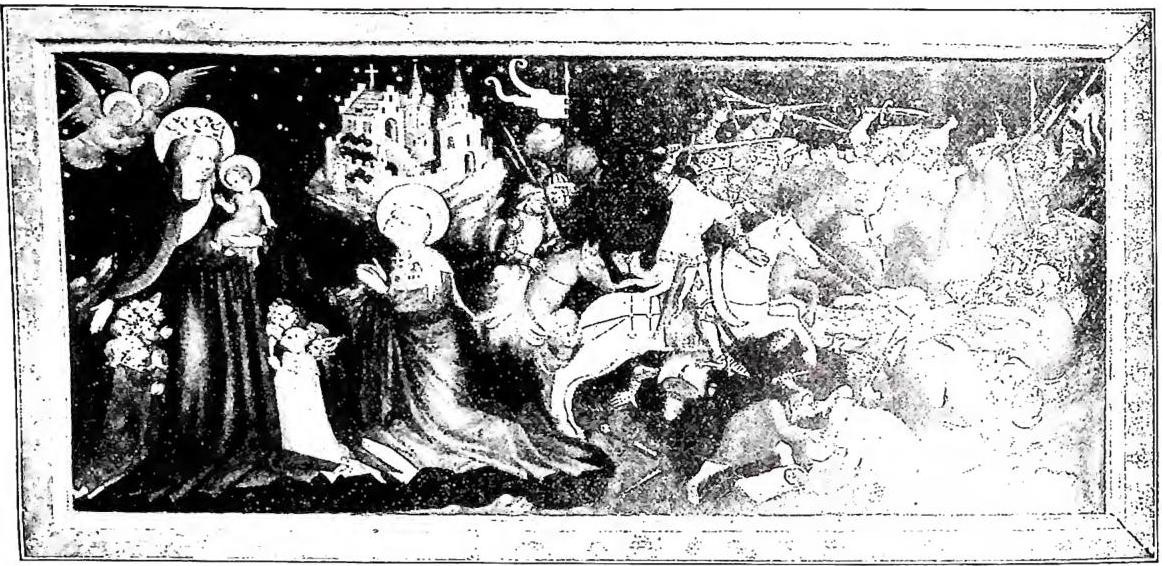
AUSTRIA – Votive panel from the convent of St Lambrecht (c. 1450), by Hans von Tübingen – Graz, Gallery.
After the Congress of Vienna (1815) and the establishment of the reactionary system of the “Holy Alliance,” experience soon showed the need to turn to the Church and religion as guarantees and foundations of the State. Hence the celebrated motto “Throne and Altar,” which might serve, in a certain sense, as the denominator of the following period, down to the fall of the Empire.
The period up to the 1848 revolution, the so-called “Vormärz,” is characterized, on the one hand, by a continuous state domination over the Church, though in diminishing measure, even though among the higher bureaucracy Josephinism long persisted; on the other hand, a growing Catholic reaction began, which had already found, since 1808 and precisely in Vienna, an outstanding champion in the person of St Clement Mary Hofbauer, C.SS.R. He knew how to gather around himself the best forces of the nobility, the most distinguished figures in politics, science, literature, and university youth, and the “Hofbauerkreis” (Hofbauer circle) became one of the most effective causes of the Catholic restoration (F. Schlegel, philosopher; Ad. Müller, politician; Gius. Klinkowstrom, pedagogue; Zacc. Werner, Em. Veith, sacred poets and orators; not to mention the Eichendorffs, Brentanos, Günthers, Baaders, and others). The reformer of Styria, Bishop Rom. Seb. Zangerle, was a disciple of the Saint, as was Gregorio Ziegler, Bishop of Linz, and above all the celebrated Otmar Joseph Rauscher, Bishop of Graz, then of Vienna and Cardinal. But new forces also began to arise in the provinces; the Redemptorists, founded by the Saint (1820), and the Jesuits, readmitted in 1826, contributed effectively to this with their missions and retreats for the people and clergy. Even among the secular clergy a certain revival made itself felt (Schlor in Graz, Archbishop Gruber in Salzburg, the Venerable Tschiderer, Bishop of Trent, and others).
The year 1848 brought the entire absolutist system crashing down; it plunged into full liberalism, so much so that in certain ecclesiastical circles even Josephinism was regretted, since, in its moderate form, it had at least guaranteed the Church a certain freedom of action and rights. In 1855 the Concordat was finally concluded, negotiated, overcoming only slight opposition (the Hungarian bishops), above all thanks to Archbishop Rauscher of Vienna and the Minister Count Thun. The Concordat had the misfortune of being tied to a new period of state absolutism, which ended in 1876; once this was over, the establishment of the parliamentary system, with all its train of parties—liberal, national, social, democratic—in continual struggle with one another, in constant shifts of alliances and oppositions, soon involved the Church in political strife. After the fratricidal German war of 1866, the growing pressure of the various nationalities composing the Austrian Empire and of German (Protestant-liberal) nationalism intensified. In 1868 laws on marriage, mixed schools, and freedom of worship were issued without any agreement with the Holy See; against these Pius IX protested in the consistorial allocution of 22 June 1868. Finally, the dogmatic definition of infallibility in 1870 gave the Beust ministry the pretext to denounce the Concordat unilaterally, because (as stated in the imperial decree of abrogation) the Concordat “has lapsed of itself, by virtue of the most recent declaration of the Holy See on the plenitude of the power of the Supreme Head of the Catholic Church.” The vehement struggles over schools, the religious character of marriage, and other issues led almost to a real “Kulturkampf” (various laws were arbitrarily issued, especially in 1874, on Church relations, ecclesiastical benefices and patronage rights, the exercise of parochial ministry, etc.), but the personal attitude of Emperor Francis Joseph and some of his direct interventions (he prevented, for example, the arrest, already ordered by the government, of the Bishop of Linz, Fr. G. Rudigier) spared Austria the violent unleashing of the struggle. The ecclesiastical laws, indeed, although issued unilaterally in violation of the Concordat, were on the whole anything but hostile to the Church; so much so that Leo XIII, in a letter of 15 June 1887 to Cardinal Rampolla, his Secretary of State, could affirm that the “outstanding piety” of the Emperor and “his devotion to the Holy See... ensure that the best relations exist between the Holy See and that Empire.” Meanwhile Catholic organizations grew in strength (Vogelsang and the Catholic conservative party; Lueger and the Christian-Socials), the press (Vaterland, Reichspost; the “Pressverein” in the provinces); even the religious life of the people, somewhat decayed under liberalism, revived (religious organizations of the most varied kind, missionary work, Fr. Abel S.J. [v.], the Redemptorist Freund, numerous institutions of Catholic education and charity, of Orders and Congregations, etc.), as well as the activity of Catholics in the cultural, scientific, and literary fields (Kralik and the “Gral,” the “Leogesellschaft,” etc.). The “Los-von-Rom-Bewegung” (anti-Roman movement) at the close of the 19th century, the growing Protestant-tinged liberalism of the German-speaking bourgeoisie, and the socialist labor movement estranged many from the Church, which appeared increasingly tied to the policies of Catholic parties, not without serious detriment to its independent activity. Another grand manifestation of Austrian Catholicism before the world occurred in 1912, with the International Eucharistic Congress.
The internal revolution of 1918, the inevitable collapse of the Habsburg monarchy, and the ruin, with it, of so many centuries-old institutions and ties, produced for many years in the new small Austrian republic severe political convulsions and put the entire activity of the Church to a hard test.
The external life, although the Austrian Constitution of 1 Oct. 1920 recognized many of the Church’s rights, was difficult because of many preconceptions, fostered especially by the states that had succeeded the monarchy; its internal life was even more difficult because of the disastrous economic situation and the struggles among the parties. Among these, the socialists showed themselves ever more openly atheistic and anti-religious, while the German-nationalists inclined toward the absorption of the small republic into Germany and never concealed their aversion to the Catholic Church; only the Christian-Socialists indefatigably sought to rebuild the new Austria on a Christian basis. Unforgettable was the work successfully accomplished, especially in the field of international politics, by the chancellor, Monsignor Ignaz Seipel, who thus laid the foundations upon which could rise the political construction, of a distinctly Catholic character, of Chancellor Engelbert Dollfuss. It was only natural that the Church should give its full support to such a policy, inspired by the directives of the Gospel and of the Popes for a truly Christian socialism. As this political work progressed, so too did the purely religious, social, and cultural activity of the Church itself increase (one may recall, in the Exhibition of Catholic Press in Rome, the Austrian hall; the liturgical movement, with its center at Klosterneuburg, directed by Fr. Pius Parsch; and the academic union). The Christian policy of Dollfuss reached its double culmination in the new Constitution of the Austrian Confederation (Österreichischer Bundesstaat) based on corporations (Ständestaat), with an equitable distribution of powers and rights among all estates of the population, with Catholic principles for education, marriage, and social legislation; and in the new Concordat, published together with the Constitution on 1 May 1934.
The Concordat, negotiations for which had begun on 17 March 1931 and which was signed on 5 June 1933, is one of the most complete and perfect known. Its spirit is summarized in the first three paragraphs of art. 1: “The Austrian Republic assures and guarantees to the Holy Roman Catholic Church, in its various rites, the free exercise of its spiritual power and the free and public exercise of worship. It recognizes to the Catholic Church the right to issue, within the scope of its competence, laws, decrees, and ordinances; it shall not hinder or render difficult the exercise of this right. In the fulfillment of their spiritual ministry, ecclesiastics shall receive the protection of the State.” Among the other fundamental provisions, one may recall: the recognition of the Catholic Church as a society with public-law status (art. 2; cf. art. 29 of the Constitution of 1934); and the referral to canon law for all other matters relating to ecclesiastical persons and things not treated in the Concordat (art. 22).
The laws enacted by the Austrian Republic for the implementation of the Concordat in some points seem to diverge somewhat from the concordat provisions (the marriage law of 1934 is modeled in part on the Italian one of 1929).
But while Austrian Catholicism once again attempted to revive in accordance with its centuries-old glorious religious traditions, the pressure of Hitler’s National Socialist Germany began to be felt more and more, with every kind of violence, such as the attack and death of Dollfuss (25 July 1934). Finally, the small Republic succumbed, with the so-called “Anschluss” of 13 March 1938, which made the name “Austria” disappear along with all the Catholic works and institutions of the country. From that time onward, Austrian Catholicism shared the religious fate of Catholicism in the “Greater Reich,” until the liberation and the recovery of the country’s independence in 1945, an independence that was somewhat precarious because of the quadripartite occupation and its inevitable consequences. The establishment of the central government and of the provincial governments, elections to the chambers, and constitutional life were, however, permitted, based on the Constitution of 1920.
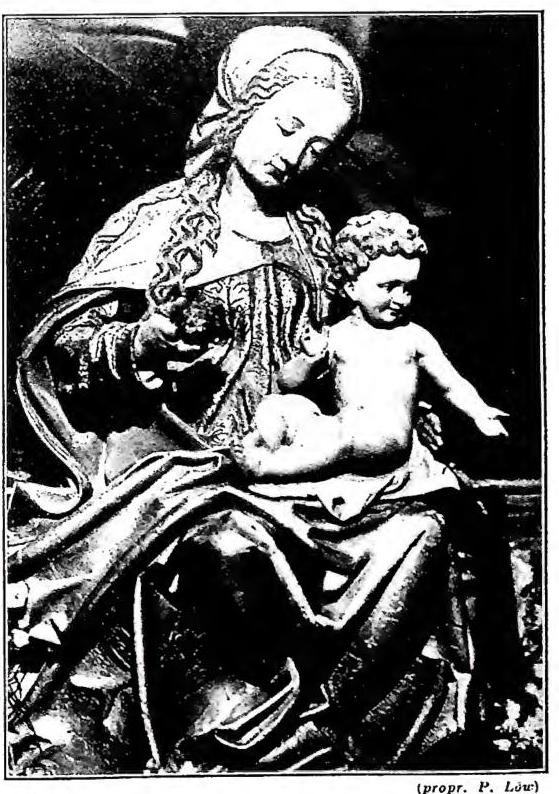
AUSTRIA – The choir stalls of St Stephen’s Cathedral, a work by Guglielmo Rollinger (1476–86), were completely destroyed in 1945 – Vienna.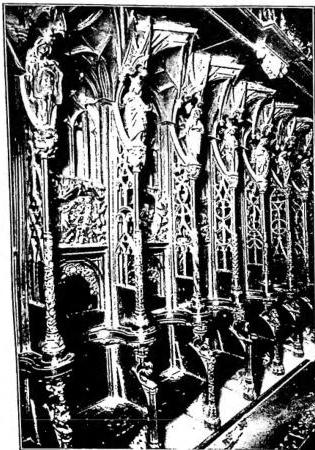
Statistical information. – After the war, Austria extended over 83,868 sq km, and according to the 1934 census it had 6,760,233 inhabitants (another census in 1939 gave 6,880,800); Vienna, the federal capital, had 1,874,130 inhabitants.
Of these, 6,112,658 were Catholics, i.e. 90.5%; the remainder were: Evangelicals (of the Augustana or Helvetic confessions) 295,452; Jews 191,481; Old Catholics 36,776; without religion 106,080; others 7,105. The ecclesiastical jurisdiction comprises two metropolitan sees: Vienna, with the suffragans of Sankt Pölten and Linz; Salzburg, with Gurk (residence in Klagenfurt), Seckau (with residence in Graz), and two apostolic administrations: Burgenland (under Vienna), and Tyrol-Vorarlberg, with its seat in Innsbruck; according to the Concordat, Innsbruck was to be elevated to a diocesan see, but events prevented its implementation. There are six minor and four major seminaries; in addition, four theological faculties (Vienna, Graz, Innsbruck, and Salzburg); there are 3,600 religious (of 37 Orders) and 16,200 religious women (of 54 Orders). Catholics ran 1,050 private schools. Further statistical material is found in: C. de Waal, General-Schematismus der kath. Pfarrämter und Ordensniederlassungen in Österreich, Innsbruck 1934; J. Gurtner, Der Sölcularhlerus und die religiösen Orden Österreichs, Vienna 1934; Ecclesia-Almanach 1948, ibid. 1949, useful for the latest ecclesiastical statistics.
Interesting information on the geographical, geopolitical, and geocultural situation is in H. Gsteu, Länderkunde Österreichs, 2nd ed., Innsbruck–Vienna 1948, with an excellent rational bibliography.
For general information on political history, the following works are recommended: F. Kronex–M. Uhlirz, Österreichische Geschichte, 4 vols., Berlin 1915–23. – Shorter: H. Hantsch, Geschichte Österreichs, I (only volume published), 2nd ed., Innsbruck 1947 (goes up to 1648, with an excellent bibliography). For the sequel one may consult the fine study by the same H. Hantsch, Die Entwicklung Österr.-Ungarus zur Grossmacht (Herders Geschichte der führenden Völker), 15, Freiburg 1933. The history of the last few decades, and especially of the final period of Austria’s political existence, is traced masterfully in K. Schuschnigg, Dreimal Österreichs, Vienna 1937.
Those seeking information on the overall cultural history of Austria in all its ramifications (art, religion, commerce, science, etc.) will profit greatly from consulting F. M. Mayer–F. R. Kaindl–H. Pirchegger, Geschichte und Kulturleben Deutschösterreichs, 3 vols., 2nd ed., Vienna 1929–37, with extensive bibliography; or the collection of monographs, all by leading authors, edited by J. Nadler–H. V. Srbik under the title: Österreich: Erbe und Sendung im deutschen Raum, Salzburg–Leipzig 1936. Each article is accompanied by a reasoned bibliography.
As regards the sources of Austrian Church history, much material has been collected in the various volumes of the Monumenta Germanica Historica (see the indexes); but the work of H. Pez, Scriptores rerum austriacarum, 3 vols., Leipzig 1721–45, still retains its full value in many parts.
For Church history, one should also note the work of A. Klein, Geschichte des Christentums in Österreich und Steiermark, 7 vols., Vienna 1840 ff.; among more recent works: C. Wolfsgruber, Kirchengeschichte Österreich-Ungarus, ibid. 1909; and above all the unfortunately incomplete work by E. Tomek, Kirchengeschichte Österreichs, I (the only volume published), s.l. 1935, which goes up to about 1500, with a rich bibliography, lists of bishops, and of mother parishes. Extremely useful supplements are found in J. Thaurén, Atlas der kath. Missionsgeschichte, St Gabriel 1932; and in the very rich collection of maps and diagrams prepared by G. Lüdtke–L. Mackensen, Deutscher Kulturatlas, the section: Katholische Religionsgeschichte, Berlin 1934. Special mention should be made of the Austrian Historical Institute in Rome, founded in 1881 by Theodor von Sickel, known for his edition of the Liber diurnus (Vienna 1889), whose director was subsequently Baron L. von Pastor, the noted historian of the popes. For a list of the Institute’s publications cf. Ph. Dengel, Das Österr. Hist. Institut in Rom. 1901–1913, Vienna 1914, p. 61 ff.; H. Kramer, Das Österr. Hist. Institut in Rom. 1881–1931, Rome 1932, p. 45 ff.
For the most recent history, see J. Hollsteiner, Das Konkordat, Leipzig–Vienna–Berlin 1934; and G. di Meglio, De novissimo Austriae regimine, Vatican City 1936.
Regarding archaeology, it should be noted that archaeological excavations are officially supported and published by the Austrian Archaeological Institute, which has also conducted famous excavations abroad, such as at Ephesus, Salona, and elsewhere. A good synthesis of what concerns the classical and early Christian periods in Austria is found in R. Egger, Die österreichischen Länder im Altertum, in Nadler–Srbik, Österreich (cited above); id., Die frühchristliche Kunst in Österreich, in K. Ginhart, *Die bil