
COSTANZA. – A moral virtue that gives the soul continuity in doing good, guarding it against the difficulties that come from outside: discouragement, disappointments, laxity, ridicule, reproaches, flattery, bad examples, persecutions (cf. Sum. Theol., 2ª-2ª, q. 137, a. 3). It is a potential virtue of fortitude. Its importance is deduced from the fact that, for fallen human nature, doing good always entails an effort; all the more so when the other difficulties mentioned above are added to the weakness of nature, and these may, in certain circumstances and settings, impose a heroic way of life. Forming the «fortem et tenacem propositi virum» of Horace (Carmina, III, 3) requires a will resolved to persevere, come what may. Moreover, without c., all the other virtues and resolutions to do good either remain dead letters or are condemned to sterility. For this reason, Sacred Scripture insists on the necessity, especially in the spiritual life, of c. (Eccli. 2, 16; 27, 12; Ps. 17, 38; Mt. 10, 22; Io. 4, 34; 17, 4; I Cor. 9, 24; 15, 58; II Io. 8, 9, ecc.); which, ultimately, comes down to the maxim of popular common sense: «chi la dura la vince».
C., like all the other moral virtues, may be acquired or infused. Acquired, when, in the merely natural sphere, it is attained through the repetition of acts (a small sacrifice each day, one good deed each day, a resolution, a commitment to be carefully observed for a specific number of days), and serves fundamentally to form character and personality; infused, when it descends into the soul with Baptism and operates there
in the supernatural sphere, and is acquired through prayer, reflection on the joys of heaven and the vanity of transient earthly ones; on the heroic beauty, however hidden, of sacrifice, indeed also of the fulfillment of daily duty; on the reversibility of strength and grace, which each person’s every action effects in the souls of others.
COSTANZA. - City and ancient diocese of
southern Germany, situated on the homonymous lake and on the Rhine, near the borders with Switzerland. It has a predominantly Catholic population. The diocese was founded around the mid-6th century for the evangelization of the region; it was initially suffragan of Besançon and later of Mainz.
Some believe that the bishopric of Vindonissa was transferred to C., but L. M. O. Duchesne (Fastes épiscopaux de l'ancienne Gaule, III, Paris 1915, pp. 21 ff. and 259) and M. Bes-
son (Recherches sur les origines des évêchés de Genève, Lausanne et Sion, Fribourg 1908, p. 140 ff.) argue that Vindonissa should be identified with Avranches.
The first known bishop is Gaudenzio, d. 613. Others to be remembered are Salomone I (839-71), Salomone III (890-919), St. Corrado (935-75), and Gerardo II (979-95). Its boundaries expanded to such an extent that it became the largest diocese in Germany. It comprised ten archdeaconries and 64 deaneries.
In 1435, the diocese included 17,060 priests, 1,760 parish priests, and 350 monasteries, among which the most celebrated were those of Reichenau and S. GALLIONE (v.). The latter abbey engaged in a long dispute with the bishops of C. during the 17th and 18th centuries.
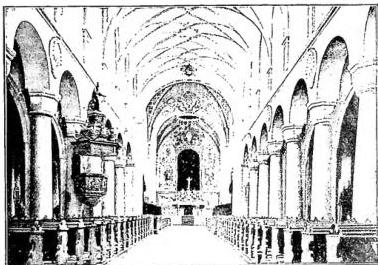
The cathedral church was that of S. Maria (Marien-Münster), erected in the 6th century above a Roman castle; during the time of Bishop Lamberto (995-1018), the crypt was built; it was restored under Gerardo III in 1089. It is a cruciform building with three naves divided by columns; the choir is due to Simone Haider and Nicolaus of Leyden (15th century). S. Giacomo (Schotten) was founded in 653, S. Giovanni was built in 1276, and S. Stefano, of Romanesque age, was enlarged in the 15th century. The convents of the Franciscans, Dominicans, and Augustinians, all from the 13th century, are also remembered, as well as the Jesuit college (1592-1774), with its Baroque church.
THE COUNCIL OF COSTANZA - It was convened by solemn bull of 30 October 1413 by Giovanni XXIII, induced
Ida J. Bernt, Der romanische Kirchenbau des Bodenseegebiets, Basel 1908, Taf. III.
COSTANZA - Interior of the cathedral of S. Maria, consecrated in 1089, with later restorations.
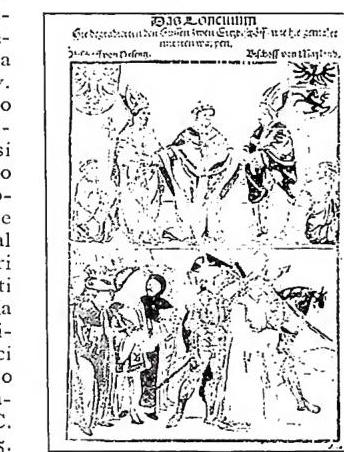
by the insistence of Sigismund, king of Hungary and later king of Germany. The primary aim was to restore peace and unity to the Church, torn by a schism that had lasted since 1378, divided as it was into three obediences: that of Benedict XIII, the Avignon antipope; that of John XXIII of the Pisan obedience; and that of the legitimate pontiff Gregory XII, the true successor of Urban VI. The second aim was to promote the reform of the Church and the condemnation of the heresies that had arisen in England and Bohemia. The Council was indeed opened by John on 5 November 1414, and Sigismund soon arrived as well. It immediately organized itself into four nations, as at Pisa, and doctors and representatives of princes were also admitted to vote. But John, frightened by the ill rumors spreading about him, secretly left Constance on 20 March 1415. The Council would have dissolved without Sigismund’s energy; instead, in the tumultuous sessions from 29 March to 6 April, it recognized itself as legitimately assembled, denied anyone the right to dissolve or transfer it, and decided it must continue its work of pacification and reform of the Church. In doing so, it placed itself above a pope whose legitimacy it had, on its own account, recognized. After long hesitation, John had to yield and surrender himself as a prisoner of the Council, which, having put him on trial, condemned him to deposition (29 May). John accepted the sentence. Gregory XII, on the other hand, sent as his representative to King Sigismund Carlo Malatesta, lord of Rimini, with the authority to negotiate his resignation; Cardinal Giovanni Dominici convened the Council in his name, communicating to it the authority to provide for the good of the Church in the best way, and presented Gregory’s formal resignation (4 July). Thus, the legitimate Pope safeguarded his dignity, sacrificing himself for peace and concord. Benedict XIII refused to appear or resign; his protests were ignored, and he was put on trial, ending with his deposition (26 July 1417).
During this long interlude, the Council had entrusted Cardinal Pierre d’Ailly, archbishop of Cambrai, and a special tribunal with the case of Jan Hus and Jerome of Prague, who, as impenitent heretics, ended at the stake. It was then necessary to provide the Church with a head: all cardinals present, regardless of which pontiff had appointed them, were admitted to the election; there were 23, and to them were added 30 electors chosen by the Council from the various nations. They entered the conclave in the city palace on 8 November 1417, and on the 11th, Cardinal Oddone Colonna was elected under the name Martin V. After promulgating some reform decrees and particularly imposing the periodicity of ecumenical councils, the Council dissolved on 21 March 1418 in its 45th session with a generic approval from the Pope. The long schism was thus ended; but its consequences were not removed: the feelings of suspicion and jealousy between nations, the distrust toward the Apostolic See, to which the principal responsibility for past evils was attributed, that kind of superior tutelage that the Council had attempted to arrogate to itself over the Church, considering itself the ultimate supreme arbiter in matters of faith and discipline. The abuses, which had grown enormously due to the schism, could no longer be eradicated, precisely because of the ill will of those—clerics and laymen—who benefited from them, while readily shifting all blame onto the Roman Curia.
COSTANZA (Flavia Julia Constantia). - Daughter of Constantius Chlorus and Theodora, half-sister of Constan-
COSTANZA – Degradation and execution of J. Huss.
Daughter of Constantius Chlorus and Theodora, half-sister of Constantine the Great. In 313, for political reasons, she married Licinius and followed him to Nicomedia. When war broke out between Licinius and Constantine, C. vainly attempted to reconcile the two contenders. After her husband’s death, she remained on good terms with her brother. Urged by Eusebius of Nicomedia, she supported the Arians and participated in the Council of Nicaea in 325.