
MÜNSTER, DIOCESI di. — City and diocese in Westphalia (Germany).
The diocese has an area of 15,128 sq. km., with 3,606,669 inhabitants, of whom 2,075,795 are Catholics. It has 622 parishes, served by 1,466 secular priests and 84 religious priests, 14 male and 58 female religious communities (Annuario Pont., 1951, p. 280). The diocese is a suffragan of Cologne.
It was founded by Charlemagne during his wars in Saxony. The first bishop was St. Ludger, between 792 and 794; he founded a monastery at the locality of Mimigarderford, where he led a common life with the priests and clerics subject to him. From this monastery the city of M. took its name in 1100. In addition to the administration of western Saxony, between the Ems and the Lippa, Ludger also had jurisdiction over the Frisian territory on the lower Ems.
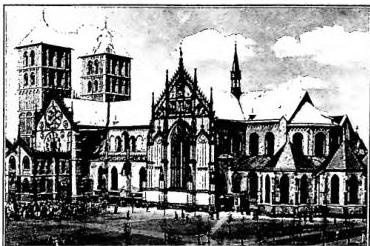
(courtesy of Msgr. A. P. Frutez)
MÜNSTER, DIOCESI di. — The Cathedral (fourteenth–fifteenth centuries).
Count of Katzenellenbogen (1174–1203), an ally of Frederick Barbarossa against Alexander III, subsequently obtained, following the deposition of Henry the Lion and the dismemberment of the Duchy of Saxony, territorial sovereignty, later confirmed by Frederick II on 26 April 1220. He enlarged and restored the cathedral, fortified the city, and reorganized the parochial structure. The Cathedral Chapter, composed exclusively of nobles, exerted great influence over the political and religious life of the diocese. From 1203 it exercised the exclusive right to elect the bishop. Through the archdeacons, very frequently chosen from among the canons, it also exercised a directing role over the parishes. Involved in the struggles among the nobles (Münsterische Stiftsfelde, 1450–56) and in the critical conditions of the Empire, the diocese declined. Henry von Schwarzburg (1466–96) undertook the reform of the monasteries and clergy. The Protestant doctrines preached in M. by Bernt Rotmanns in all the city’s parishes were subsequently followed by the domination of the Anabaptists; after this was suppressed in 1535, Catholic worship was restored. Bishop Franz von Waldeck (1532–53) favored Protestantism and attempted to transform the ecclesiastical principality into a hereditary principality; the same attempt, also unsuccessfully, was repeated by his successor Wilhelm von Ketteler (1553–57). From 1643 M. was the seat of the peace congress following the Thirty Years’ War, which was concluded there by the treaty of 1648. Bishop Christoph Bernard von Galen (1650–78) distinguished himself through his pastoral zeal. Bishop Ferdinando von Fürstenberg (1678–83) simultaneously administered the diocese of Paderborn, to which he devoted his principal efforts. In 1803 the ecclesiastical principality was secularized. After the diocese was reorganized by the bull De salute animarum of 16 July 1821 and the remnants of the Enlightenment had been overcome, a notable Catholic revival resumed in M. During the Kulturkampf, Bishop Bernhard Brinkmann (1870–89) lived in exile for nine years. From 1933 to 1945 the diocese was governed by Clemens August, Galen (v.), formerly parish priest in Berlin, a fearless defender of the rights of the Church against the National Socialist regime and an indefatigable organizer of charitable works during the Second World War. He was created cardinal in February 1946.
The diocese comprises the Westphalian province of M., five Rhenish districts, and the district of Oldenburg with the city of Wilhelmshaven and the island of Wangerooge.
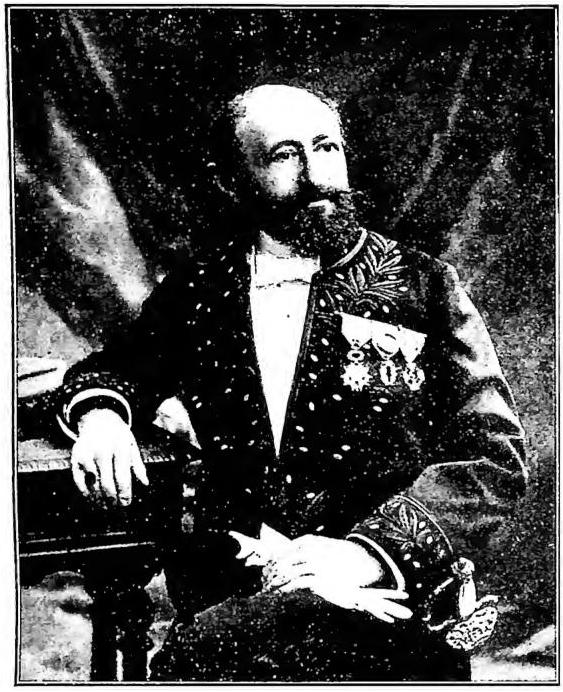
(from E. Châtlain, Notice sur la vie et les travaux de E. M. Parigi 1907, plate 1)
MÜNTZ, EUGÈNE - Ritratto.