
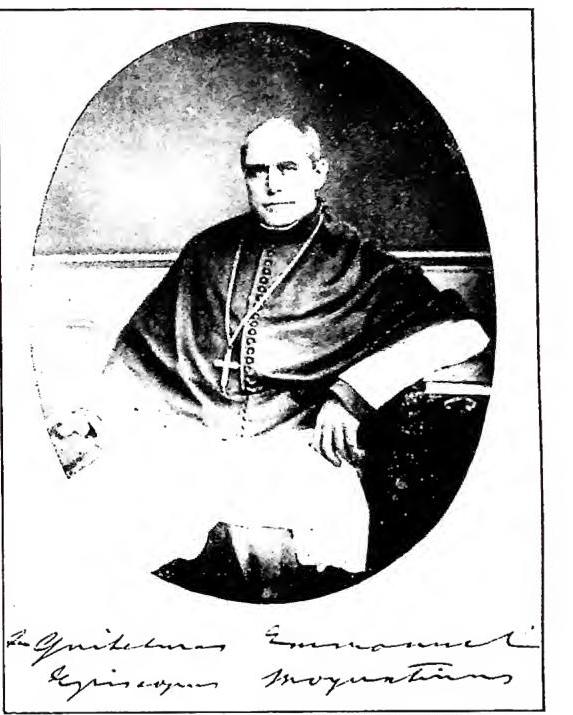
KETTELER, WILHELM EMANUEL VON. – Bishop of Mainz, initiator and supporter of the ideological and practical movement of German social Catholicism, b. at Harkotten (Westphalia) on 25 Dec. 1811, d. at Burghausen (Oberbayern) on 13 July 1877. He studied theology in Munich and was ordained a priest in 1844. Chaplain at Beckum and later parish priest at Hopsten, by spreading the Society of St Vincent and personally assisting the sick and the poor, he had the opportunity to draw close to and become acquainted with the social misery of his time. In those years the Industrial Revolution was beginning in Germany, with the consequent great transformations in the economic and social structure that were to lead to the formation of the proletariat: the separation of labour from capital, the disintegration of the family bond, and the abuses of the nascent and unchecked capitalism.
The young priest initially approached this painful and chaotic reality in the spirit and manner of Christian charity, contemplating a work of renewal cen-
K. knew how to interpret and assess promptly every change in the economic and social circumstances of his time and to adapt the orientations of Catholicism accordingly. The economic crisis of 1857 and the following years, which stated the terms of the question more drastically; the growing predominance of Marxist ideology within German social democracy; and the supersession of the old police state in favor of more prudent state intervention, first on the part of the Prussian state and then of the new German Empire, led to an evolution in K.’s thought and practical directives for action. From 1865 onward he accepted broader state intervention in social problems and subsequently emphasized ever more strongly the need for a coherent and organic social policy of the state, aimed less at overcoming the capitalist system than at mitigating its excesses.
A member of the German Parliament from 1873, he distinguished himself among the representatives of the Center parties through his speeches, also presenting a comprehensive draft of social legislation on a corporative basis. Its foundation was the overcoming, within the sphere of professional morality framed by Catholic morality, of the class struggle in favor of the principle of collaboration among the various factors of production, in accordance with the requirements of the common good. This project, which lacked the support of the Center majority, was not accepted. Along with other Catholic deputies, K. played an important role in the struggle against the «Kulturkampf»; the grave political-ecclesiastical conflicts that resulted from it slowed his activity toward the end of his life.
His fundamental idea, however, had by then spread and been accepted even in non-Catholic circles. K. had in fact succeeded in demonstrating that the social question cannot be resolved solely by rational means and that the proletariat is not characterized only by the scarcity of economic goods; he maintained that the capitalist system cannot be overcome except by modifying its spirit through a slow and profound educational effort. By drawing attention to the function of the state in this education, K. laid the foundations for the theoretical orientation and practical activity of German Catholic social policy. He may therefore be considered a precursor, because half a century before this principle became generally accepted, he discerned the need for social legislation based not only on humanitarian motives or on «ragion di Stato», but as the consequence of a moral requirement, consonant with the ethical nature of human society. By grounding the critique of capitalism in the notion of the individual’s natural right to existence, freedom, and the development of his own personality, K. also laid the foundations for the theoretical basis of the modern Christian solution and, indirectly, for a substantial critique of economic collectivism and laissez-faire liberalism.
Principal works: Libertà, autorità e Chiesa (Parma 1864); Die Arbeiterfrage und das Christentum (Mainz 1844); Deutschland nach dem Krieg von 1866 (there 1867); Das Allgem. Konzil und seine Bedeutung für unsere Zeit (there 1869); Liberalismus, Sozialismus und Christentum (there 1871); Die Katholiken im deutschen Reich (there 1873); Predigten und Briefe, edited by J. M. Raich (there 1878).