
TONIOLO, GIUSEPPE. – One of the foremost masters of Catholic social thought, born in Treviso on 7 March 1845, died in Pisa on 7 October 1918, reputed a saint.
Having enrolled in the Faculty of Law at Padua, he distinguished himself there through intelligence and academic achievement and was encouraged to “continue his studies.” In 1878 he was appointed extraordinary professor of political economy at the University of Modena. From there, in the same year, he was transferred with the same title to the University of Pisa, where in 1884 he attained a full professorship and then spent the rest of his life. In 1878 T., having by then fulfilled his most serious obligations concerning the establishment of his brothers, married
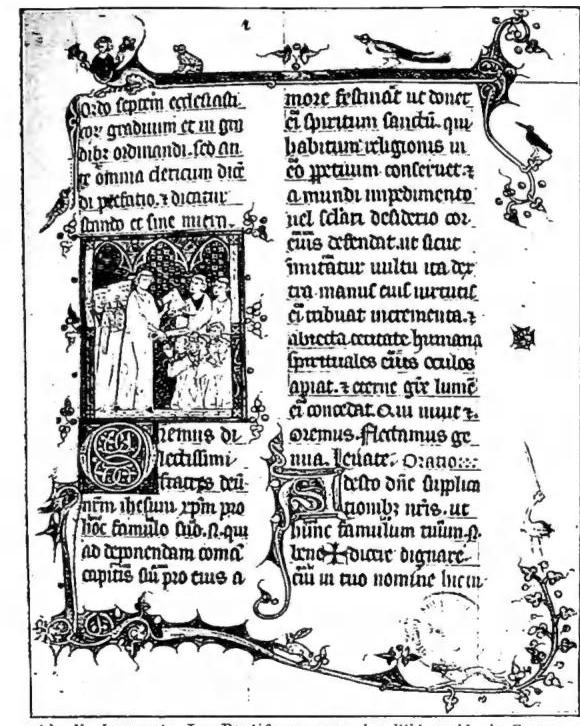
(from V. JALABERT, LOUIS, Les Pontificaux mss. des Bibl. publ. de France, Paris 1897, pl. 12)
TONSURE - Bishop in the act of cutting the hair of a cleric. Miniature from the Roman Pontifical adapted for use in Besançon (1st half of the 14th century) - Paris, National Library, ms. lat. 17336, fol. 1.
...into Catholic organizations the awareness, which he had acquired in the scientific sphere, of the redemptive mission that Catholicism was called to fulfill in the social field, and then to win them over to the program of Leo XIII, who, in taking a position on the social question, had particularly emphasized the duties of justice violated to the detriment of the working classes. He nevertheless acted with the utmost delicacy, so as, insofar as possible, to prevent divisions within the Catholic camp. Blessed Pius X, also in consideration of this, therefore made use of his counsel for the reorganization of the Catholic forces, rendered necessary by the crisis provoked within them by the growing influence of these ideas, and made him the first president of the new national organization of Catholics (Unione Popolare [v.]). Previously, in order to promote the ideas dear to him, and in full agreement with the Holy See, he had established, as a complement to the general Catholic organization, the Unione cattolica per gli studi sociali ([v.] 1891), the Società cattolica italiana per gli studi scientifici ([v.] 1899), had revived the Union of Fribourg, had founded the Rivista internazionale di scienze sociali e ausiliarie ([v.] 1893), and had furthermore established and assumed the presidency of the Italian Section of the Association internationale pour la protection légale des travailleurs (1901).
To promote this practical activity, T. composed a series of popular and original writings on the themes of the social crisis, capitalism, and the strategy and tactics of the work of reconstruction. The following characteristics in particular deserve mention: faith in the future of democracy; lively insistence on the organic structure of society and on the primacy of social organization over political organization; on the necessity of public intervention in the economy for the protection of workers; on society’s religious-ethical heritage as its unifying element; and on the necessity of international cooperation. This activity also led him to turn to sociology, which, in keeping with the intellectual fashion of the period, he conceived as a science rather than as a scientific discipline, indeed as the synthesis of all sciences, while disputing the monism of the sociological methods then in vogue.
Through his intense practical and scientific activity and the purity of his character, he became the mentor of Italian Catholics and was also regarded abroad as one of the foremost masters of Catholic social thought.
The name of T. as a scientist is especially commended by the «Introduzione» to his Trattato di economia sociale and by his Storia dell'economia sociale toscana nel medioevo, only recently published in his Opera Omnia (during his lifetime he published only a small part of it!). T.’s reputation as a social ideologue rests especially on the writings: La democrazia cristiana; Concetti e indirizzi sociali all'esordire del sec. XX, and Provvedimenti sociali popolari.
The cause of beatification was introduced by decree of 7 January 1951.