
PIEVE. — A name used in Italy for a parish, or even for hamlets or cities.
Its origin is to be sought in the word plebs, used, with the advent of Christianity, to indicate the community of the baptized. At first this expression, plebs christiana, had a generic meaning; but, beginning at some unspecified period, it came to designate not only the people of the baptized, but also an institution—perhaps at first both together, that is, a corporately conceived body of persons and the unified institution that derived from it and was summed up in the church entity, the place of worship where the body of the faithful assembled and prayed; finally, it also came to designate the territory in which that people of the baptized had settled: thus, for example, one spoke of the plebs of such-and-such a Saint. The generic meaning is preserved here and there almost everywhere and is a literary usage, but over time and across different places it fades and disappears; the specific, juridical, constitutional meaning, on the other hand, remains confined to particular regions, where it takes root and becomes established in a definite territory.
This territory is northern and central Italy, approximately as far north as the 42nd–43rd parallel (Viterbo–Chieti), including Corsica (but excluding Sardinia, or at least part of Sardinia) and certain Latin valleys north of the Alps. From the historical-political standpoint, this is a Franco-Carolingian zone and, from the glottological standpoint, a Romance-speaking one. Yet the fact remains that the ecclesiastical Latin word plebs was imported much earlier into England, where it still survives in Wales (Celtic pleuf); from there, after the Saxon occupation of the island, it emigrated with the Bretons, pure Celts, grouped in claus, to French Brittany. Here, through numerous variants, it remains rooted in the soil in approximately two hundred toponyms (it is not known, however, whether in Brittany the plebs had during the medieval period the same constitutional structure as in Italy). As early as the 5th century in Italy—that is, in the regions indicated above—the word plebs was used, apparently both in the corporative sense and in the institutional sense (the plebs Cluentensis of two documents of Pope Gelasius).
The constitutional structure of the Italian p. within its own territory is distinctive. It differs from the parish: the latter is the church of the Late Middle Ages; the p. is the church of the Early Middle Ages; and it is the baptismal church, mother of all the other minor churches in the district. It often has a plural clergy and an archpriest who is a grand archpriest, an originally common patrimony, and an extensive territory in which there are often many dependent chapels. This is the typical pattern; but it is possible to find p. which, although they are such—that is, mother churches—do not display all these characteristics. Evidently this is a form of organization of the rural territory, eccentric in relation to the diocesan capital, but centripetal with respect to the population scattered across the extensive rural district. Naturally, these baptismal mother churches increase in number with the passage of time and with the growth of population and economic activity. But it seems certain that, at their origin, through their districts, they reproduced the frameworks of Roman municipal organization. The correspondence between the Roman pagus and the p. remains to be studied and examined in greater depth; certainly, the map of the districts of the oldest p. may reproduce the administrative geography of the early-medieval territory in the Italian countryside.
The Italian area of expansion of the p. ends where the type of settlement with a scattered population (Celtic-Gallic) comes to an end and where the form of colonization characteristic of the Greek city begins (southern Italy and the Mediterranean islands). Outside Italy, in France for example, the rural archpresbyterate was in force during the early centuries; it perhaps had a structure analogous to that of the Italian p., but it rapidly dissolved.
P., pievania, piviere is therefore a rural district that remained in existence until the Late Middle Ages, when the rural commune was about to arise; but the rural communal division of the territory modified the overall structure of the plebs. Around the large urban communes, several p. came to be grouped within the same modern municipal territory, while the pleban districts in the outlying communes of the old diocesan territory remain recognizable. Finally, the unitary bond linking the mother church to its dependent churches was dissolved; only honorary titles remained to the former, and these too eventually disappeared, while the dependent chapels became entirely equivalent to the old mother church.
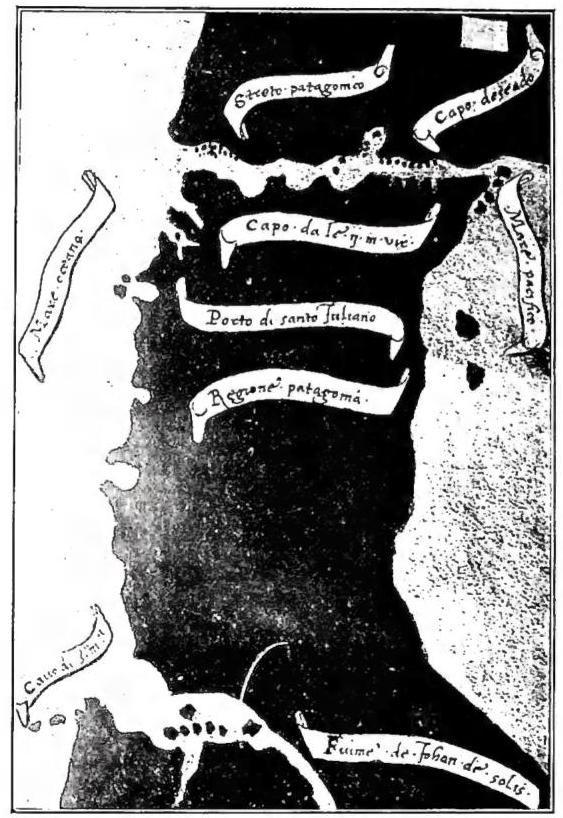
(from Magellana voyage, London 1889, rev. between pp. 32 and 33) PIGAFETTA, ANTONIO – Map of the Strait of Magellan. Map from the Ambrosian codex of P. – Milan, Biblioteca Ambrosiana.