
SARDEGNA. – In extent (24,089 sq. km, including the adjacent islands), it is the second-largest island in the Mediterranean and the third of the Italian administrative districts.
1. GEOGRAPHY
Its position in the Mediterranean, the considerable development of its coastline, and the presence of good natural harbors could have made it an eminently maritime region, had its millennial history, by repeatedly exposing it to the easy access of invaders and pirates, not driven its inhabitants toward the interior, isolating them still further from contact with the other Mediterranean peoples.The Island is predominantly mountainous, but its relief is highly fragmented; isolated massifs (Gennargentu, Gallura) alternate with plateaus (Logudoro, Nuorese), hills (Sarcidano, Ogliastra), river valleys (Tirso, Flumendosa, Coghinas), and more or less extensive plains (Murra, Campidano), giving rise to a division into numerous smaller regional units, which have been and continue to be preserved with tenacious persistence (Gallura, Nuoro, Logudoro, Barbagie, Ogliastra, Sarcidano, Sulcis, Sarrabus, Igliesiente, etc.).
S. is the only Italian administrative district whose population is still far below its carrying capacity (uncultivated land and pasture occupy 61% of the surface area). Agriculture there is based on extensive and little-advanced systems, and its products (cereals, grapes, olives) are of modest importance; animal husbandry, by contrast, is much more widespread. Although it is essentially devoted to free-ranging livestock (in numbers of sheep and goats, S. ranks first in Italy), it does not neglect cattle and horses, and makes its weight felt in exports (meat, dairy products, cheeses). The produce of the coastal tuna fisheries is also considerable. S. is moreover the richest mining region in Italy, supplying, among other things, almost the entirety of our production of zinc, lead, silver, and ammonium; but the island’s industries are still in a primitive state. Although much has been done, much remains to be done (land reclamation, railways, port facilities) to strengthen these resources and develop the economy.
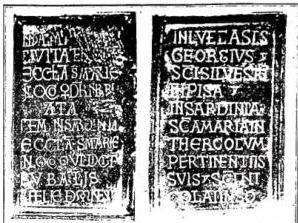
SARDEGNA - Judgment of Uberto, archbishop of Pisa and papal legate in S., dating from 1135, to settle a dispute between the canons of S. Gavino and the Cassinese monks—Montecassino, Abbey Archives.
(photo by Enis)
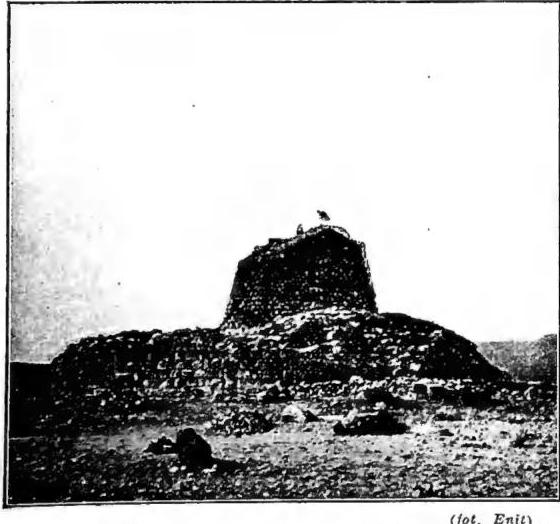
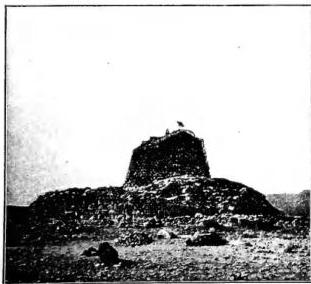
SARDEGNA – The Nuraghe S. Antime, attributed to the Hellenistic period – Torralba (surrounding area).
 | Province | Area in sq. km. | Population (1936 census) 1-1-50 (in thousands) | Density per sq. km. | Population of the provincial capital (in thousands) |
|---|---|---|---|---|---|
| Cagliari | 9297 | 505 640 | 69 | 137 | |
| Nuoro | 7272 | 217 249 | 34 | 16 | |
| Sassari | 7519 | 303 350 | 47 | 70 | |
| SARDEGNA | 24088 | 1025 1239 | 51 | — |
(from A. Saba, Montecassino e la Sardegna medioevalve, Montecassino DC, bar. D)
SARDEGNA - List of Cassinese churches in S., engraved on the right-hand door leaf of the bronze door of the abbey of Montecassino during the time of Abbot Oderisio II (1723–26).
II. HISTORY
Around the middle of the 6th century B.C., the Carthaginians, after disputing the Island with the Greeks, secured possession of it and established themselves chiefly in the southern and western coastal areas, while the inland tribes remained free, also protected by the malaria that infested those regions. After the revolt of the mercenaries of Carthage, S. became Roman territory in 238 B.C., and for Rome it was a strategic base and a source of grain supplies. In 226 B.C. S. was constituted as a province together with Corsica. Under the Empire, Romanization extended also into the interior. The first penetration of Christianity can be ascertained in the early years of the 3rd century through Christian elements deported to the Island from the mainland; subsequently the first dioceses must have arisen. An unconfirmed tradition designates St. Simplicius as the first bishop and commemorates the martyrs Gavino, Saturnino, and Efisio. During the reign of Commodus, the future Pope Callistus was exiled to S.In 235, Pope Pontian and the priest Hippolytus (an adversary of Callistus) were exiled to S., where they died. After the Edict of Constantine, there is isolated information concerning a bishop of Cagliari, Quintasius. In the same 4th century, one must recall the bishop Lucifero of Cagliari, who fought bitterly against Arianism and against Constantius. Lucifero was metropolitan bishop of S., while S. and Corsica were declared suburban provinces of the diocese of Italy. Conquered by the Vandals in 455, S. suffered the Arian persecution and became a refuge for exiled African bishops. Having returned to imperial possession, under Justinian it became one of the seven provinces of the African prefecture. Byzantium exploited the Island economically and abandoned it; this permitted an ever greater assertion of the Church’s economic power and political authority. Gregory the Great undertook to reorganize the Island in the religious and civil spheres. Then, for three centuries, S. suffered the attacks and depredations of the Arabs, but was saved with the help of the Franks, Pisa, and Genoa. The severing of its ties with Byzantium increased the predominance of the Church, which played a notable part in the formation and life of the four giudicati (Cagliari, Arborea, Logudoro, Gallura) into which the Island was politically divided after 1000. The diocesan jurisdictions coincided with the giudicati. The influence of the Church was consolidated by the Cassinese monks, who received donations (v. BARISONE), acquired property, and founded churches and monasteries. In 1063 the first Benedictine monastery was established in Logudoro. The sovereignty of the Holy See was explicitly asserted for the first time by Gregory VII. With Rome’s support, Pisan dominion was meanwhile expanding throughout the Island: Urban II appointed the archbishop of Pisa apostolic legate for S. The policy of Innocent III strengthened ecclesiastical power, but did not eliminate the conflicts caused by the miserable condition of the secular clergy and by the wealth and privileges of the monasteries. In 1226 the Synod of S. Giusta was celebrated in S.; it applied the decrees of the Fourth Lateran Council. Meanwhile Genoa, which disputed possession of S. with Pisa, succeeded in prevailing in Logudoro and in part of Arborea. On 4 April 1297 Boniface VIII enfeoffed S. to James II of Aragon, and the grant was confirmed by Benedict XI, Clement V, and John XXII. In 1326 Pisa had to abandon the Island; but the Sardinians resisted for a long time: the final, futile defense was led by Eleonora of Arborea (d. 1404). In the 15th century the archbishop of Cagliari began to use the title of primate, for political rather than religious reasons, since Cagliari was the center most favored by the Spaniards. After the great religious revival that followed the Catholic Reformation, at the beginning of the 17th century the dispute over precedence between Cagliari and Sassari was settled in practice in favor of Cagliari. Spain carried out a profound work of penetration and succeeded in replacing the Italian “custom” with a Spanish one. It also made some effort to improve the conditions of the Island, but until the beginning of the 18th century S. was troubled by continuous struggles between the nobility and royal officials, between the nobility and the clergy, and between the higher and lower clergy. After the brief Austrian occupation, resulting from the War of the Spanish Succession, and after Alberoni’s attempt at recovery had failed, S. was assigned to Piedmont. Victor Amadeus II had to struggle against the hostility of the ruling class, which had remained loyal to Spain, and his action was made more difficult by the conflict between his absolutist tendencies and the Sardinians’ spirit of autonomy. But the most serious clashes occurred in the jurisdictional sphere: the abusive and enormous extension of immunities (privileges of jurisdiction, fictitious clerics) obstructed the Island’s economic recovery and the establishment of better social justice. Finally, the Piedmontese ambassador D’Ormea, assisted by the Sardinian Cardinal Agostino Pipia and by Cardinal Prospero Lambertini, was able to conclude a Concordat with Benedict XIII (25 October 1726) that restored religious peace to S. and consolidated Savoyard power. Although defending the rights of regalian authority, Victor Amadeus II, and even more so his successor Charles Emmanuel III, adopted a policy of moderation and understanding in relations with the Church. After the Treaty of Aachen, especially through the work of Minister Bogino (1759–73), the Sardinian government did much to restore the Island’s economy and to improve the cultural and financial conditions of the clergy. The more rigid absolutism of Victor Amadeus III provoked reactions against “Piedmontism.” During the French Revolution, S. was shaken by struggles of an economic and anti-feudal character, which had no connection with the new foreign ideologies (a French attempt at invasion was repelled by the Sardinians in 1793). Toward the Church, the Savoy dynasty always maintained an attitude of benevolence and respect. When the Jesuits were suppressed, Turin permitted the return to S. of Fathers expelled from other countries, and Victor Amadeus III retained the Jesuits engaged in teaching in their positions. Political disturbances and
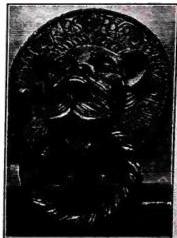
(phot. Enis) SARDEGNA - The cathedral of Cagliari (13th–14th century).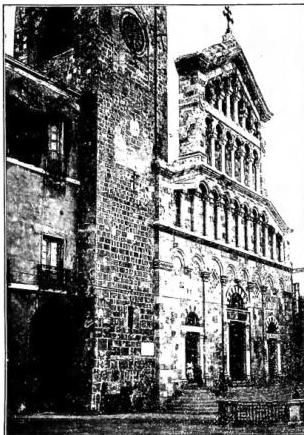
Sardinia has obtained regional autonomy under the Constitution of the Italian Republic.
Boll. stor. pisano, 8 (1939), pp. 1-32; 10 (1941), pp. 1-71; D. Scano, Codice diplomatico delle relazioni fra la S. Sede e la S., 2 vols., Cagliari 1940-41; R. Carta Raspi, L'economia della S. medievale, there 1940; S. Pola, Francia, Corsica e S. nell'ultimo periodo della rivoluzione, in Studi sardi, 5 (1941), pp. 19-111; R. Carta Raspi, Verso l'autonomia, Cagliari 1944; M. P. Arcari, Il Quarantotto in S., in Il 1848 nella storia italiana ed europea, edited by E. Rota, Milan 1948; S. Arzeni, Templari e cavalieri ospedalieri del S. Giovanni in S., in Humana studia, 2ª serie, 2 (1950), pp. 262-82. Roberto Palmarocchi
III. ART
Whereas in prehistoric and protohistoric times S. succeeded in elaborating an autonomous and original culture, extensively documented by the nuraghi and by characteristic artifacts such as the small bronzes also found in Sicily and Etruria (Proto-Etruscan tombs at Vetulonia), from the period of Roman domination onward it ceased to develop its own themes; archaeological finds in fact indicate a substantial adherence to the forms of the artistic civilization of the rulers, in a translation conditioned only by the use of materials that the island could provide.This process continued during the period of Byzantine influence (6th–10th centuries) and under the subsequent Genoese, Pisan (the richest in works of art), and Aragonese dominations (11th–15th centuries), particularly with regard to buildings intended for religious and military use. Only in painting—as Aru has demonstrated—is it possible to speak, from the final decades of the 15th century to the middle of the 16th, of a local school with distinctive characteristics. Mannerism and the Baroque then triumphed in the forms of Neapolitan and Spanish art, with which the island maintained continuous and decisive exchanges until the advent of Piedmontese rule (16th–18th centuries). From that time onward Sardinian art, in its few valid manifestations, adapted itself to the prevailing concepts of the Neoclassical academy and Romanticism, accepting, without reworking them, the distant echoes of the peninsula. A notable revival instead characterizes the more recent period, since the region’s economic value also began to be reassessed.
The principal monuments of the Byzantine and pre-Romanesque periods are the ancient church of S. Saturnino (today SS. Cosma e Damiano) at Cagliari—already mentioned in the 6th century in a Vita of S. Fulgenzio—and that of S. Giovanni di Sinis (8th–9th centuries), both originally built on a Greek-cross plan and subsequently brought back to the basilical model of Romanesque-Pisan constructions in the 12th century. Singular in its central plan, analogous to that of the baptisteries of Galliano (Cantù) and S. Tommaso di Amenno S. Salvatore (Bergamo)—and therefore presumably the work of a Lombard master—is the little church of S. Sabina at Silanus (before 1000).
The Romanesque-Pisan buildings, which constitute the most imposing ensemble and the highest artistic level, have been divided by D. Scano into three groups corresponding to three different periods. The classification was accepted by Toesca and Biehl. The archaic group (11th–12th centuries, first half) has its prototypes in S. Savino at Portotorres, with its singular plan repeating the scheme of the Roman imperial basilicas by having two apses at the ends of the central nave and entrances on the sides, and in S. Maria del Regno at Ardara. It is characterized by the uniformly repeated motif of hanging arches along the side walls, by mullioned or tripartite windows standing out on the façades, and by small rose windows. S. Giusta at Oristano, S. Simplicio at Terranova, S. Maria at Uta, and S. Maria at Tratalias belong to II.
The second group presents false loggias on the façades and arches resting on isolated columns and pillars (12th–13th centuries). It includes S. Trinità at Saccargia, S. Maria at Tergu, S. Antioco at Bisarcio, S. Michele at Ploiano, S. Pietro at Sorres, and S. Pietro at Bulzi. The major and later examples at Pisa (Duomo, S. Paolo a Ripa d'Arno, etc.) and Lucca (S. Giusto, S. Maria del Giudice) appear to derive from these buildings.
In the constructions of the third group (13th–14th centuries, second half), Gothic motifs are added to the traditional Romanesque decorative elements (ogival mullioned windows and moulded bands with trefoil arches on the gables), for example, in the churches built by the Donoratico family at Villa di Chiesa,
in the side walls of the cathedral of Cagliari, and in the Carmelite church at Mogoro. Common to all three groups is the use of horizontal bichrome bands, while lozenges and radiating circles beneath the arches are frequent. The plans and structures are usually of modest scale. In these centuries, few religious buildings depart from such schemes by revealing different orientations or derivations. It will suffice to mention S. Pietro at Zuri, in which the Comacine builder Anselmo rigorously adapted himself to Lombard constructional criteria and to the corresponding modes of phytomorphic, zoomorphic, heraldic, and symbolic decoration; S. Pantano at Villa Speciosa; and S. Maria Maddalena near Oristano.
During the period of Aragonese domination, Catalan Gothic predominated in the interior arrangements. It was slower, at least initially, to establish itself on the exteriors, where the traditional Romanesque-Pisan manner long resisted (S. Maria at Tiesi, S. Pantaleone at Martis), even when the felicitous solutions of the cathedral of Alghero (disfigured in modern times by unfortunate restorations; it is nevertheless still possible to admire the portal and the slender bell tower on the façade in their original forms) determined a more decisive orientation toward the new style (parish churches of Semestene, Bonorva, Macomer, and Padria). It would ultimately prevail and become universally established at the end of the 14th century (cathedrals of Oristano and Iglesias, many churches of Cagliari, S. Pietro in Silki at Sassari, and most of the island’s parish churches) and would persist in weary repetitions until the introduction of the Baroque (17th century).
Civil construction, insignificant in the settlements, is instead notable for the imposing fortifications with which the Genoese and Pisan rulers and the principal native feudal families sought to secure their dominion and defend themselves especially against maritime incursions (12th–14th centuries). Ruined castles and remnants of sturdy walls remain scattered almost everywhere, but especially along the coasts, attesting to the advanced technique of military construction. It will suffice to recall, among them all, the formidable Pisan castrum of Cagliari, from which the two towers of S. Pancrazio and the Elefante emerge, works of the Sardinian architect Capula (14th century).
Poor and of little interest are the manifestations of local sculpture, which throughout the Middle Ages did not depart from the Romanesque decorative vocabulary. Only the popular expressionistic vein occasionally succeeded in producing valuable wooden examples, intended, however, to achieve pictorial effects through the magniloquence of the drapery and the vivid, dissonant coloration. The island’s greatest monument, the magnificent pulpit of that magister Guillelmus (12th century), identified by the documents as Bonanno’s assistant at Pisa, was transferred from the Duomo of that city to that of Cagliari in 1312, but does not seem to have exerted any appreciable influence on local art.
Painting, on the other hand, makes it possible to outline a fairly precise profile of the various orientations and influences to which the centers propelling local culture adapted themselves, identifiable, from as early as the 9th century, in Cagliari, in the giudicato of Arborea, and in Torres. This city is indeed identified in a parchment of that century as the homeland of the finest and most industrious artists. The few surviving traces (for example, in the cathedral of Ardara, where a master Costantino is known to have worked) document the influence of Byzantine iconography, translated into the modes of popular monastic language, much as occurred in the Italian territories subject to Eastern administration. From the 12th to the 14th century, motifs and themes of Tuscan painting (Saccargia) were accepted alongside these, until Aragonese rule opened the door to Catalan painters, who from the second half of the 14th century began to receive commissions on the island.
Cagliari became the center from which Spanish influence radiated. The church and convent of S. Francesco in Stampace (which collapsed in 1872) were the first to receive and disseminate works of this school, of which only two examples assignable to the 14th century remain in the Cagliari picture gallery: a Crucifixion and a mounted saint. The mi-
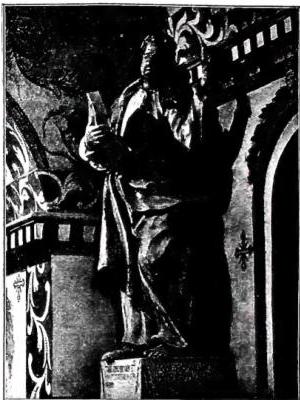
The school departed from Catalan models through a search for monumentality and abstraction in which a questionable influence of Antonello da Messina and of the art of central Italy has been recognized. Its vitality died out in the mid-16th century. From that moment the island opened itself to Italian influence, above all through the presence of Tuscan artists (Bacio Gorino, active in Cagliari, Codrongianus, Cargeghe, etc.; then, in the 17th century, Giacomo Conti, active at Bonaria), Neapolitan artists (Girolamo Imparato, who signed a panel in the Carmine church in Cagliari in 1594), and Roman artists (Giacomo Altamonti, late 17th century, who resided in Cagliari). They influenced the principal local painters (Andrea Lusso of Ollasta, active at Martis and Colangianus between 1590 and 1615; Diego Pinna, of Sassari, from the second half of the 17th century), imposing the modes of academic Mannerism, which, as has been said, would dominate undisputed until the 19th century, through the experiences of Neoclassicism and genre painting.
In the minor arts, by contrast, the imagination of Sardinian craftsmen preserved the prestige of its own excellence, especially during the centuries of lesser splendour of the major arts: works of superior quality are found among carved wood objects (gilded frames of the 15th and 16th centuries, Madonnas) and, above all, in goldsmithery (processional crosses of S. Francesco of Oristano and of the cathedral of Cagliari; reliquary of the cathedral of Ales, etc.). Sardinian craftsmen also worked outside the island: the Cagliari-born Giovanni Cioni, for example, executed the processional cross of the cathedral of Salemi in Sicily.
IV. CONCILIAR REGION
It comprises the entire territory of the Island and the small adjacent Islands, with three metropolitan sees: Cagliari, Oristano, and Sassari, and, in all, twelve dioceses, of which Ampurias and Tempio are united. The metropolitan jurisdiction of Cagliari includes the dioceses of Iglesias, Nuoro, and Ogliastra; that of Sassari includes the dioceses of Alghero, Ampurias and Tempio, Bosa, and Ozieri. Oristano has only one suffragan diocese, which nevertheless bears the two names of Ales and Terralba.The episcopal conference meets in Cagliari (Nuoro), which is also the seat of the regional seminary (Pont-Seminario regionale sardo del S. Cuore), directed by the Jesuits. The regional tribunal of first instance, pursuant to the motu proprio Qua cura of 8 December 1938 (AAS, 30 [1938], pp. 410–13), has its seat in Cagliari and has as its court of appeal the Tribunal of the Vicariate of Rome.
The last plenary Council was celebrated on 25 May 1924 (cf. Concilium Plenarium Sardum, Roma 1925).
V. FOLKLORE
S. constitutes, also from the standpoint of folklore, as well as language, a predominantly conservative area: a veritable demological island. The survival there of certain archaic forms of tradition has been demonstrated; these must once have been widespread over a very extensive area and are still found among the Basques or in the Balkans, and among the primitive peoples of Africa and America: flatbread; the solid-wheeled cart resembling the ancient plaustrum; the two forms of plough, that of Logudoro, of Roman type, and that of Gallura, of Egyptian type; the bullroarer, used as a children’s toy during Lent and Holy Week, which also retains a certain sacred character; and various other agricultural implements and practices. The betrothal ceremony (pricunta) is likewise found, in identical form, in the Baltic countries; in Gallura it takes place as follows: the fiancé’s procession sets off at a furious gallop amid rifle shots, as though assaulting a fortress, and stops before the girl’s house; at the door stands her father, with the poet beside him, and a dialogue then takes place, often in verse, following the traditional pattern: the suitor says that he and his companions are searching for a lost dove or kid, and the father invites them to enter and search; all the women of the household are presented to the young man one by one, and finally the chosen one, dressed entirely in festive attire, who is recognized as the sought-after dove or kid, amid cries of joy and further shots outside. The custom of a mounted wedding procession is also still alive in S.; this gives rise to the “race of the distaff” (la currita di la rucca): two horsemen take part, one representing the man’s side, the other the woman’s, and the winner is the one who is first to tear away a distaff adorned with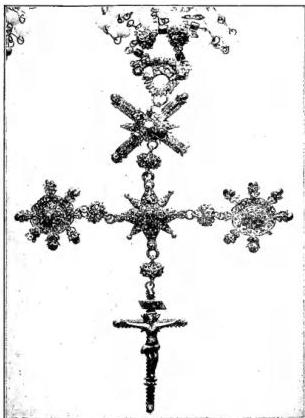
the witches stop to count the sickle’s teeth, or the broom’s bristles, or the grains, but, being unable to proceed beyond the number seven, they are surprised at dawn and forced to withdraw. Special stones and herbs are used to ward off the evil eye and protect against illness. In other cases, medicinal substances are obtained from animals: at Padria, the eyes are treated by bathing them with the blood of bovine liver; at Cagliari, by rubbing them with an eye-shaped murex called «occhio di s. Lucia», or with a cross while reciting certain incantations known only to fishermen. With regard to the annual cycle, Carnival preserves in S. very notable traces of its original ritual character: from the slow, danced procession of the mamutones, masked shepherds and peasants, with a bundle of cowbells on their backs and rattles hanging from their necks, and of the tuscadores, bearers of soca (a long rope for animals), who go out through the streets of the village on 17 January, and in earlier times on Epiphany or at Christmas; to the burning of the Carnival effigy called Giorgio (a remarkable and perhaps unique survival in Italy of the springtime cult of this saint), which is first carried around on a horse or a donkey, followed by a crowd shouting and singing various little stanzas; for example, at Sassari they say: «Giogli méu cumenti se anladdu», and at Cagliari: «È mortu canciofari, canciofa... È mortu carnovali, e carnova... Binu niedd'e bonu, niedd' e bo». Worth recalling, for their magical basis, are the elements composing the complex ritual of the feast of s. Giovanni: votive fires lit with great piles of wood (in Gallura and Anglona they use a special herb, with little yellow flowers, called biondella, whose scent keeps away the witches who at night roam about with the souls of the slain), around which young men and girls dance and leap, becoming compari and comari by exchanging three times the rounded tips of a handkerchief, untying the knots and alternately laying one hand over the other, while reciting special formulas that vary from village to village; and finally the healing practice (also known elsewhere) of passing a child suffering from ringworm three times through a cleft in a tree.
Of the calendar festivals, the most celebrated are those of the Candelieri at Sassari and Nulvi (14 August), and the procession on 1 May at Cagliari in honor of s. Efisio. On these occasions, above all, one can admire the Sardinian costumes in their beauty and variety, particularly that of Osilo for the harmony of its lines and colors, and that of Quartu S. Elena for its wealth of gold, silver, and gems.
The characteristic dance of the Sardinians is the ballo tondo, a kind of round dance that usually takes place outdoors: the male and female dancers form a long chain in a circle, while in the middle stand the musicians with their characteristic instruments, the lamedda or laumedda, the bagpipe, and the small drum.
Popular poetry, too, displays a conservative character and is inherent to the ethnic character of the inhabitants: leaving aside funeral songs, hymns to the saints (gósos), and lullabies (duru-duru), it should be recalled that the principal form of lyric song, the mutu, with its characteristic meter and poetic technique (it almost always consists of two parts, the istérria and the torrada, linked to each other only by rhyme), is confined to S. and is found in no other region of Italy.
Finally, the forms of the rural house are elementary, in relation to the predominant economic activities of the inhabitants, namely pastoralism and agriculture; the one-room or two-room dwelling already marks in S. a degree of development in comparison with the rectangular hut and the pastoral enclosure, whose persistence from one end of the island to the other is an expression of traditional economic life. The latter reveals in certain primitive customs, such as that of the pondidura in Gallura, a sense of solidarity and courtesy that characterizes the soul of Sardinian shepherds: when natural disasters (epidemic, flood, etc.) destroy a shepherd’s flock, he can rebuild it by asking each of the other shepherd-owners for a young head of livestock. - Vedi tavv. CXXVI-CXXVII.