
SAN MARINO. – One of the smallest (60.57 sq km) and the oldest (at least since the ninth century) independent states in Europe.
I. GEOGRAPHY
Its territory, enclosed between the provinces of Forlì and Pesaro-Urbino, consists of a series of hills dominated by the sharp ridge of Titano (749 m.), on which are situated the crops (cereals, vines, olives) that form, together with livestock farming (cattle and pigs) and artisanal activity (ceramics), the basis of the local economy. The population amounts to 12,300 inhabitants, of whom 1,850 live in the capital S. M., which stands at an altitude of 643 m.The Republic, which is linked to Italy by treaties of friendship and economic conventions, is governed by two Capitani reggenti, elected every six months, who rule with the assistance of several Councils and Congresses, likewise elected and frequently renewed. The territory is administratively divided into 10 castelli.
Giuseppe Caraci
II. HISTORY
The legend of the ninth-tenth century traces the origins of the Republic of the Titano to s. Marino (v.), a stonecutter from the island of Arbe, who, together with his companion Leone, is said to have landed around the middle of the fourth century on the shore of Rimini to work on the restoration of the harbor and the walls devastated by the Liburnians; but then, worn out by the hard labor and, as a Christian, seeking to escape the persecution of Diocletian, he withdrew with Leone into a cave on the mountain, where other companions in work and faith soon followed him. A noblewoman from Rimini, Felicita, donated the mountain to Marino because he had converted her to the faith of Christ.S. Gaudenzio, bishop of Rimini, is said to have conferred the diaconate upon Marino. The hermitage developed into a small, independent religious community, and before long a chapel dedicated to s. Pietro and a monastery were erected on the summit of the mountain; dwellings multiplied around them, forming the first nucleus of the future city of S. M.
The barbarian invasions that devastated Italy spared S. M., which, because of its inaccessible position and its bleak poverty, offered the raiders nothing. But the subsequent incursions of the Saracens, Magyars, and Normans forced the people of S. M. to strengthen their natural defenses by constructing the three towers—the Rocca or Gusita, the Cesta or Fratta, and the Montale—which, joined by solid walls, made the nascent bastion of liberty impregnable. They also extended their original domain at the expense of the counts of Carpegna and the monks of S. Gregorio in Conca.
Meanwhile, the Arengo, or assembly of heads of families, was established, and the Statutes were written; the oldest that has been preserved dates from 1295, while the latest is from 1599 and, in its fundamental provisions, is still in force.
The first dangers that S. M. had to overcome came
The Arengo of the heads of families was replaced in the middle of the fifteenth century by the closed Grand Council, composed of sixty citizens. Cesare Borgia, duke of Romagna, held the Republic of Mount Titano in 1503 for approximately six months. Forty years later, Pope Paul III sent five hundred soldiers to seize S. M.; but San Marino’s independence emerged unscathed and withstood every subsequent threat.
The Grand Council reduced the number of its members to forty-five, and the nobles obtained various privileges; an aristocratic-oligarchic regime consequently arose. The administration of justice was entrusted to a foreign judge, the commissioner of laws; the right of asylum was restricted; and an Edict (1707) was issued punishing idlers with perpetual exile.
When Urban VIII incorporated the Duchy of Urbino into the Papal States (1631), he reconfirmed the independence of S. M., to which he granted protection and customs privileges. In the eighteenth century, Cardinal Giulio Alberoni, papal legate for Romagna, suddenly occupied (1739) the Republic of Mount Titano, which annoyed him so greatly as a “stain” in the midst of the Papal States, intending to annex it to the Papal States. The inhabitants’ fierce resistance, combined with their prudent diplomatic skill, forced the papal troops to withdraw on 5 February 1740, a day that is still solemnized: Clement XII ordered that S. M.’s traditional privileges be restored and concluded a treaty of perpetual friendship. When Cardinal Luigi Valenti Gonzaga, legate in Romagna, returned to besiege S. M. (1786), he encountered the disapproval of Pius VI, and the Republic’s liberty was saved; the event is commemorated on the day of the patron saint (the fifth Sunday after Easter).
Napoleon, having conquered Lombardy, asked S. M. for permission to pass through its territory and offered cannons, grain, and part of the territories conquered in the neighboring states. At the suggestion of the citizen Antonio Onofri, the Council accepted one thousand quintals of grain, paying for them, because of the famine then raging, but refused the territories offered. Metternich, too, had the legitimate existence of S. M. recognized at the Congress of Vienna.
During the Risorgimento of Italy, the State of Mount Titano offered broad hospitality to Italian exiles. Garibaldi, too, experienced S. M.’s hospitality when, pursued by the French and Austrians, he crossed into its territory (31 July 1849), where he disbanded his legion. Two years later (June 1851), because it had prolonged asylum to certain deputies of the Roman Constituent Assembly, S. M. was occupied by Austro-papal forces; its territory was evacuated only after the political refugees had been handed over.
During the events of 1859–60, S. M. remained neutral; once Italian unity had been established, it enjoyed undisturbed peace, devoting itself to adopting laws and institutions suited to the new needs of its citizens.
Foreign speculators attempted to establish a gambling house there, a new Monte Carlo (1868), accompanying their request with substantial offers, including the construction of a railway to Rimini; but the Captains Regent replied that the honesty of which the Republic was so proud would cease to exist there. The proposal was again rejected in 1879. Only in 1949 did the government of S. M., albeit reluctantly, have to resort to the financial expedient of a gambling house, which was nevertheless definitively closed two years later.
A treaty of friendship and good neighborliness exists between the Republic and Italy: concluded on 22 March 1862, it was renewed in 1877, 1897, 1914, and 1948. The peaceful democratic revolution of 25 March 1906 restored the original system of election to the General Council Prince, without distinction of class between nobles and commoners, with one third renewable every three years. In September 1920, universal suffrage with proportional representation was adopted.
Events on the peninsula frequently reverberate in the small Republic. In 1915 it broke off diplomatic relations with the two Central Empires, and a group of its volunteers fought alongside the Italian army. Fascism also established itself on Mount Titano, where it fell, as elsewhere, on 25 July 1943; traditional liberties were restored. During the Second World War, too, numerous refugees—approximately 100,000—found shelter there. After the Germans, the Allies camped there.
III. LEGAL STATUS OF THE CHURCH
Although it has a diplomatic representative accredited to the Holy See, with the rank of Minister, the Republic of S. M. has not accredited a diplomatic representative of the Holy See to its own government and, ecclesiastically, is subject to the jurisdiction of two Italian dioceses, Rimini and Montefeltro.The territory in fact lies on the boundary between the Romagna and the Marches ecclesiastical regions. Most of it, however, is included in the latter ecclesiastical region, forming part of the territory of the diocese of Montefeltro, with its own vicariate forane (S. M.), comprising
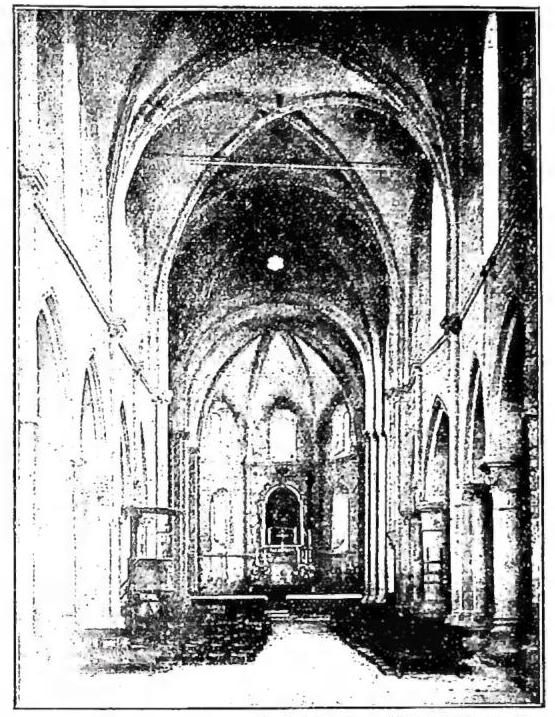
(from T.C.I., Lazio, Milan 1913, fig. 15)
SAN MARTINO AL MONTE CIMINO - Interior of the abbey (13th century).
the parishes of S. Marino; Acquaviva, dedicated to s. Andrea Apostolo; S. Giovanni sotto le Penne; Borgomaggiore, dedicated to the ss. Antimo e Marino; Chiesanuova, dedicated to s. Giovanni Battista; Domagnano, dedicated to s. Michele Arcangelo; Ferentino, dedicated to s. Bartolomeo apostolo; and Montegiardino, dedicated to s. Lorenzo martire. Only two parishes belong to the diocese of Rimini and thus to the Romagnan conciliar region, and they are included in the forane vicariate of Verucchio: Falciano, dedicated to s. Pietro apostolo, and Serravalle, dedicated to s. Andrea apostolo.
As is well known, the Republic does not possess its own civil code (there is only the Penal Code promulgated in 1878); in matters of civil and public law, the fundamental laws are contained in Books II and IV of the Statutes of the 16th century, based on Roman and canon law. The latter therefore regulates almost everything concerning relations between the civil and religious authorities, as well as matters of matrimonial law. Subsequent legislation, however, while not substantially altering these relations, was influenced by new political or jurisprudential orientations, which were not always favorable to the Church. In recent times, among other things, one should recall the favorable treatment granted by the courts of San Marino to Italian divorce-seekers, who, on the basis of the Treaty of Friendship and Good Neighborliness between the Republic and the Kingdom of Italy of 31 March 1939 (art. 5, nos. 1 and 7, § 11), applied there to obtain matrimonial annulments to be submitted for recognition in Italy. The social-communist government, which prevailed in the political elections of 5 September 1943, 11 March 1945, and 27 February 1949, subsequently drew up plans for the introduction of civil marriage, which thus far have not been enacted into law.
IV. ART
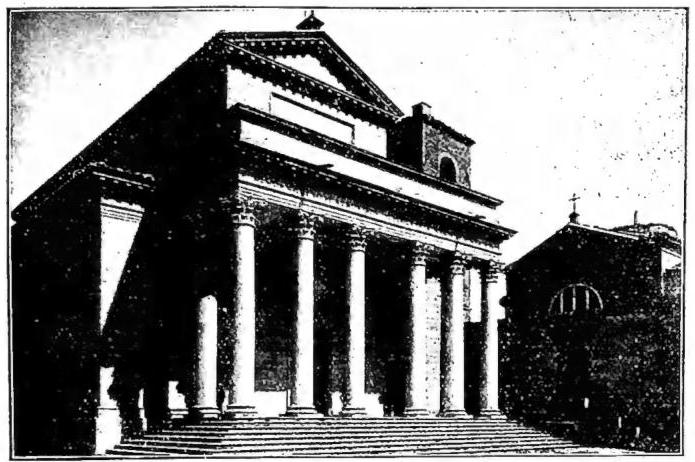
The city is surrounded by the ancient walls—begun in the 13th century, subsequently enlarged and recently restored—which terminate at the three towers or “penne” of Guaita, Fratta, and Montale, beyond which the precipitous slope of the mountain made any fortification unnecessary; set on three ridges along the crest, the three towers give the mountain’s profile its characteristic appearance; they are the emblem of the Republic, which has represented them in its coat of arms.The city has narrow, steep streets and—apart from a few small palazzi of the 16th and 17th centuries—simple houses in which every ancient element has been carefully enhanced. The only surviving medieval monument is the 14th-century church of S. Francesco, altered at various periods and internally transformed in the 18th century, which retains an interesting fragment of the ancient fresco decoration (by the Rimini school of the late 14th century) and several altarpieces (by the Umbrian school of the 15th century, by Girolamo da Cotignola, and by Guercino). The ancient parish church dedicated to the founding saint, situated at the highest point of the city, probably retained a Romanesque character; it was demolished at the beginning of the 19th century for the construction of a larger basilica, completed in 1838 by the architect Serra of Bologna in neoclassical forms; beside it, entirely transformed, stands the ancient shrine of S. Pietro, whose foundation tradition attributes to the same s. Marino. In 1884 the construction of the new Palazzo comunale was completed, based on a design by the Roman architect F. Azzurri and inspired by medieval models, reflecting the historicist tendencies of the period. The city also possesses a small museum, consisting of material of various kinds but including some notable pieces; and the Library, important for local history and for the history of the Italian Risorgimento. — Vedi tav. CXV.