
GARIBALDI, GIUSEPPE. - General and national hero, b. at Nizza on 4 July 1807, d. at Caprera on 2 June 1882. Brought up as a Catholic by his parents, Domenico and Rosa Raimondi, he very soon embarked upon
the adventurous life of the sea and came into contact with exiles and conspirators; in 1833 he was initiated by Barroult into the Saint-Simonian sect and by Mazzini into Giovane Italia. He enlisted in the Sardinian navy and in 1834 took part in the attempted insurrections at Genova; he was tried and condemned to death. Escaping punishment, he moved first to France and then to America, where, at the head of a legion of Italian volunteers, among whom the first group of redshirts distinguished itself, he took an active part in the long war waged by Uruguay against Brazil (1839–46). Here there first manifested itself
the heroic courage and military genius of G. Upon hearing of the reforms granted by Pio IX, in an address to the nuncio Bedini he placed his sword at the Pope’s disposal; in Apr. 1848, having returned to his homeland with 63 companions, he hastened to Lombardia, where the first war of independence against Austria was being fought, but found Carlo Alberto distrustful. When the Roman Republic was proclaimed, G. fought as a general against the Bourbons at Palestrina and Velletri, and against the French at Porta S. Pancrazio. After the fall of the Republic, he left Roma with a few faithful followers (2 July 1849) and took refuge in S. Marino. Setting out by sea from Cesena, he was forced to land at Migliavacca, where his wife Anita, who had followed him in his adventurous flight, died. After dramatic vicissitudes, he emigrated to the United States (July 1850), devoted himself to industry, and reappeared at Genova on 7 May 1854, with modest savings which he invested in the purchase of half the uncultivated island of Caprera; little by little he succeeded in making it entirely his own and improved it by intensifying agriculture and stock-raising there.
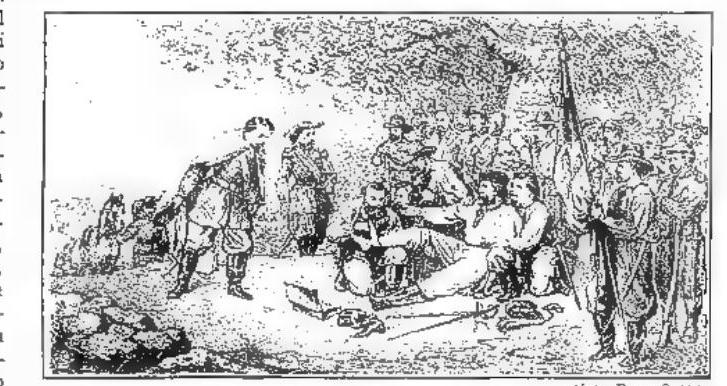
GARIBALDI, GIUSEPPE - G. Wounded at Aspromonte, lithograph of the period. Rome, Museo dei Risorgimento.
to seize an opportunity and withdraw to Caprera. On reaching Nizza, however, he issued a proclamation to the friends of central Italy, recommending the subscription of one million rifles for the armed nation; and, in a letter to the King, he asserted his freedom of action. Convinced that Vittorio Emanuele fully supported his projects, he implored him to rid himself of Cavour and assume the dictatorship, in order to march toward the liberation of Rome. On 28 Dec. he met him again, and it appears that they reached an agreement on the matter; but Vittorio Emanuele, alarmed by the possible consequences, subsequently withdrew, limiting his assent and his provision of arms and money to an expedition in Sicily. Thus, in spite of Cavour, who at once feared the thunderbolts of Napoleon and the ascendancy of the republican faction, the Expedition of the Thousand was carried out (May 1860) with successful results, under the auspices of the king and with the motto: «Italy and Vittorio Emanuele». The two protagonists remained in contact during the enterprise through Trecchi. But when G. was about to cross the Faro and descend upon Naples and then Rome, where he already imagined himself proclaiming Vittorio Emanuele king of Italy on the Capitoline, both the King and Cavour, alarmed, hastened to stem the Garibaldian advance and to supervise the movement in Sicily through La Farina. The fear that the revolutionary action personified in G. and Mazzini might be strengthened, together with the fear that English influence might prevail in Italy, persuaded Napoleon to close one eye to the occupation of the Marches and Umbria, which the royal troops, commanded by the King in person, carried out under the pretext of opening a passage to penetrate into Napoleon and stop G. before he attacked Rome. The meeting between the king and G. took place at Teano on 26 Oct., and on 7 Nov. they entered Naples triumphantly, side by side. Once again they discussed the occupation of Rome, but Vittorio Emanuele urged G. to wait still longer. Seeking by every means to limit the influence of G. and his friends, he also denied him the lieutenancy of the Two Sicilies; hence the general, indignant and disappointed, refused emoluments and honours and, on 9 Nov., having left Naples, withdrew to Caprera.
Relations with Cavour, whom G., together with Napoleon, regarded as the supreme obstacle to his bold enterprises, became increasingly tense. When a proposal to enrol the Garibaldian officers in the army was debated in the Subalpine Chamber on 18 Apr. 1861, G., already irritated with Cavour over the cession of Nizza and Savoia, attacked him with such vehemence that he is believed to have contributed to shortening his days. With Vittorio Emanuele, however, relations soon became cordial again; after Cavour’s disappearance and Rattazzi’s accession to power, G. hastened to Torino, where the King received him with great cordiality. He undertook a journey through the principal cities of northern Italy, ostensibly to promote rifle shooting, but with the intention of strengthening the action party and stirring up enthusiasm for Rome and Venezia. But the King, once again threatened by the Emperor of the French, resorted to his usual delaying method toward G.: for the moment, renounce Rome and turn his thoughts to another objective. Thus came the expedition to Trentino (May 1862), which, after its initial successes, had to be broken off and was violently suppressed by the royal government, under Rattazzi himself, as a result of the hostility of European diplomacy.
Having withdrawn to Caprera, G. left for Sicily on 27 June 1862, began gathering men, and from Palermo issued a fervent proclamation to the Italians, with the cry: «Rome or death». At first the King tried to calm him; but when he saw that G. was becoming increasingly insolent, even toward him, he proscribed him by an edict dated 3 Aug. It was commonly believed that Rattazzi was privy to the scheme; documents published by Lazio, however, show that Rattazzi had issued orders, which were not carried out, to prevent him from undertaking that rash action. Nevertheless, there was no small astonishment when, on 29 Aug., G. was halted by the royal troops at Aspromonte and, wounded and taken prisoner, was confined in the fortress of Varignano, and then returned to Caprera. Some even demanded that the King, to whom responsibility for those events was attributed, abdicate the crown; but everything ended with a simple cabinet crisis.
In March 1864 G. went to London and was reconciled with Mazzini, from whom his Sabbatarian loyalism had separated him. In 1866 he took part in the campaign against Austria at the head of three thousand volunteers and achieved successes at Monte Suello, Condino, and Bezzecca (4, 16, and 21 July). With the armistice, having uttered his «I obey», he evacuated Trentino and withdrew to Caprera. Once Venezia too had been reunited with Italy, only Rome and the tiny Papal State remained; and G., dominated by his exacerbated passion, reappeared on the peninsula from Caprera in the spring of 1867, undertook a thoroughly anticlerical propaganda tour through northern Italy, with the cry: «war on the priests: Rome or death», and launched so harsh a campaign against the minister Ricasoli, whom he disliked for his conciliatory tendencies toward Rome, that he provoked a crisis which brought Rattazzi back to power. New intrigues against the ecclesiastical State then resumed; taking advantage of its scanty forces after the withdrawal of the French garrison following the Convention of Sept. 1864, he attempted a coup de main by concentrating bands of volunteers along the borders. A detachment of redshirts was dispersed near Terni in March by the royal troops; but in the autumn, with stronger forces, he advanced as far as Sinalunga, south of Orvieto, where, having been stopped (24 Sept.), he was returned to the island. What agreements then existed among G., the King, and Rattazzi has not yet been clarified; but there is no doubt that the latter, at least, was the secret architect of these attempts, in order to confront Europe with a fait accompli. Indeed, despite apparent measures of severity and a wave of demonstrations hostile to the government, G. was acclaimed in demonstrations of sympathy, almost a plebiscite in favour of the occupation of Rome. While bands of volunteers, commanded by Nicotera and Menotti Garibaldi, violated the Papal frontiers at several points, others secretly entered Rome, where in a few days sensational incidents took place: the attack by Monti and Tognetti on the Serristori barracks (22), those of the Cairoli brothers (23), and of the Ajani house (25 Oct.), revealing a coordinated plan of action such as Vittorio Emanuele and Rattazzi were indeed presumed to desire.
G., having secretly left Caprera, landed at Livorno on 18 Oct. and joined his followers at Monterotondo, where he had a first clash with the papal forces. These, numbering approximately 2,000, commanded by Gen. Kanzler and supported by an equal number of French troops who had arrived, inflicted a decisive defeat on the Garibaldians at Mentana (3–4 Nov.). G., arrested at Figline, was returned to Caprera (25 Nov.). The royal government was compelled to withdraw from Viterbo to Civitavecchia, which it had occupied, and Rattazzi to resign (20 Oct.). The French foreign minister then declared that Italy would never go to Rome.
The occupation of Rome, following the collapse of Napoleon III, nevertheless took place on 20 Sept. 1870 through the regular troops of General Cadorna. Precisely in those days G. landed at Marseille (7 Oct.) to offer his arm in defence of the newly born French Republic. He took part in that campaign with his customary valour, but it ended with little glory
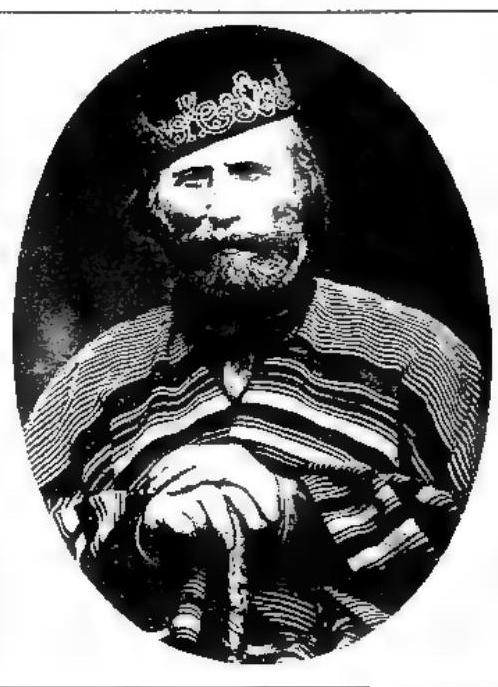
(Int. Alinari)
These final years of his life, spent in inaction, were also the most wretched from the moral point of view. G. found no better way to vent his grievances than through books in prose and verse, for the most part foolish, overflowing with vulgar insults and denigrations directed against the clergy and the Pope, and with bombastic declamations against a society whose fault was that it did not take seriously the dreams of his mind, clouded by stale anticlericalism and narrow Masonic ideals.
Lacking any genuine religious formation, G. passed through all the pseudo-religious forms of his age. He was successively a Saint-Simonian, a pantheist, and a syncretist, and very soon, together with his faithful followers, he placed himself in the arms of Freemasonry. To counterbalance the Cavourian Masonic current, in 1862 G. was made perpetual master of the Grand Orient of Palermo, in opposition to the Grand Orient of Turin. The Fourth Masonic Constituent Assembly, held in Florence in 1864 with the (unsuccessful) aim of gathering all Masonic forces into a single body, confirmed him in the title of grand master of Italian Freemasonry, and appointed A. Mordini deputy grand master; in 1867 he was succeeded by L. Frapolli. But G.’s work, as Valori observes, had «become almost solely verbal» literary ». Long before his final hour arrived, and before the ashes of his body—which he wished to be cremated upon a pyre of mastic branches—were scattered to the winds, he was a survivor. His name served as a pretext for sectarian anticlericalism, to intensify ever further the old resentments that divided the hearts of Italians.
Nevertheless, it should be noted that in him a glimmer of faith and veneration toward the Divine Redeemer never died out completely, but surfaced in his finest moments. At the time of the fortunate expedition of the Thousand, perhaps attracted by the influence of an austere atmosphere of Christian feeling, he too expressed accents of faith and piety that appear sincere.
The Garibaldian literature is very rich, but for the most part of little critical value; and, apart from a few good monographic studies, among which that of Dalle Torre cited below should be noted, little has been produced in our field. The best sources are still almost all liberal in outlook: G. Guerzoni, G., Florence 1882; A. V. Vecchi, La vita e le gesta di G. G., Bologna 1882; J. White-Mario, G. G. e i suoi tempi, Milan 1884; G. M. Trevelyan, G. e la difesa della Repubblica Romana, Bologna 1900; id., G. e i Mille, ibid. 1910; id., G. e la formazione dell'Italia, ibid. 1913; A. Luzio, G., Casour, Verdi, Turin 1924; P. Dalla Torre, L'anno di Mentana, ibid. 1928; M. Rossi, G., Bologna 1932; A. Monti, La vita di G. G. giorno per giorno, Milan 1932; A. Luzio, Alpormonte e Mentana, Florence 1935; A. Valori, G. G. (Grandi italiani, 3), Turin 1941; F. Cognasso, Vittorio Emano le II (Grandi italiani, 23), ibid. 1942. Pietro Pirri