
URUGUAY. -
I. GEOGRAPHY
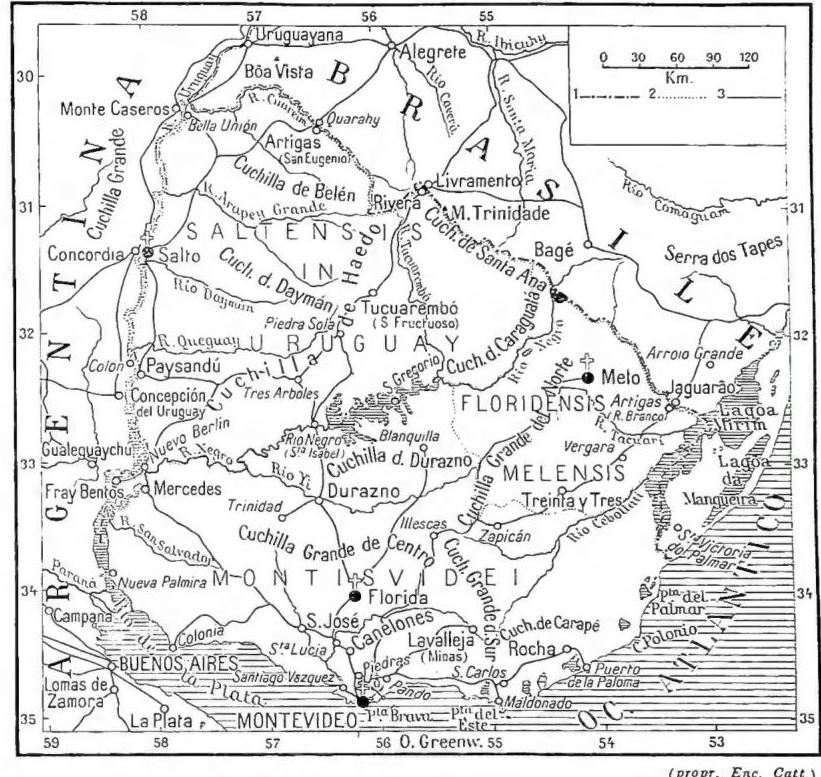
South American state, enclosed between Brazil and Argentina and facing onto the estuary of the Rio de la Plata.It is a country of plains, over which modest hilly elevations (600 m. in height) rise, both plains and hills covered with grasslands, and thus possessing a pronounced pastoral vocation. Livestock breeding still remains the basic activity of the economy of U. (22 million sheep and 7 million cattle; from them are obtained meat, hides, fats and dairy products), but
it is increasingly tending to be supplemented by agriculture: the warm, humid climate permits the cultivation of cereals (wheat, maize) and oil-bearing crops (flax, sunflower), and does not hinder that of vines, citrus fruits and fruit trees. Mineral resources are lacking, and for this reason too the development of industry remains insignificant.
The area is 186,926 sq. km.; the population (2.4 million inhabitants; 12 per sq. km.) consists almost entirely of whites (95%; among these approximately 70,000 Italians), and is concentrated to the extent of one third in the capital, Montevideo (900,000 inhabitants), which is the country’s principal industrial and commercial centre.
U. is a unitary Republic, with an elected bicameral parliamentary government and a president renewable every 4 years.
II. HISTORY
The first to reach the shores of U. were: Juan Díaz de Solís, who, following in Balboa’s footsteps and seeking, in 1515, the passage to the South Sea, was slaughtered by the natives on a small island lying off the Uruguayan shore; Magellan, whose ships entered the Rio de la Plata in 1520 as far as the point where Montevideo would later arise; and Sebastiano Caboto, who, in 1526, sailed up the river without exploring II. Colonization began only in 1559; in 1564 the first colony was founded at the mouth of the Rio Negro: it was S. Domingo de Soriano, which still exists. The complete exploration of the country was accomplished only in the 19th century.The Treaty of Tordesillas of 1494, by which Spain and Portugal accepted the famous «raja» devised at the suggestion of Pope Alessandro VI, caused a series of struggles between the Portuguese and the Spaniards for possession of U., to which both nations laid claim. This state of affairs ended only with the Treaty of S. Ildefonso of 1777, after the Spanish governor of Buenos Ayres, De Zabala, had founded Montevideo as early as 1726, populating it with people from his own city. At about that time Carlo III incorporated Montevideo and its territory into the intendancy of Buenos Ayres.
(progr. Enc. Catt.)
URUGUAY - 1) State boundaries; 2) boundaries of ecclesiastical jurisdictions; 3) railways.
and his companions, approximately 16,000 men, determined to make themselves independent of Spain, withdrew into upper U. in the march remembered as the «exodo del pueblo oriental». Artigas envisaged a confederation between U., the Argentine provinces of Entre Ríos, Santa Fé, Corrientes, Cordoba, and the territory of the missions included within the Brazilian state of Rio Grande do Sul; but the Argentines, the Portuguese, and the Brazilians opposed him. Despite his perfect knowledge of the region, the total devotion of his followers, their proverbial courage, and the many acts of heroism performed by all, it was impossible to withstand the repeatedly renewed offensive; compelled by the superiority of his adversaries to acknowledge defeat, Artigas, having set his men free, took refuge in Paraguay, where he remained until his death (23 Sept. 1850), in a certain sense a prisoner of the dictator Francia.
The war against the Portuguese first, and then the Brazilians, lasted from 1820 to 1828, and the Portuguese succeeded in subjugating U., which became their Cisplatine Province (1821). Then the patriots of the region, led by one of Artigas’s principal lieutenants, Gen. Rivera, and assisted by the Argentines under Gen. Alvear, succeeded in defeating the enemy in the engagement at Ituzaingo (Feb. 1827), while the small Argentine flotilla of the Irishman Brown prevailed over the Brazilian squadron. A successful offensive by Gen. Rivera in Brazilian territory led to peace in 1828, thanks to the intervention of the British minister in Rio de Janeiro, Lord Ponsonby.
(from K. von Schumacher, Südamerika, Berlin 1931, plate 19)
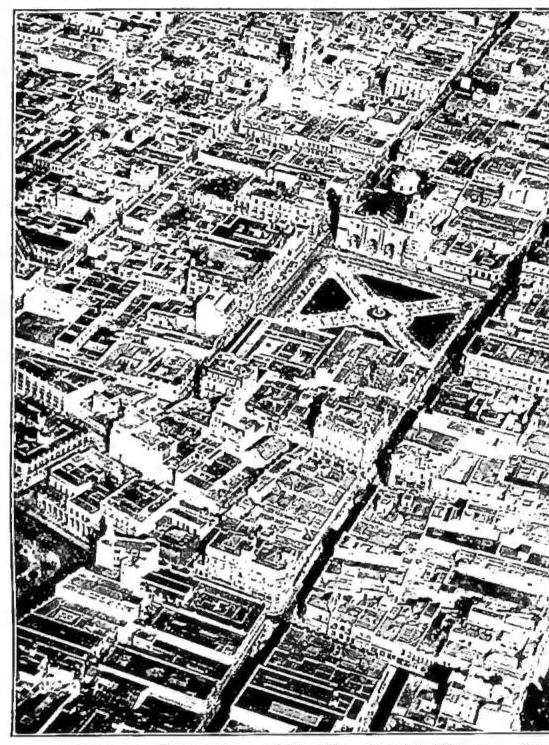
URUGUAY - Aerial view of Montevideo.
There were continuous struggles among the presidents, between the two parties, and against the Argentine dictator Rosas, who, hostile to Gen. Rivera, president of U. in 1830–34 and 1839–1843, organized actual expeditions from Buenos Aires to seize Montevideo, the center of the unitarios and patriots. Giuseppe Garibaldi carried out his work at that time and, after commanding the Uruguayan flotilla with Colonel Coe against Tosas’s squadron, achieved numerous successes on the Paraná and elsewhere, eventually enabling Rivera to return as a victor to liberated Montevideo, following an eight-year siege.
The second half-century was nevertheless difficult as well, owing to the incessant struggles between the parties, pronunciamientos by leaders, and dictatorial attempts by presidents. The transition from military to civilian leaders, which brought about an economic revival, took place with the appointment to the highest office of the State of the jurist Julio Herrera y Obes, an excellent statesman (1890–94). After him, Juan Lindolfo Cuestas succeeded to the presidency; he began the works intended to make Montevideo one of the most important and best-equipped ports (1899–1903). He was followed by José Battle y Ordones (1903–1907), an enterprising and uncompromising creole, advocate of a series of far-reaching social reforms, which were continued and implemented by his successor, Claudio Williman (1907–11). The latter turned his attention to the judiciary and education, establishing the High Court of Justice. For the first time in its history, U. recorded a budget surplus. At the side of the Allies in the First World War, U. derived considerable financial advantages from the greatest expansion of its agricultural economy and livestock breeding, the principal source of its prosperity.
A constitutionally and profoundly Catholic region, with its metropolitan see in Montevideo and suffragan sees in Florida-Melo and Salto, the Republic has in recent years been able to overcome internal difficulties caused by rising prices, inequitable wages, strikes, and drought, which imposed severe restrictions.
Nardo Naldoni
III. EVANGELIZATION OF U
The missions established by the Jesuits in the 17th and 18th centuries along the U. River, belonging to the famous “Reductions” (v.) of Paraguay, extended only through their estancias into the northwestern part of the present-day State of U. The few Indian tribes—numbering 4,000—in the territory of present-day U. probably did not come under the direct influence of the Franciscan and Jesuit missions.The Charuas held first place among the Indians, known for their fierce resistance to Portuguese and Spanish colonization in the 18th century; they were subsequently completely exterminated in 1832 by Gen. Ribera. Only after the foundation of the State of U. in 1825 was an apostolic vicariate established at Montevideo, in 1830 and then definitively in 1832; it was elevated to a diocese in 1878 and to an archdiocese in 1897.
In 1897 the dioceses of Salto and Melo were created, the latter called Florida y Melo from 1931 onward; but they were separated and received their own bishops only in 1919.
IV. LEGAL STATUS OF THE CHURCH
The Uruguayan Constitution declares all forms of worship free and affirms that the State supports no particular religion (art. 5).The Catholic Church is recognized as a legal person under private law. The same recognition is granted to the dioceses presently existing (that is, the archdiocese of Montevideo [v.] with its suffragans of Salto and Flora y Melo). In order to be recognized by the State as the representative of the diocese, the Ordinary must present to the Government a certificate from the apostolic nunciature declaring him lawfully appointed. The State has no involvement in the appointment of bishops. The other juridical persons contemplated by canon law may obtain juridical personality according to the provisions of ordinary Uruguayan law.
The Church may, subject to certain restrictions, acquire, possess, and administer temporal goods. The Constitution recognizes its ownership of all buildings of worship constructed wholly or partly with public funds, with the exception of chapels intended for the service of orphanages, hospitals, prisons, and other public institutions (art. 5). The same article exempts from taxation buildings intended for the worship of any religion, and a decision of the Supreme Court of Justice dated 29 July 1940 extended this privilege to annexed buildings as well. Sacred and religious objects are exempt from seizure, and objects intended for worship are not subject to customs duties.
Priests are placed on the same footing as other citizens in the exercise of political rights, and the penal code protects ministers of every religion in the exercise of their ministry. As regards religious, the so-called Ley de conventos of 13 July 1885 has never been explicitly abrogated, although in practice it is not applied.
The law of 12 February 1879, in addition to establishing the civil-status registry, provides that “parish priests shall not enter any baptismal registration in their parish books before those concerned have presented to them the certificate of registration in the civil birth registry.” This provision was confirmed by a law of 10 May 1886, but no penalty is imposed on violators.
The only marriage recognized by the State is civil marriage, introduced by the law of 22 May 1885; the religious rite may be celebrated only after the civil ceremony. The civil code, which incorporated the law in its entirety, imposes penalties on a minister of religion who officiates at a marriage before the civil act has been completed; an exception is made for marriage in extremis, which nevertheless produces no civil effects. Divorce is permitted on numerous grounds. A law of April 1909 prohibited all religious instruction in state schools. The Constitution guarantees freedom of teaching and recognizes the right of parents and guardians to choose for their children or wards the school they wish. State intervention in private schools concerns hygiene, morality, safety, and public order (art. 68).
The municipal regulations provide that corpses be transferred directly from the home to the cemetery. The authorities rarely grant exemptions from this rule. The Republic of U. maintains diplomatic relations with the Holy See through, respectively, an Envoy Extraordinary and Minister Plenipotentiary and the Apostolic Nuncio in Montevideo. Ippolito Rotoli
V. For the literature: V. ISPANO-AMERICANA LETTERATURA, XI.
VI. SCHOOL SYSTEM
It may be said that for several years the school system in U. has been moving toward a greater degree of stability and a more conscious responsiveness to the needs of the times and to the nation’s increased cultural level.a) Preschool education is provided from the ages of 3 to 6 in kindergartens.
b) Primary education begins at the age of 7 and comprises two levels: the first lasting 4 years, the second 2. Schools covering both levels and located in urban centres are called urban schools; those covering only the first level are called suburban schools and are located in agricultural centres. Associated with the primary schools are other types of school, more practical than theoretical; for example, schools of musical initiation; agricultural or rural schools, established in inland centres of the country and adapted to the mentality of the local populations; itinerant schools, that is, those in which instruction is provided sporadically by teachers who go to groups of workers’ children; and auxiliary schools, established to combat the scourge of illiteracy. All these types naturally share some part of their curriculum with the urban schools, but the remainder must be adapted to the ability and character of the populations.
c) Secondary education (the baccalaureate) is the level that has undergone the most radical transformations over the years, in order to attain the standard of a genuine and solid formation and preparation for the various university Faculties. At first, courses were conducted with a view solely to the requirements of the Faculties to which the pupils aspired, without taking account of their previous studies; the curricula therefore failed to correspond to the needs of the times. Until 1912, secondary school, or the baccalaureate, comprised a period of 6 years, divided into two cycles: the first, of 4 years, with common curricula; the second, of 2 years, with specialized curricula. The reform of 1912 established 18 lycées in the capitals of the various departments, retaining the two cycles; in the second, specializations were offered in law, notarial studies, medicine, pharmacy, dentistry, engineering, architecture, and agriculture. In 1942 the specializations were supplemented and combined, and reduced to six: 1) medicine, pharmacy, industrial chemistry, dentistry, and veterinary medicine; 2) law and notarial studies; 3) economic sciences; 4) engineering and land surveying; 5) architecture; 6) agricultural sciences. But not all lycées possess the second cycle, nor did this type of school win the favour of students, because it increasingly diverged from the model of 1912. That model conceived the first cycle as an improvement upon primary school and as the pupil’s preparation for life, developing intelligence and the body, without concerning itself with preparing them exclusively for the various Faculties. Hence the need for a radical reform which, rendered flexible through modifications and additions, would introduce differentiated lycées, with 4 years (the first-level lycée) of common subjects, after which pupils could enter the second-level lycée, which, in addition to common subjects, included subjects of a technical nature. Schools of a technical character were affiliated with the University of Labour; the others with the University following the ordinary model.
d) University education. The University of Labour was reconstituted in 1942 as an autonomous institution and aims to provide the most complete possible training for technicians in the most varied types of industry. The other University (Montevideo), established in 1833, now comprises ten Faculties: law and social sciences, medicine in its various branches, humanities, sciences, etc., and is organized along the lines of the other South American Universities. The Institute of Professors, established in 1949 for the training of secondary-school teachers, should also be noted.
e) As regards educational assistance, the “Children’s Code” was promulgated in 1933; from it arose the “Children’s Council” in its various sections: prenatal care, early childhood (1–3 years), later childhood (4–14), adolescence and labour (15–21), hygiene, and social and legal services.